
The 1911 Census of Canada began on June 11, 1911. Library and Archives Canada describes thirteen original schedules but says only Schedule 1, Population, has survived. It records households, reported month and year of birth, immigration and naturalization years, detailed occupations, wages and insurance information. Those employment and insurance answers are valuable 1911-specific leads, not payroll files or proof that a policy paid out. Start on the original population image and preserve its district, subdistrict, page and line before interpreting any numbered column.
Search the surviving population form rather than all thirteen schedules
Library and Archives Canada’s 1911 census guide says enumerators used thirteen schedules, covering subjects from the population to farms, buildings, dairies and institutions. However, only Schedule 1 survives. It is therefore misleading to promise that a page-and-line link will recover a household’s individual 1911 farm or dairy return. Use Schedule 1 to identify the person and residence, then seek farm information in independently surviving land, tax or agricultural publications.
Search by surname variants, approximate year of birth and province. Open the indexed person’s image and copy the locality, district, subdistrict, page and line; verify the household numbers printed in columns 1 and 2. Two families in a house were numbered separately. If a result crosses district pages, look at both. A database search that finds nothing should be documented with variant names and places searched, not transformed into the assertion that the person had left Canada.

Read the birth date and immigration answers as separate claims
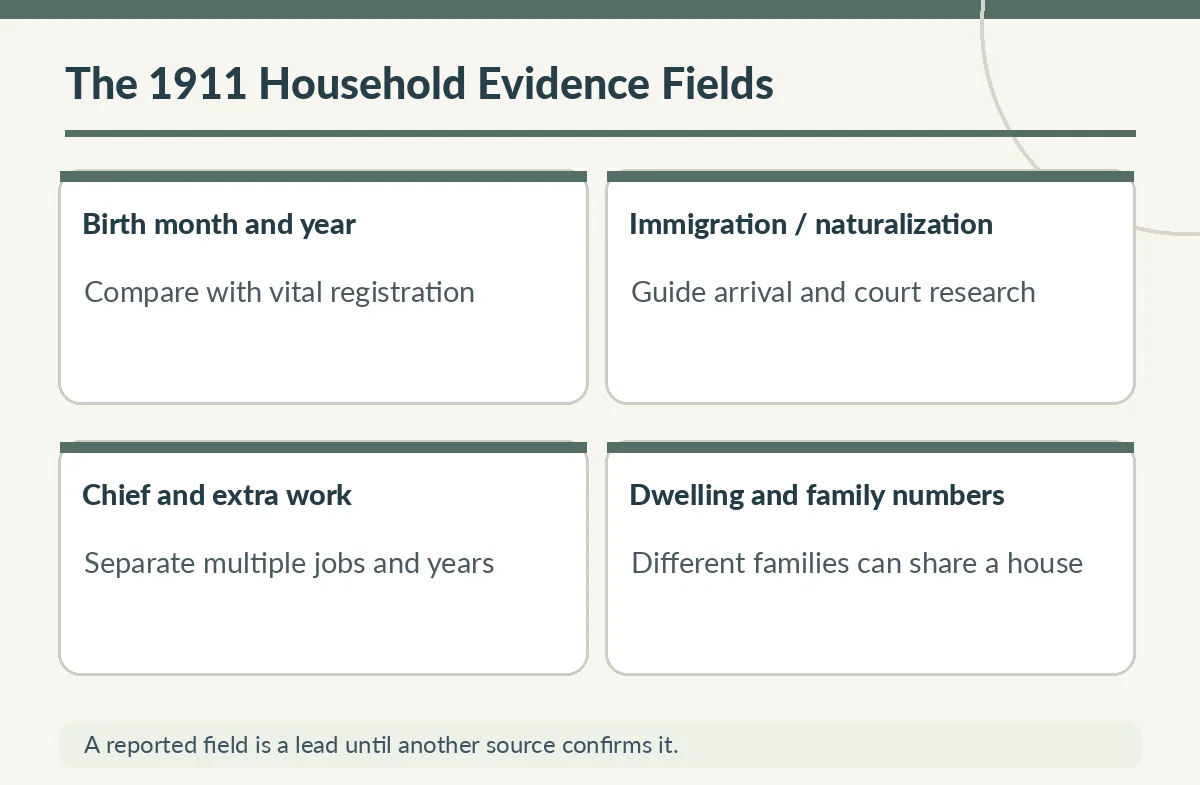
The 1911 population form asks for the month and year of birth and age at last birthday, plus the year of immigration and, for qualifying respondents, naturalization. These fields may have been reported by another household member. The LAC field notes describe age completion relative to June 1, even though the census began June 11; preserve the stated census methodology rather than quietly correcting the archival guide. An age and reported month/year that disagree should become a flagged conflict, not an invented exact date.
Immigration year means a stated year of movement to Canada, not necessarily the first landing elsewhere or a definitive ship arrival. Naturalization questions had specific eligibility conditions in that era and should not be projected onto modern citizenship rules. Compare any reported immigration year with passenger records, border lists or an earlier census, allowing for memory errors. Keep the literal birthplace and nationality wording distinct from present-day classifications, especially where the form uses offensive or obsolete historical categories.
| Population field | Specific use | Limit |
|---|---|---|
| Birth month and year | Target civil or parish record | A reported date |
| Immigration year | Narrow arrival-record search | Not a ship list |
| Naturalization year | Guide later court inquiry | Not a certificate |
| Residence description | Locate property or district | Not proof of title |
Separate a chief occupation from additional employment
Schedule 1 distinguishes a chief trade or occupation from other work, employment class and workplace. LAC describes occupational numbering systems and the meaning of wage-earner and own-account entries. Read the exact heading before interpreting an occupation code, and copy both the text and the number. A worker can report supplemental work that differs from the principal trade; that is not automatically a contradictory identity. A reported self-employed farmer may have rented rather than owned land.
The census asks about working time and earnings tied to the preceding work period, including 1910 figures, whereas the named household is a 1911 enumeration. Plot each datum against the period the question measures. A weekly-hours response should not be turned into annual earnings, and a wage figure need not include non-cash benefits. Compare employment with city directories, contracts, land or trade records only when those sources actually identify the same person. A 1911 employment category is not a permanent profession.
Treat 1911 insurance responses as reported coverage
Library and Archives Canada notes that 1911 was the first Canadian census to ask about insurance coverage. Read any recorded insurance question on the original page rather than using a provider’s modern summary. The entry may show a reported amount or expense, depending on its column; it is not an insurer’s policy file. It does not prove that a claim existed, that payments were current throughout the year, or that a beneficiary received money.
Build two columns: ‘census report’ and ‘independent policy evidence sought.’ If a possible life-insurance answer matters to a family claim, look for estate papers, surviving insurer documentation or contemporary correspondence, with proper privacy and preservation restrictions. A zero or blank may reflect nonresponse, inapplicability or data entry; do not interpret it as proof the family was unprotected. The question is historically useful precisely because it generates a targeted next research step.

Use address and household grouping to test two namesakes
The residence field can record a rural township, range and meridian in the Prairie provinces or a street and number in a city. The 1911 form assigns separate numbers for dwellings and for families or households, so two groups can share a dwelling. When comparing two people of similar age, keep both their household number and place; a plausible birth year without a matching residence or family context is not enough. Neighbors can guide later local records but proximity alone does not prove kinship.
Construct a small matrix using reported birth month/year, birthplace, spouse or child, reported trade and dwelling description. Test the strongest candidate against a marriage registration or an independent event. If one field disagrees, record the alternative explanations and do not overwrite it to fit the preferred identity. A reported racial or religious label must be contextualized as the census’s historical classification, not repeated uncritically as a modern statement about a person or community.
Cite the microfilmed 1911 page and compare 1901 carefully
Library and Archives Canada explains that the original paper returns from 1881 onward were microfilmed and destroyed; present access is based on digitized microfilm. Record the census year and schedule, district, subdistrict, page, line, household, any reel or image identifier and retrieval provider. Be precise about whether you used an image or a text index. If the old page is out of sequence online, district and subdistrict information can still help reconstruct the search. Our guide “1871 Canada Census” covers how to find nine schedules by page and line number.
A 1901 comparison is useful because that census also asked detailed birth and immigration questions, but the columns are not interchangeable. List each census date, exact wording, and source reference. Occupation or reported birthplace can change between decades; those differences must be examined, not automatically treated as a new person. An absence of 1911 farm schedules is a collection-wide survival limit, not a specific household’s negative result. Our guide “1901 Canada Census” covers how to verify birth dates, immigration, and land clues.
More Records and Archives Guides
How We Research the 1911 Canadian Census
We checked LAC’s 1911 guide for the June 11 start, thirteen original schedules, survival of Schedule 1, numbered population columns, occupation classifications and insurance questions. The general census guide supported our image-versus-index and microfilm guidance. Visuals describe search and evidence logic rather than reproducing a historic person’s return. Any hypothetical namesake scenario is methodological and not a claim that a listed ancestor has been found.
The clearest output is a precise Schedule 1 page citation, literal transcriptions and separately framed follow-up questions. We make no unsupported assertion about paid provider access or affiliate payments. Consult the official conditions for the specific platform and our affiliate disclosure before considering any third-party service.
Library and Archives Canada says the census began June 11, 1911.
No. LAC states that only Schedule 1, Population, was preserved.
No. It is a census report; verify it against a birth or baptism record.
No. It records reported census information, not a policy file or a settled claim.
Schedule 1, locality, district, subdistrict, page, line, household, image or reel reference and source of access.