
The 1921 Census of Canada counted residents as of June 1, 1921. Library and Archives Canada (LAC) explains that enumerators used five schedules, but only Schedule 1, Population, was preserved. Use the digitized population pages to identify a possible family, record its district, sub-district and line, and then test the relationships against other documents. A name-search hit is only an entry point: it cannot supply an agricultural schedule that no longer exists, and it does not independently prove a stated birthplace, family relationship or arrival year.
Check which 1921 Canadian census schedule actually survives
LAC lists Schedule 1 (Population), Schedule 2 (Agriculture), Schedule 3 (animals and products not on farms), Schedule 4 (manufacturing, trading and business establishments), and Schedule 5 (blind and deaf-mutes). Although all five were gathered, the repository reports that only the population schedule remains. Search the named population pages for individuals; do not tell a farmer’s descendants that an intact 1921 farm schedule must be available online. Keep the original schedule names in your research log so a later source is not accidentally passed off as a lost census form.
A question about a farm’s acres or livestock may be better approached through a 1920s tax roll, land patent, directory or surviving private business record. Those substitutes have different dates, populations and rules of reporting. List each as a separate source rather than relabeling it “1921 census agriculture.” The census’s stated 565 questions covered its original schedule set, not 565 fields on every surviving household line. A schedule-survival table prevents that surprisingly common misinterpretation. Our guide “1881 Canada Census” adds more detail on this.
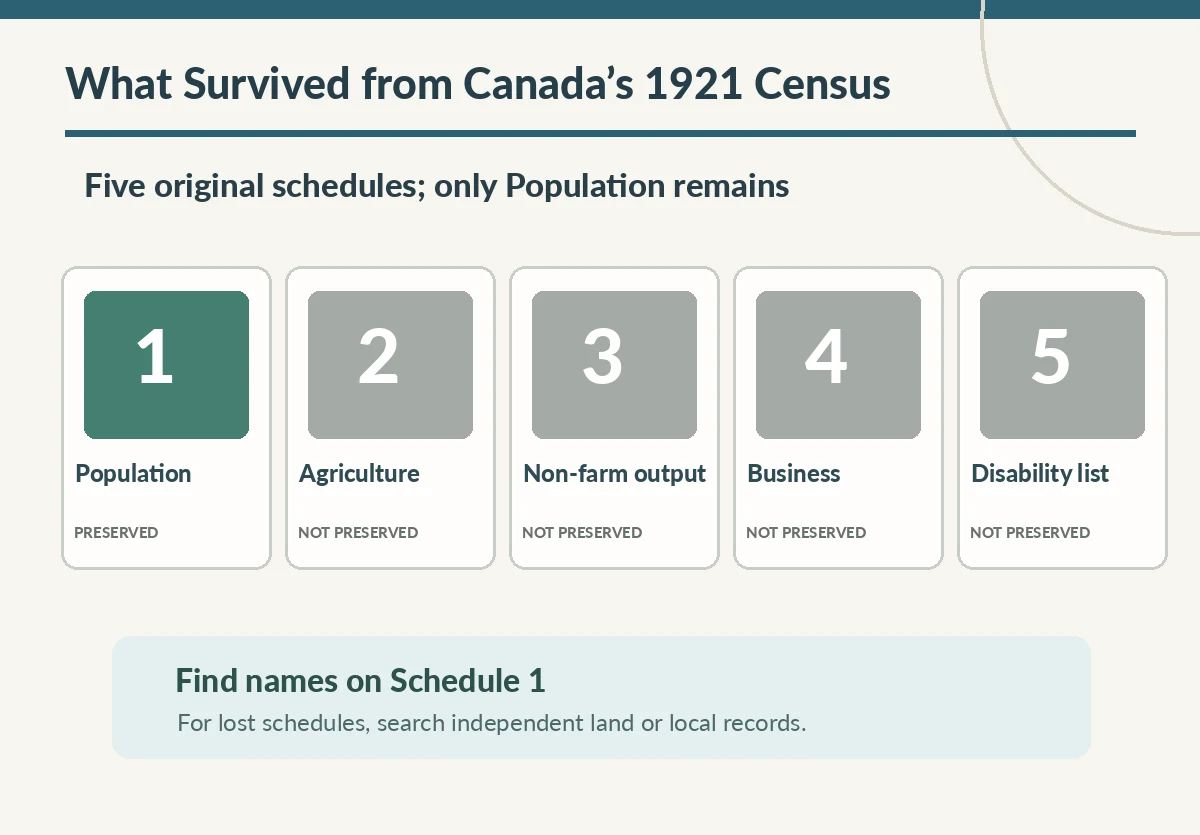
| Original 1921 schedule | Status | What to do |
|---|---|---|
| 1: Population | Preserved | Search household image |
| 2–4: Farms and businesses | Not preserved | Use dated local substitutes |
| 5: Disabilities | Not preserved | Do not invent a list |
Search the LAC 1921 population images by name and place
Begin at LAC’s 1921 census guide, then follow its links to the census search experience. Enter a documented name and a plausible province or territory; allow approximate ages and alternate spellings. Record the exact database, filters, spelling and date you searched. If a name is absent, try another household member and remove overly restrictive fields. A transcribed surname may differ from handwriting, especially where the enumerator wrote unfamiliar personal or place names.
Open the underlying scanned page. Note the column headings, consecutive lines, household or family numbers, people immediately above and below, and the enumerator’s writing habits. Do not assume an indexed age is correct when the image reads differently. On northern pages, read the printed form itself: LAC warns that different forms were used for the Northwest Territories. A household in Yukon or the Northwest Territories should not automatically be interpreted with the exact printed labels from an Ontario form.
Use district and sub-district descriptions when the name index fails
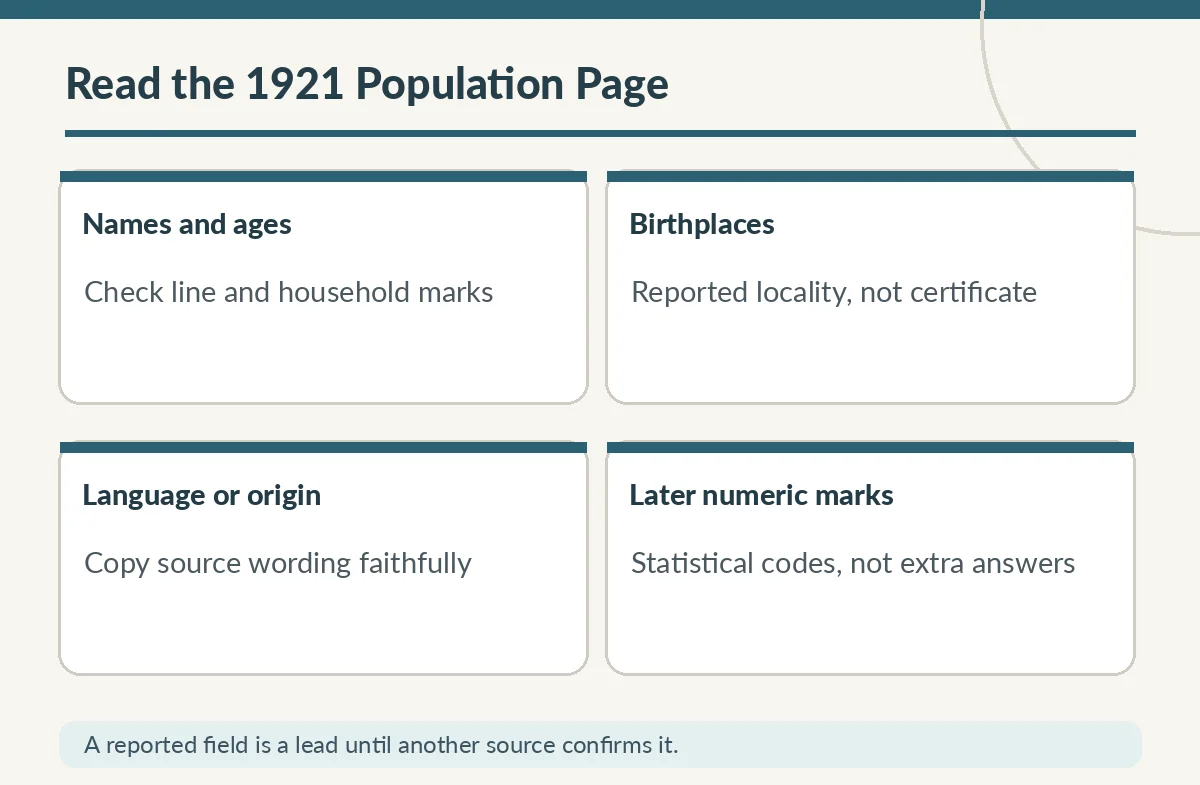
The official 1921 district directory lists province and territory, district, sub-district and geographic descriptions. These are research coordinates, not precise modern street addresses. Start from an independent 1920 or 1922 residence clue; convert the historical township, parish or ward into candidate census sub-districts. LAC notes that enumerators sometimes combined smaller sub-districts, so an apparently missing numbered subdivision may have been enumerated under an adjacent heading. Mark the candidates searched and the pages actually reviewed.
When browsing, compare neighbors and property markers only as contextual clues. Household numbers reset by district; two rows bearing the same surname are not automatically siblings. For a family between two enumeration divisions, review boundary descriptions and adjacent pages before claiming a missing household. If an institution appears in a district, household conventions may differ. Preserve the site’s image or item locator and the printed page and line, because an image counter can change when providers reorganize digital scans.
Interpret birthplace and language fields as reported details
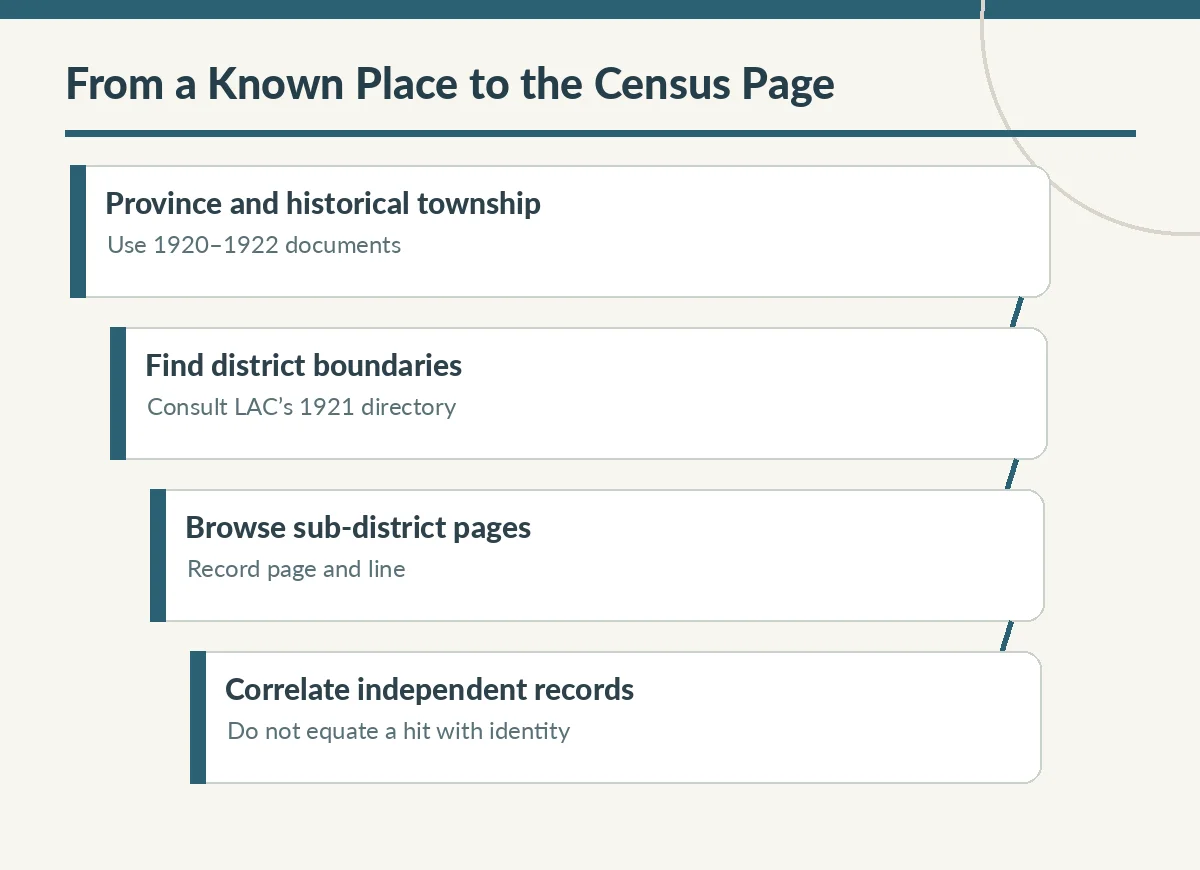
The population schedule can provide ages, birthplace, immigration and language-related entries where recorded, but each is an answer supplied to a census enumerator at a particular moment. A place of birth is a starting clue for locating a birth registration or baptism, not a transcription of that separate record. A changing country name may reflect the respondent’s vocabulary or political boundaries rather than a move. Transcribe the actual phrase before translating it into a modern jurisdiction.
Build a small identity grid for same-name families: reported age, spouse, children, birth locality, prior residence and neighbors. The strongest match will usually combine several independent details. Compare a 1911 or 1931 census entry, a civil certificate and a directory instead of averaging contradictory ages. The 1921 return does not prove every relationship biologically and cannot establish exactly when someone moved into the household. State which features coincide and which facts remain unresolved. Our guide “1931 Canadian Census” shows how to find families, homes, and work clues.
Do not mistake penciled statistical codes for extra family facts
LAC explicitly warns that statistical compilers later added numerical marks to some pages. Those numbers recode answers already given, not new personal information. For example, the repository’s guide shows numeric codes that can appear alongside birthplace entries. A penciled code adjacent to a name may be interpreted only against its column and the archive’s explanation. Keep copied marginal annotations in a separate field from the enumerator’s household answers.
The same caution applies to strike-throughs, repeated ditto marks and uncertain ink. Identify the writer or mark type where possible, but never silently repair a page. A statistical number is not a street number, ticket identifier or later residence. If an indexed database expands a coded answer into an English country, retain the underlying image wording in your transcription and identify the indexed expansion as a derivative interpretation.
Build a reproducible 1921 household citation and negative-search log
For each located person, record “1921 Census of Canada,” province, district, sub-district, division where applicable, printed page, line, enumerated name, image reference and the LAC access route. Capture the exact household as imaged and cite your retrieval date. In an identity worksheet, write “reported in 1921” rather than “proved born” or “proved parent.” Add the separate source that tests every key assertion. If an image is cropped, inspect adjacent pages for missing headers before using a transcription.
If a target remains missing, preserve negative searches with your input spellings and covered geographic scope; do not label the person absent from Canada. Travel, enumeration mistakes, mis-indexing or unknown residences may explain the result. A strong future search needs a named locality, a bounded date, a record category and a reason that category should contain the person. The 1921 Canadian population schedule is a powerful snapshot, not a complete inventory of every person’s life. If you want the full process, read how to search Canadian census records and identify the right household.
More Records and Archives Guides
How We Research the 1921 Canadian Census
We compared the federal archive’s 1921 year-specific guide with its general census search instructions and province-based district directory. Those official pages establish June 1 as the census date, the five original schedules, the survival of Schedule 1 only, special Northwest Territories forms and the problem of later statistical numbers. The search examples are hypothetical; no real family or living person is presented as a demonstrated match.
For editorial transparency, no paid census provider is recommended here. Original images and archival finding aids carry distinct evidentiary value; availability and access conditions should be checked on the current host. Read the affiliate disclosure. We use “reported,” “inferred” and “not established” separately when discussing family relationships and migration.
No. The census date was June 1, 1921; ages and circumstances should be interpreted in relation to that date.
Not in the surviving federal census holdings. LAC states that only Schedule 1, Population, was preserved.
Index variants, an unexpected district, poor handwriting or census omissions can all cause a missed match. Try relatives and place-first browsing.
Usually not. LAC explains that statisticians added codes to classify existing answers; read them in the proper column context.
No. It reports household relationships. Compare civil and church records, other censuses and independent dates before asserting lineage.