
The 1901 Canadian census can reveal something an earlier Canadian census often cannot: a reported day, month and year of birth, plus immigration and naturalization years. The census date was March 31, 1901, not June 1. Library and Archives Canada identifies eleven schedules in the original census but says that only Schedules 1 (population) and 2 (buildings and lands) survive. Start with the complete Schedule 1 page and its neighboring pages, not with the search-result snippet. A date or origin entered by an enumerator is a valuable lead, not an independently established vital event.
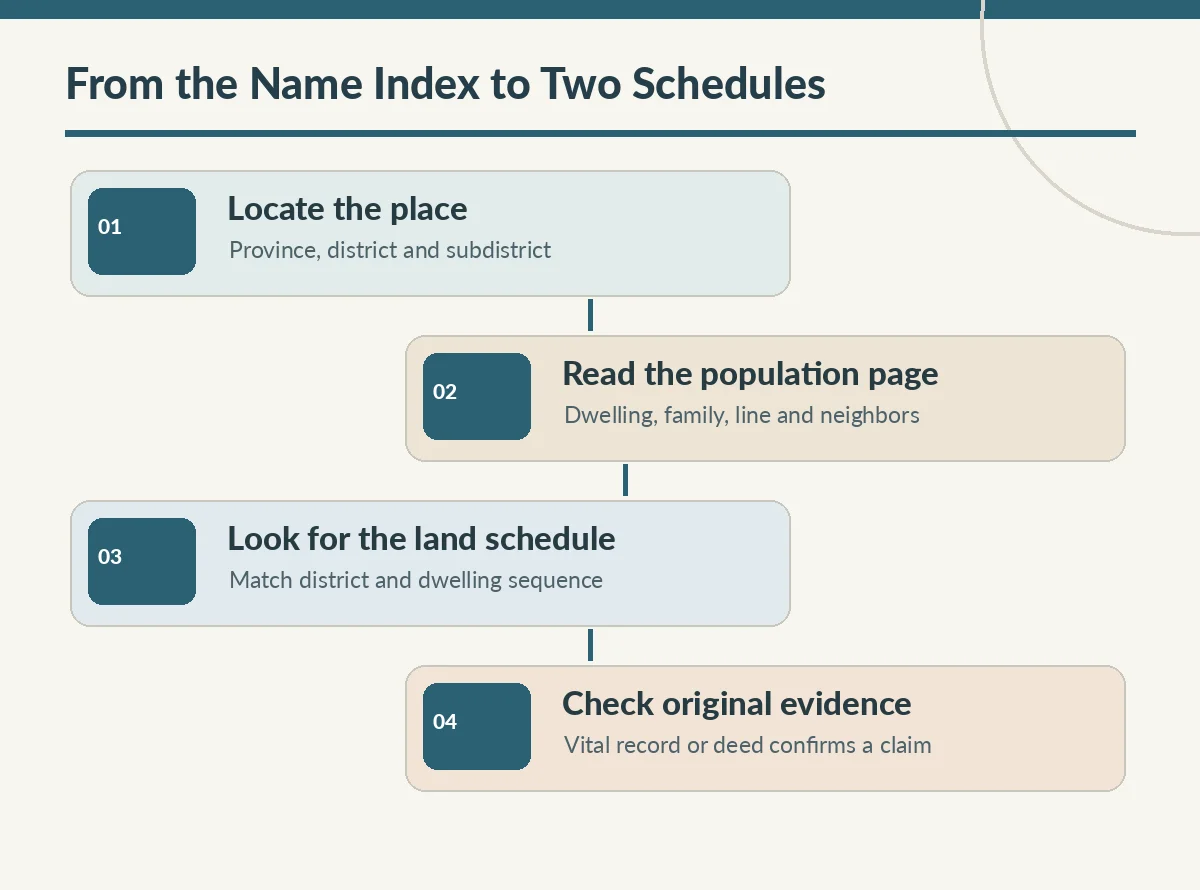
Locate the 1901 Schedule 1 household, not just a name hit
Search the Library and Archives Canada 1901 census guide from a known province and approximate locality. Begin with a surname and a flexible given-name spelling; narrow by district only once you have a plausible candidate. The LAC page links district and subdistrict descriptions, essential when a modern municipal name is not the name used in 1901. Record the census year, province, district, subdistrict, page and line, image location and access date. If a name is unclear, compare the handwriting on several adjacent entries instead of relying on the index transcription.
Read household columns 1 and 2 separately: the first enumerates a dwelling house and the second a family or household within that house. More than one family could share a dwelling. Copy every person on the page and the relationship to the recorded head, including lodgers, domestic servants and unrelated boarders. The relationship field describes the reported relationship to the head, not an automatically verified biological relationship. A family grouping is a search hypothesis to check against civil registration, churches or another census.
Reconcile birth month, birth year and age at last birthday
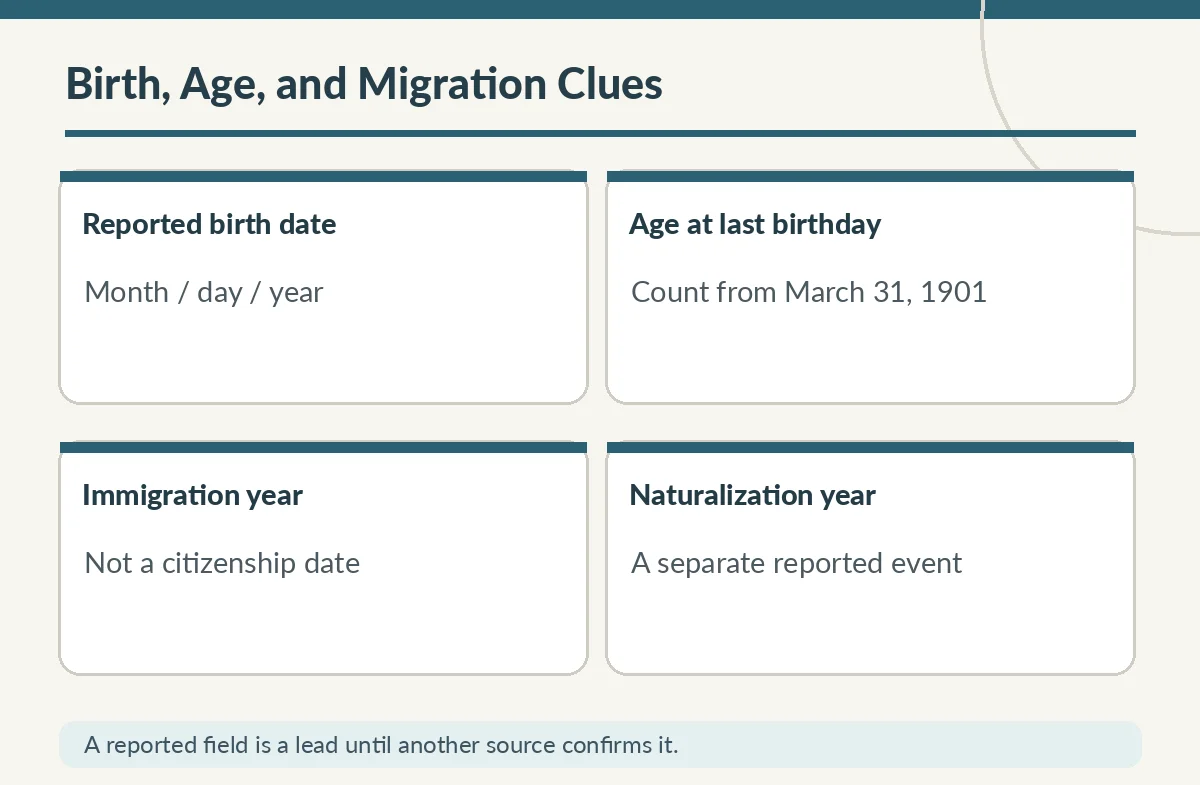
Column 8 supplies the reported month and day of birth; column 9 the reported year; column 10 the completed age at the last birthday before census night. Place all three values on one worksheet. If a person was reportedly born in April 1865, for example, the completed age on March 31, 1901 should ordinarily be 35. If a transcribed age instead says 36, verify both images and check whether the clerk or informant supplied inconsistent facts before altering the family tree. Keep the competing readings in your notes.
Do not treat the exact-looking date as the equivalent of a birth certificate. A household respondent may have estimated, remembered incorrectly or supplied a date adjusted in later records. Compare the reported birthday against a baptism, a civil certificate where registration existed, later death documents and at least one additional census. The same person can appear with a slightly different birth year across enumerations; overlapping residence, household ties and occupation may be stronger identification evidence than an identical given name.
| 1901 field | What to write down | Independent check |
|---|---|---|
| Birth date | Day + month + year as written | Baptism or birth registration |
| Age | Completed age on March 31 | Check date arithmetic |
| Immigration | Reported entry year | Passenger or border records |
| Naturalization | Reported year or code | Citizenship file when available |
Distinguish immigration year from naturalization year
On Schedule 1, column 12 asks for the year of immigration to Canada, while column 13 concerns naturalization. A person could have entered Canada years before any citizenship procedure, or arrived without later naturalizing. LAC notes that the notation ‘pa’ could mark someone whose papers were applied for but not completed. Do not convert a blank field or a code into a positive claim about nationality. Record the literal mark, its column, and any adjacent remarks before interpreting it.
Build a dated sequence: the earliest reported residence in Canada; 1901 immigration entry; later censuses; and any passenger list, border arrival or citizenship record. Where the years conflict, test whether the question was misunderstood or the household informant was different. The column for nationality is not a modern citizenship database; it reflects the definitions and reporting practices of the historical enumeration. Treat old racial classifications as administrative categories of the time, not validated identities.
Use the surviving buildings and lands schedule carefully
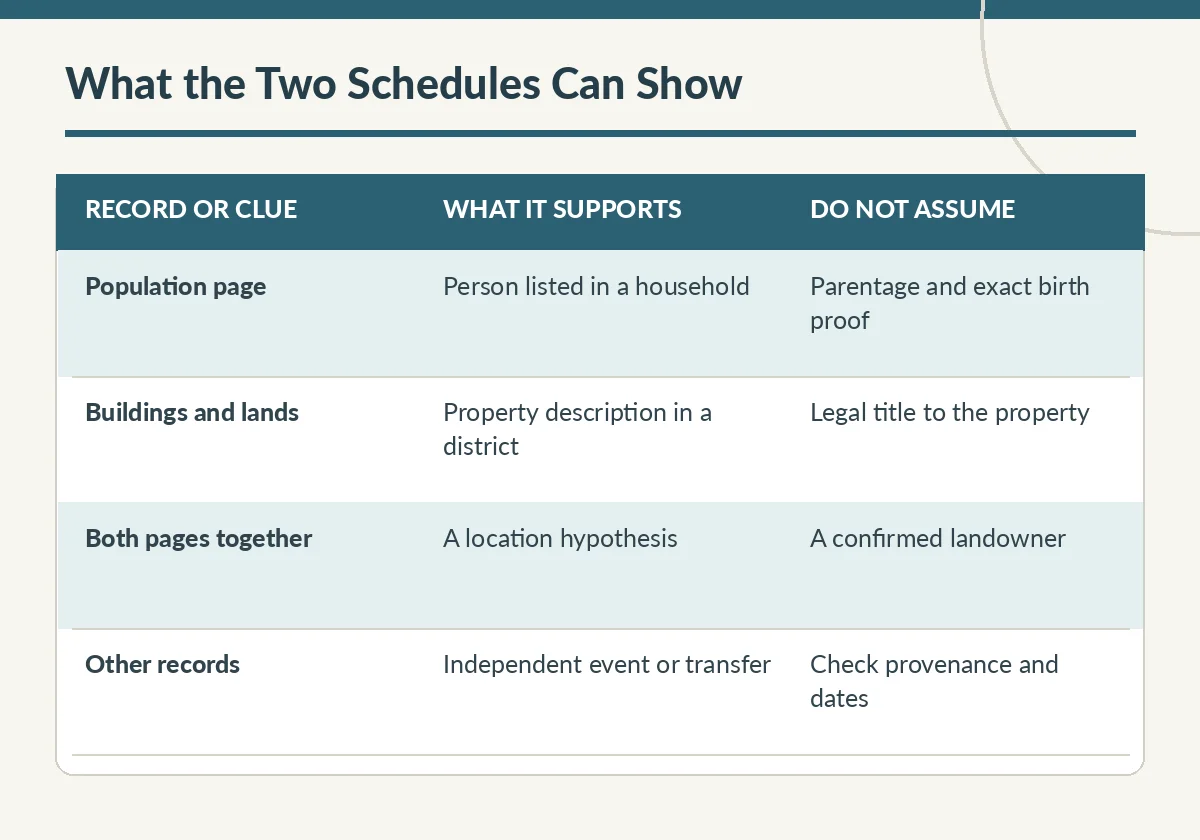
Unlike most later censuses, the surviving Schedule 2 may provide a description of buildings or land associated with a locality. It is not a second every-name roster: LAC specifically cautions that Schedule 2 cannot be searched by personal name. Start from the Schedule 1 locality and its dwelling or family sequence, then investigate Schedule 2 for that same district. In town areas you may find a street-related clue; in rural areas, a concession, lot or another land description can help direct a deed or assessment search.
Treat the association as something to establish from page identifiers and enumerator order. Similar surnames, an adjacent holding or a lot number do not make the resident a legal owner. Verify ownership separately in land registry or title documents and compare property assessments for occupation. Schedule 1 and Schedule 2 capture different kinds of observations; document any failed crosswalk rather than fabricating a parcel match.
Account for missing forms and uneven enumeration
LAC reports that four specialized Schedule 1 forms did not survive; it also notes incomplete enumeration of Indigenous peoples and separate forms microfilmed in specific reels. A missing ordinary name entry may reflect those collection limits, a historical classification decision, spelling variation or damage. In parts of New Brunswick, material was recopied onto later blank forms after damage. An unusual form appearance is therefore not by itself evidence that the person belonged to a different census year.
When a search returns nothing, test the district against the archive inventory, widen the parish or neighboring township, then compare 1891 and 1911 evidence. Write down the exact spelling, location range and repository searched. Absence from a surname index is never proof of absence from Canada, and administrative categories on an old census should never be used to assign a living person’s identity or community affiliation. For the next step, our guide “1911 Canada Census” explains how to read Schedule 1 birth, work, and insurance fields.
Test a two-person match with independent records
Suppose two residents named Margaret Fraser have roughly matching birth years. Candidate A is in an urban boardinghouse with no matching known relative, while Candidate B is in a household whose reported spouse and child’s age fit an independently sourced marriage and birth. Candidate B is stronger, but the match still needs a second record. Transcribe the address, religion or birthplace only as reported, and compare all facts instead of privileging the first indexed result. To go further, our guide “1891 Canada Census” shows how to verify parents’ birthplaces and household clues.
Keep a small decision register: evidence favoring A, evidence favoring B, points in conflict, sources not yet examined, and the next cheapest decisive record. If the best match changes after inspecting a neighboring page, preserve the original rejected hypothesis in the log. The research product is a well-supported identity decision and a reproducible citation—not merely the name found by search.
More Records and Archives Guides
How We Research the 1901 Canadian Returns
We use the current Library and Archives Canada census description for the census date, field definitions, preserved schedules and explicit gaps, then use a separate image-access description to distinguish transcripts from original pages. We do not infer ownership from Schedule 2, nor citizenship from an immigration-year entry. Our example uses invented people solely to illustrate arithmetic and competing identities; it is not a purported transcription of a real 1901 page.
Before publishing a conclusion, capture the page reference, transcribe disputed columns as written, make the Schedule 1-to-2 crosswalk where possible and compare at least one independently created record. This guide contains no affiliate links. Read our affiliate disclosure for the site’s general policy.
No. The fourth national census used March 31, 1901 as its census date according to Library and Archives Canada.
No. It is a reported statement; compare it with baptismal or civil birth evidence before accepting an exact date.
No. Its surviving buildings-and-lands information has no names for a normal name search. Start with a Schedule 1 locality and check the matching district.
No. Immigration year and naturalization are distinct columns and may show different years or incomplete information.
Variant spelling, damaged entries, incomplete collection survival and the special enumeration of some groups all affect discovery; inspect place coverage before drawing conclusions.