
The 1861 Census of Canada was not one uniform national questionnaire. It covered Canada East (present-day Quebec), Canada West (Ontario), New Brunswick, Nova Scotia, and Prince Edward Island, but the surviving return you need depends on the province. Ontario, Quebec and New Brunswick primarily name individuals; the Nova Scotia and Prince Edward Island returns are largely organized around named household heads and counts. An indexed name is only the start: in some provinces the personal schedule continues across additional image pages that a search result may not display automatically.
Choose the 1861 census form by province, not by surname alone
Begin with a place documented before the census date: a marriage record, deed, church register or surviving 1851 return. Use the Library and Archives Canada 1861 guide to select the province and learn its form. Canada East and Canada West enumerated January 14, 1861; Nova Scotia used March 30 and New Brunswick August 15. The exact Prince Edward Island collection date is uncertain. The date matters when you are interpreting an infant, an occupation or a family that moved during the year.
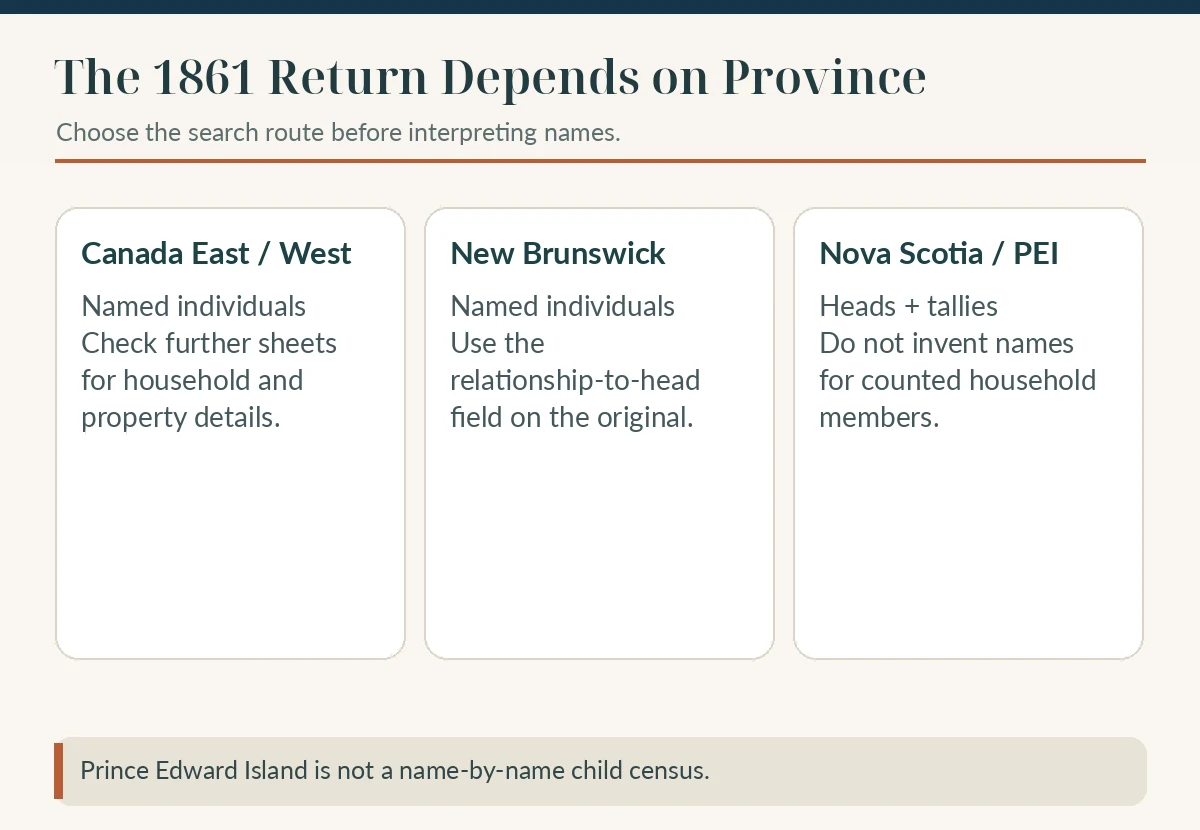
Do not tell a researcher to find a named wife or child in every province. Nova Scotia grouped its detailed counts into age and social categories and Prince Edward Island listed household heads with family tallies. New Brunswick recorded names and a relationship-to-head column. Ontario and Quebec contained considerably more individual detail; some urban enumerations used a separate sheet for each household. Your first research decision is therefore not how to spell a name but which kind of return can hold it. Our guide “1851 New Brunswick Census” goes into more detail.
Search Library and Archives Canada by district and original page
Open LAC census guidance and use its census search. First try a surname with a province; broaden to a district or sub-district when transcription fails. Record the image identifier, province, district, sub-district, page and line if supplied. In a nominal province, compare surname neighbors, reported birthplace and religion instead of treating an isolated indexed hit as an identity match.
If a family is missing, confirm the historical locality name and browse the image sequence around the most plausible district. LAC notes that Leeds County, Canada West, has several places where sub-district names were not indexed. A failed sub-district filter is therefore a possible index limitation rather than evidence that the resident was absent. Save what you tried, including variant names, neighboring parishes and date assumptions.
Rejoin Ontario and Quebec details spread across several images
Canada West and Canada East personal enumerations could contain many columns across several pages. LAC warns that a database result commonly points to the first image with names instead of automatically linking all accompanying columns. Look for corresponding sheet sequence, household or page number and handwriting; inspect adjacent images for births, deaths, household structure and other headings that continue the original return. Note whether the pagination is stamped or handwritten, because the two can disagree.
For example, a named farmer and three apparent family members may appear on the first side, while housing and livestock columns continue elsewhere. Record the adjacent page as part of the same evidentiary unit only after checking matching identifiers and order. Do not attach a neighboring agricultural schedule simply because the farm surname is familiar. Some agricultural returns did not survive, so a genuine match may have no property continuation at all.
| Province | Name visibility | First comparison |
|---|---|---|
| Canada East / West | Individuals named | Birthplace, age next birthday, adjoining columns |
| New Brunswick | Individuals named | Relationship to head and stated occupation |
| Nova Scotia | Heads named; others counted | Age/sex counts and separate parish evidence |
| Prince Edward Island | Heads named; others counted | Township, rent/land and church entries |
Compare the 1861 questions without inventing family relationships
Canada West recorded age at next birthday, not necessarily age at the last birthday. For a person recorded as twenty on the January census date, calculate a possible birth interval instead of fixing an exact birth year. Entries about family members present, absent or not related to the household should be read in their own columns. An occupation and residence can support identity, but neither establishes biological parentage. For a step-by-step method, see how to search Canadian census records and identify the right household.
New Brunswick has a distinct relationship-to-head field, useful when confirming an apparent household. Prince Edward Island counts people by age and sex while naming the head only; it cannot directly identify every unnamed child. Nova Scotia also requires interpreting category counts, not converting them into personal names. All provinces used historical administrative categories; quote them only when needed, explain their period context, and avoid adopting outdated descriptions as present-day identity. For the fuller picture, see our guide “Early Nova Scotia Census Records”.

Use a five-province comparison to decide the next record
Make a worksheet with columns for province, date, named-person coverage, page structure and next independent source. If the target is an unnamed child in Prince Edward Island, your next step could be a baptismal register for the particular parish. If the target is a named New Brunswick resident, use relationship-to-head, age and locality to select a corroborating civil or church event. Different census architectures call for different proof strategies.
Where a record seems inconsistent with 1851 or 1871, consider a changed parish boundary, a relocation or an age-reporting mistake before deciding there are two different people. Use at least two independent identifiers, such as a spouse and birthplace, and preserve conflicting observations in the log. The census is evidence that an enumerator reported a person or a household, not a certificate guaranteeing every statement.
Plan for damaged pages, missing returns and an honest negative search
Some 1861 pages were microfilmed out of order and numbering may be inconsistent or absent. LAC reports particularly faded original documents for Alma Parish, Albert County, New Brunswick. Treat an illegible column, an absent agricultural page and a genuinely unsearched district as three separate outcomes. A database no-result without a coverage and browsing check is not proof that a person lived elsewhere.
A reproducible negative-search note should identify the provinces and sub-districts examined, names and spellings tried, years compared, image sequences checked and a documented collection limitation. This makes the next archive request focused. It also prevents later researchers from turning a known survival gap into a confident migration date. Our guide “1851 Canada Census” goes into more detail.

Write a source citation that includes the continuation image
Cite the 1861 province, county or district, sub-district, page or household identifier, individual or named head, and the image or microfilm reference returned by the archive. When multiple images contain one household entry, list each relevant image or describe how the continuation was matched. If the record lacks a reliable page number, give stable neighboring entries and the image sequence instead.
In your conclusion keep three lines separate: the original enumerator wrote a stated age and birthplace; other records make the person a plausible match; a parent-child relationship remains unproved until a direct or strongly correlated independent record is found. This distinction is especially important in the head-only maritime provinces.
More Records and Archives Guides
How We Research the 1861 Provincial Census
Our review starts with the record creator and holdings guidance rather than repeating an index description. We compared the dated archival instructions and forms above, checked which fields are genuinely present, tested the difference between an original record and a derivative index, and built the visual worksheets around one specific failure mode: treating all provinces as named-person returns or overlooking continuation sheets. The examples are illustrative, not transcriptions of real individuals, and source claims should be rechecked if a custodian changes its access policy.
All recommended resources here are informational archival sources, not sponsored endorsements. We have not inserted paid links or assumed that an affiliate relationship exists; see the affiliate disclosure. Keep identifying information about living people private, and document unresolved claims rather than publishing unverified family connections.
No. Canada East and West were dated January 14, Nova Scotia March 30, and New Brunswick August 15. The exact date for Prince Edward Island is unknown.
Generally not from the household-head return. Use age/sex counts to frame hypotheses, then consult baptismal or other independent named sources.
It refers to the age the person would attain on the coming birthday, so it should not be silently treated as an age at the preceding birthday.
In Canada East and West the questionnaire could span multiple images; the index usually points to the page bearing names, not all later columns.
No. Not all agricultural returns survive, and an unmatched or missing continuation is not a conclusion about the household occupation.