
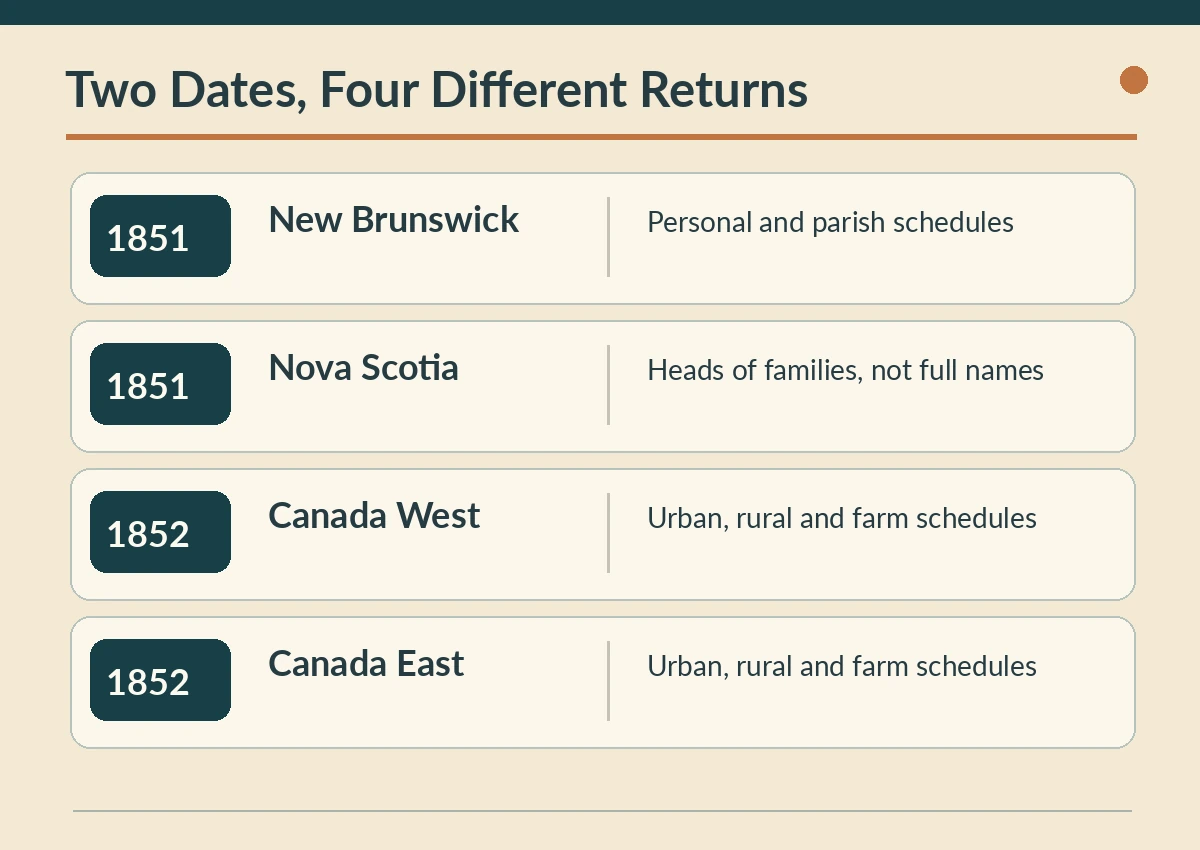
The collection usually called the 1851 Canada census is not a single uniform form completed everywhere in 1851. New Brunswick and Nova Scotia were enumerated in 1851, but Canada East (roughly present-day Quebec) and Canada West (roughly present-day Ontario) began counting on January 12, 1852. The provincial questions and survival of returns differ. Start with the historical province, then read the actual schedule before assuming that a name, relationship, farm or absence means the same thing across the entire collection. This route is especially useful when an indexed name fails to identify a family conclusively.
Decide which province and census date actually apply
Locate the family as closely as possible to 1851 using a township, parish, county, land record, letter or marriage entry. In the united Province of Canada, Canada East and Canada West were counted in early 1852, so record the local enumeration date rather than labeling every observation 1851. The Library and Archives Canada 1851 guide explicitly separates the four areas and provides district lists. Do not project the modern provincial boundary backward without checking historical place names and local subdivisions.
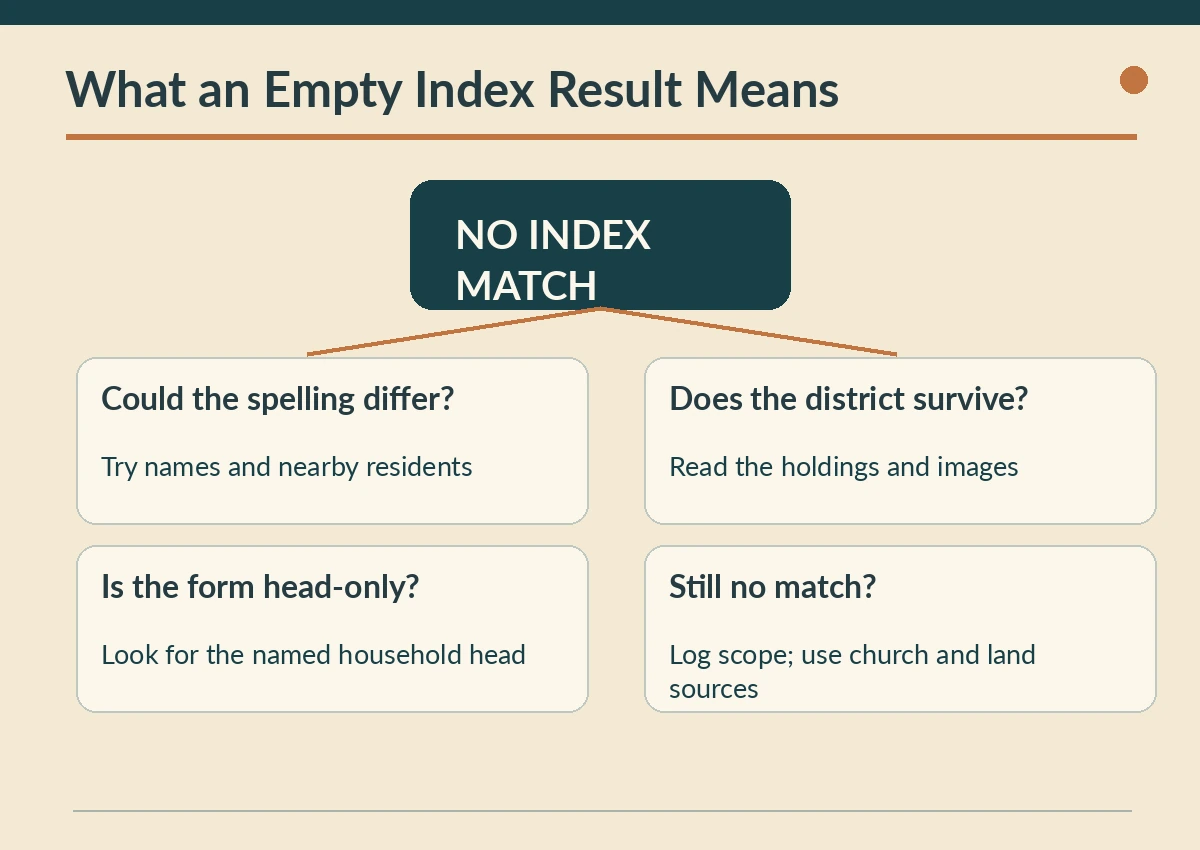
New Brunswick was enumerated in 1851 and has personal and parish schedules; Nova Scotia was also enumerated in 1851 but its surviving form generally identifies heads of families rather than every household member. Ontario and Quebec have the more detailed personal returns, with urban, rural and agriculture schedules listed by the national archive. Before interpreting a blank index result, write down the census jurisdiction, surviving format and the district you actually searched. A family may be invisible as individuals in a head-only count.
Read household columns only on the correct provincial form
For Canada East and West, transcribe the names in sequence with ages, religion, birthplace, occupation and the columns distinguishing family residents from persons not classed as family. The original wording Names of Inmates refers to people residing in a household, not necessarily people confined in an institution. Keep the contemporary label in the transcript, then explain its historical meaning. A modern database may flatten the heading or supply a relationship not actually written in the relevant field.
Ontario and Quebec forms also recorded people absent from the household and certain events, such as births and deaths in the preceding period. Do not read a marked count as a certificate for a named child, or equate people on adjacent lines with biological kin. Ages were recorded as age at the next birthday in relevant schedules, which can shift an estimated birth year. Use a bounded birth-year interval and compare baptism, marriage and later censuses before resolving apparent discrepancies.
Search the name index and then rebuild the original page
Start at Library and Archives Canada using a combination of surname variants, province, district and likely household associates. Search likely alternative spellings, French or English forms and parents or adult children when the target fails. An index entry can lead to the wrong family even with a persuasive name; the original image supplies the household order, column context and geographic heading. Keep the image identifier, district, subdistrict, page and line or household position in your research log. If that is your next decision, our guide “1871 Canada Census” explains how to find nine schedules by page and line number.
Use district and subdistrict descriptions when a name search returns nothing. Search the place before deciding the ancestor was absent. If a page looks missing, inspect nearby frames and the archive’s coverage notes. Original paper was microfilmed and destroyed after authorization in 1955, so consult the preserved images and archive metadata rather than expecting an unfilmed paper version for every schedule. A negative search is meaningful only after explaining exactly which surviving pages were checked.

Use agricultural schedules without inventing land ownership
Canada West and Canada East agricultural records may report occupiers, concession or lot, acreage, cultivated land, livestock and production. Search these only when the relevant schedule survives for the locality. Names of occupiers and lot descriptions may guide a further land-registry or tax search, but acreage on a census form does not by itself prove the legal title to a parcel. Record the agricultural schedule separately from a person schedule and note any uncertain linking surname. Our guide “1861 Census of Canada” adds more detail on this.
If an index describes a farmer and a nearby agricultural form has a matching occupier, verify township, lot, concession, neighbors and the date. The surname alone cannot establish that the two entries are the same person. Compare a deed, assessment, township map or local directory for a stronger land connection. When an agricultural page is missing, note the gap rather than attaching someone else’s farm by convenience. Rural and urban questions are not interchangeable.
Compare an indexed candidate against a second record
Create a candidate grid with the observed name spelling, age category or age at next birthday, neighbors, religion, birthplace and occupational clues. Enter what each census column actually says; treat an inferred spouse or child relationship as a separate proposition to prove. For a same-name candidate in two parishes, compare a marriage register, later census or land transaction that links the localities. Agreement in only one common surname is weak evidence. To go further, our guide “1901 Canada Census” shows how to verify birth dates, immigration, and land clues.
A practical example is a household that seems to contain a daughter aged seventeen and a nearby baptism for a similarly named child. The census does not automatically identify the parents of that child: household placement, the form’s relationship wording and competing families all matter. Mark the baptism as a candidate until names, residence and dates cohere across independent documents. If the sources conflict, preserve both readings and state the unresolved question rather than silently normalizing an age.
Record coverage gaps before claiming that an ancestor was absent
The census was not preserved or indexed evenly. Consult the Library and Archives Canada general census guide for pre-Confederation limits, and inspect the 1851 province page for the return you need. A catalog may describe a year without guaranteeing an image for every township. Some local gaps are substantial. A search failure can mean an unindexed spelling, wrong jurisdiction, missing schedule or a genuinely different residence.
Write a concise negative-search statement: historical county and township, alternate surnames tried, images inspected, whether the full schedule exists and which neighboring jurisdictions remain unsearched. Then pivot to land taxes, church registers or the 1861 census where available. Do not turn an online index’s silence into proof of emigration or death. That interpretation requires positive dated evidence outside this incomplete enumeration. For the fuller picture, see our guide “Early Nova Scotia Census Records”.
More Records and Archives Guides
How We Research Canadian Census Returns
We checked Library and Archives Canada’s province-specific 1851 description and its broader pre-Confederation coverage guide. Our procedure preserves the 1851 and January 1852 dates separately, distinguishes head-only returns from named residents, and verifies agricultural claims against the actual surviving form. We treat index results as finding aids, not as a complete record of kinship or title. All sample identity choices here are hypothetical, not transcriptions of historical people.
GenHis prioritizes government and institutional archive sources. There are no paid product recommendations in this guide; see our affiliate disclosure for our editorial and relationship policy. The procedures described here are reproducible research guidance, not evidence that any particular person has been identified.
The Canada West and Canada East enumeration began January 12, 1852; New Brunswick and Nova Scotia were counted in 1851. Record the historical province and actual enumeration context.
No. Its surviving return is generally head-of-family information, so an unlisted child is not evidence that the child was absent.
Not on these ordinary Canadian census forms. The phrase refers to household residents; preserve the source wording and read its column context.
No. The form may document occupation and agricultural activity but legal ownership requires separate property evidence.
Verify the surviving district, browse nearby original pages, test spelling variants and document schedule losses before reaching any negative conclusion.