
If you are tracing a name connected with RMS Titanic, begin by asking where the person boarded and which record type names them. The British National Archives holds the 1912 outward passenger lists in BT 27, including a Titanic item referenced as BT 27/780B. The vessel departed Southampton on April 10, 1912, called at Cherbourg and Queenstown (now Cobh), and sank in the North Atlantic on April 15. A departure list may show intended passage; it is not a New York arrival list, and a name on it does not by itself establish survival, death or family relationship.
Begin with the UK departure-list series BT 27
The National Archives’ passenger research guide identifies BT 27 as British outward passenger lists, broadly covering 1890–1960 for relevant overseas departures. The archive separately identifies a Titanic outward-list image as BT 27/780B, dated April 10, 1912. Search a transcription to locate a candidate, but examine the original image and its class, ship, date and boarding context. If the site charges for scans, confirm that it supplies the original rather than just a searchable name.
A passenger manifest is a document produced for a voyage, not an enduring biography of everyone who appears on it. Name spelling, declared age and destination may reflect information given by a traveler or clerk. Copy original entries exactly, including initials and abbreviations. Do not mix a White Star Line souvenir booklet, a later memorial compilation and the archival BT 27 outward list as if they were one record. Each was produced for a different purpose and may cover different people.

Check Southampton, Cherbourg and Queenstown separately
The voyage called at Southampton in England, Cherbourg in France and Queenstown in Ireland (today’s Cobh). A specialist review of the British list explains that BT 27 material includes Southampton and Queenstown entries, while passengers who joined at Cherbourg are not captured in the same UK embarkation list. Consequently a person missing from a Southampton name index may still have joined the voyage at a later port.
Before calling a list “complete,” record the port, segment and definition of passenger used by its compiler. If the person’s home documents suggest French embarkation, look for other contemporary shipping evidence rather than forcing a British departure entry. A name in a later compiled all-passenger list needs its own provenance and an explanation of any spellings or discrepancies. Avoid assigning a ticket, berth or class to an individual merely because a namesake appears nearby.
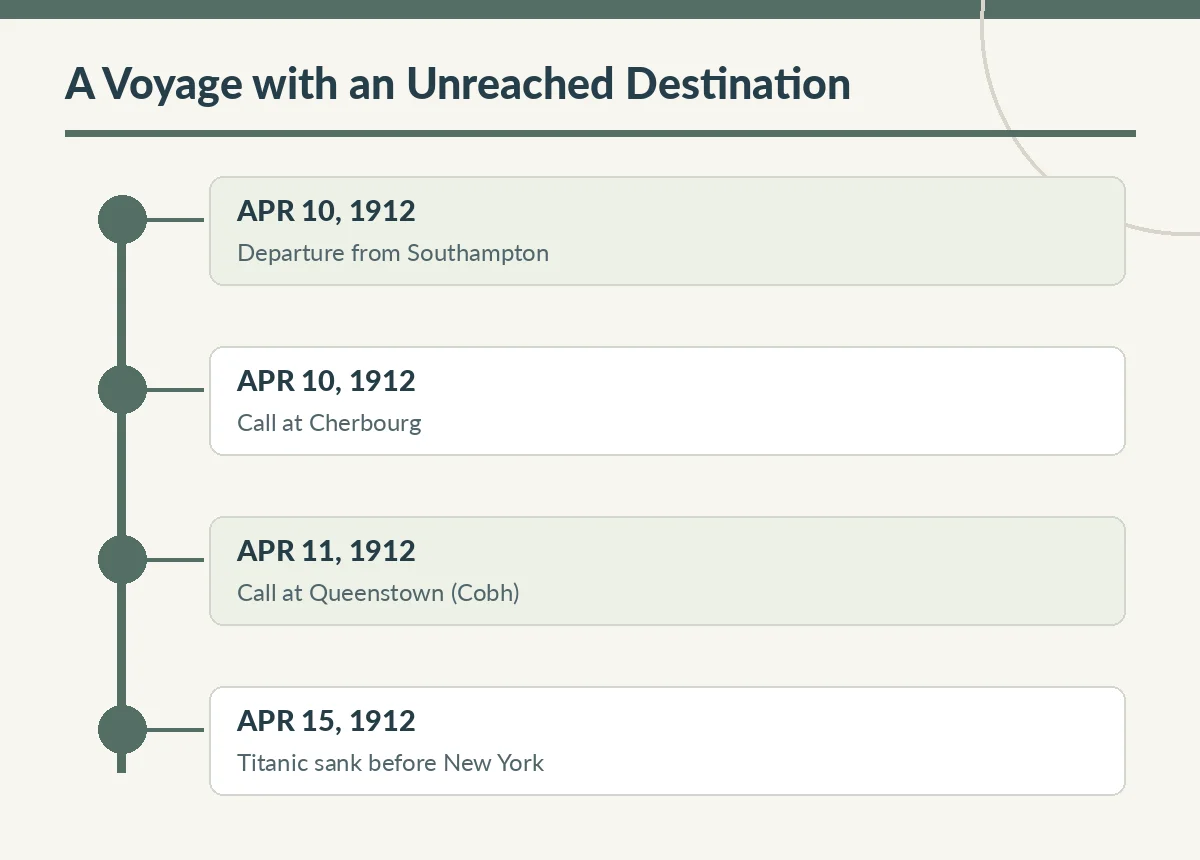
Do not treat intended New York travel as actual arrival
Titanic did not arrive in New York. This makes it especially important to separate intended destination, embarkation, survival and subsequent arrival on another vessel. A UK outward list can support the first part of a journey, but it cannot independently record a successful U.S. landing from Titanic. The National Archives’ education collection contains separate passenger and disaster-related documents that illustrate why record class matters.
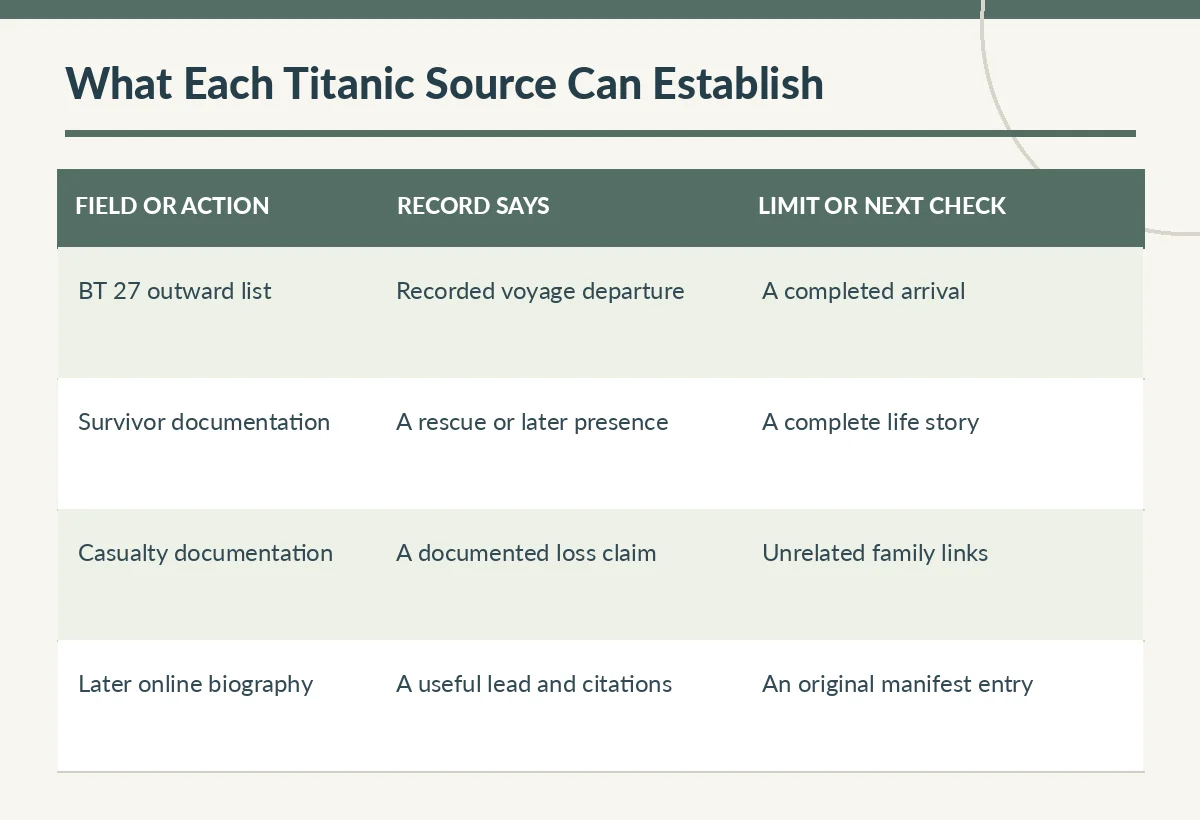
If investigating a survivor, seek a contemporaneous rescue, arrival, or later personal record and cite that separately. If investigating a death, use an appropriately sourced casualty record, official inquiry or civil source rather than inferring it from an unmarked manifest line. Some cross-channel passengers traveled only between stops and did not intend to cross the Atlantic; establish the itinerary before labeling someone a disaster passenger. A carefully qualified conclusion is more accurate than a dramatic but unsupported claim.
Match a Titanic name to the intended family using independent details
A familiar surname in an online Titanic list is a candidate, not a demonstrated ancestor. Compare approximate age, address, occupation, traveling companions, class and departure port where those details are actually recorded. Then look for an independent pre-April 1912 census, a marriage certificate, an emigration letter or a later record naming a relative. Keep the correspondence date and writer separate from the date of any trip it describes.
The passenger’s stated age may differ from birth registration, particularly when someone traveled as a child or used a shortened given name. Distinguish families with identical surnames by dates and relationships, not ticket numbers alone. Never invent a survival narrative to bridge a gap in the evidence. If two candidates remain plausible, state that the identification remains open and give the next record or locality that would distinguish them.
Recognize indexes, memorials and contemporary documents as different sources
An alphabetical Titanic memorial or community database can be a useful discovery index. However, a later biography often assembles assertions from several record classes and may inherit transcription errors. Copy the archive reference from the original document, then record any compiled work as a separate derivative source. Where a source states a passenger boarded at one port and another says a different port, compare the item headings and whether a cross-channel segment was included.
Photographs of individual pages require their own provenance; a period-looking decorative document is not a facsimile. Verify that text actually appears on the cited record before making a field-level claim. Respect the passengers as historical individuals, not props for a sensational narrative. Family links must come from demonstrable records. Missing entries may reflect incomplete coverage, port differences, name variants or a misunderstood source category, not necessarily that an ancestor had never planned to sail.
Create a source-by-source 1912 voyage evidence log
Record name spelling, embarkation port, 1912 date, record class, repository, series and item, exact image locator and the claim supported by each entry. A simple evidence status line can read: “UK departure list documents embarkation,” “survival not determined by that list,” and “family identity requires independent comparison.” This makes a public family history clearer and protects readers from the common jump from “listed passenger” to a detailed account that the document does not actually tell.
When comparing a digitized original against a secondary transcription, note every meaningful difference instead of silently choosing one. Search for relatives traveling together when the name alone is insufficient. If the presumed Titanic connection began as oral family history, preserve the original speaker’s words and date of recollection. That memory has value as testimony, but should not be rewritten as an eyewitness description of events without contemporary corroboration.
More Records and Archives Guides
How We Research Titanic Departure Records
We checked the National Archives’ passenger guide, its image catalogue entry for BT 27/780B and its Titanic teaching-resource descriptions. We used a specialist passenger-list analysis to identify the risk of treating Southampton and Queenstown lists as proof about Cherbourg boarders. The method deliberately distinguishes an archived UK outward list from contemporary rescue documents and later historical biographies. No fictional passenger has been presented as a real ancestor.
Some image providers may charge for record access, but no paid subscription is endorsed here. There is no claimed commercial relationship; consult our affiliate disclosure. Any later publication should attribute the precise list or inquiry and avoid implying that an archival catalogue photo establishes the fate of an individual named elsewhere.
It is a National Archives item reference for Titanic outward passenger lists dated April 10, 1912.
No. The vessel called at several ports, and a UK departure-list segment cannot represent everyone who joined at Cherbourg.
No. Titanic did not reach New York. Intended travel and actual arrival are different claims.
No. Survival or death requires separate reliable contemporary evidence.
Compare age, origin, companions and any address or occupation with independent family records and retain uncertainties.