
ADM 177 confidential wartime Navy Lists help place a Royal Navy officer in an official assignment at a particular edition date. A listing is evidence of appointment, not proof that the person sailed on a named voyage or witnessed an action.
What Was Confidential About ADM 177?
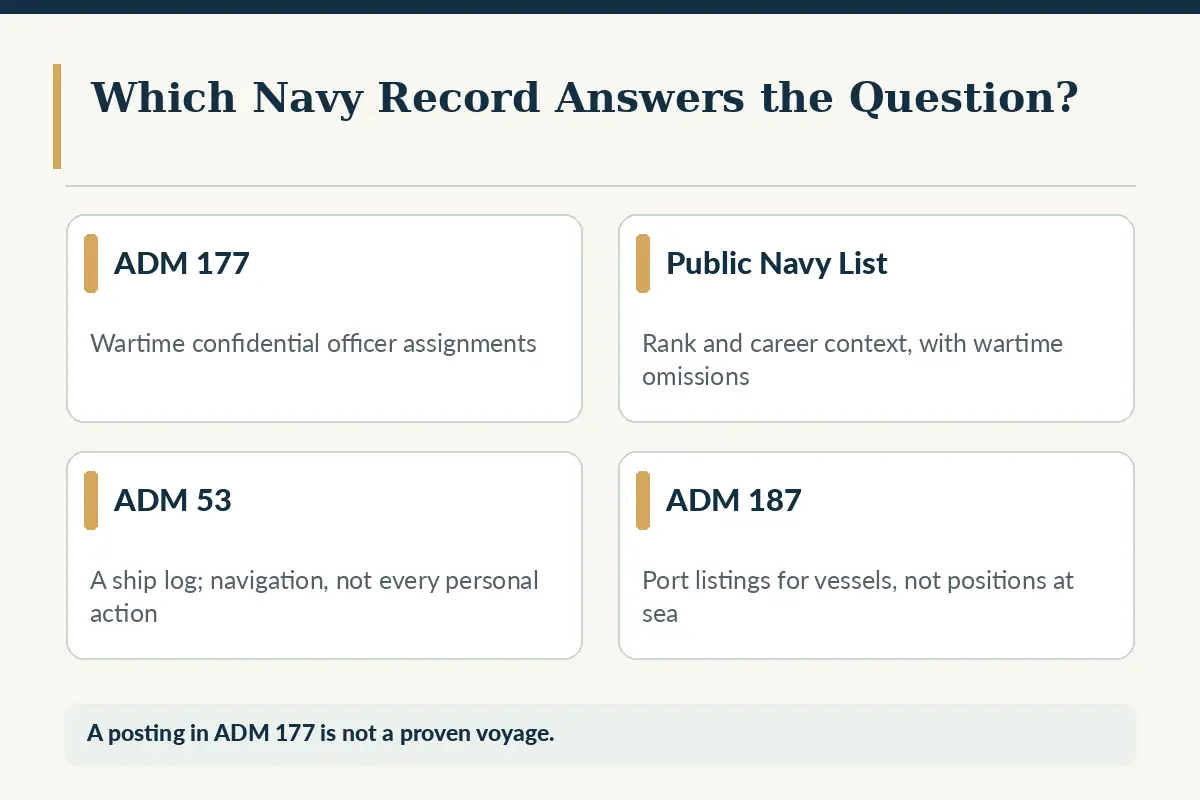
ADM 177 holds Confidential Navy Lists from the First and Second World Wars. Unlike many public wartime Navy Lists, these official-use editions include officers’ assignments to ships and shore establishments that could be omitted from published lists. A dated entry therefore provides a valuable appointment clue, not a complete personal service narrative. The record does not establish that the officer was at sea that day, personally witnessed an action, or remained in the position until the next surviving list.
Start with the officer’s full name, initial variants, rank if known, naval branch and an approximate month or year. Establish whether the person served in the Royal Navy or a reserve component. The same surname may occur across ranks and services; a rank change over time must be verified, not assumed. Treat each ADM 177 edition as a snapshot of an administrative listing rather than a retrospective biography.
Choose a Dated List and Transcribe the Assignment
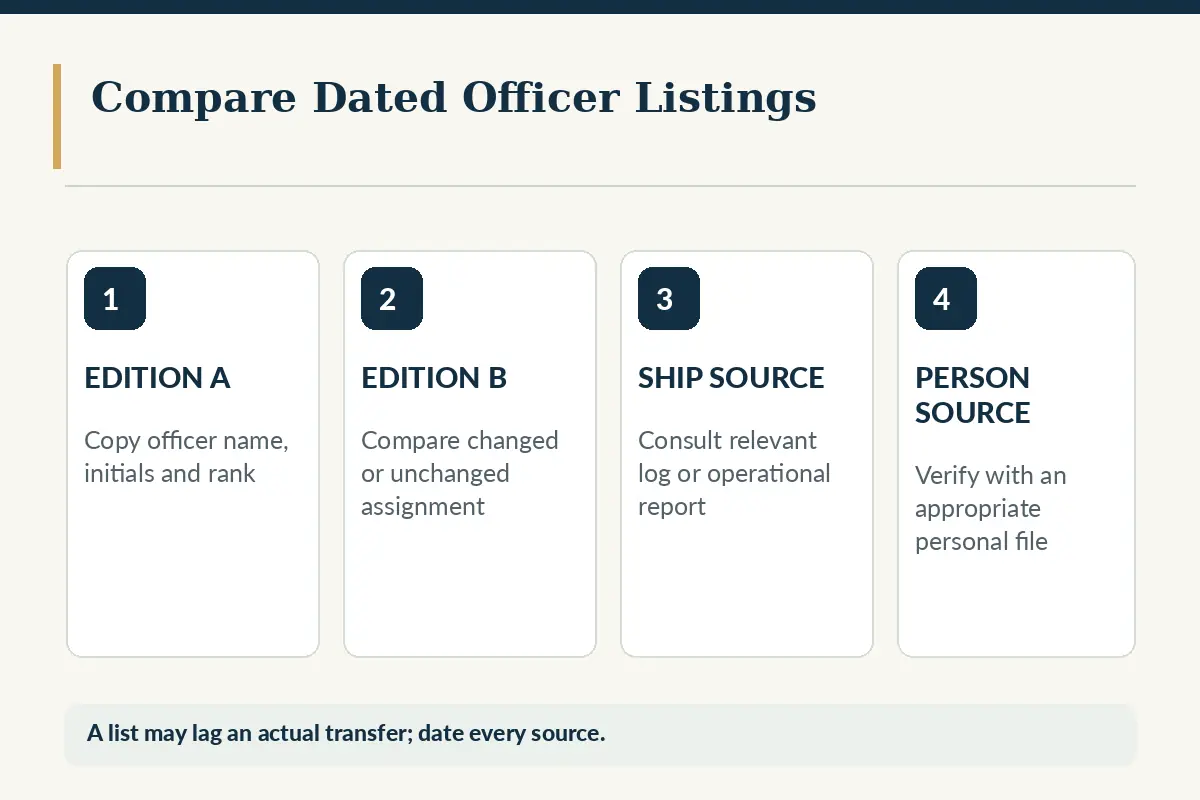
The National Archives officers research guide explains that ADM 177 lists can be browsed by date for download. Select an edition near the event or family claim, and retain the date printed on the list as well as the catalogue reference. Look for the officer’s exact presentation of rank, initials, and assigned vessel or establishment. Do not silently attach a first name from an index or modern family tree to an ambiguous initials-only entry.
Build a short ledger using at least two adjacent editions where available. If a name moves from one shore establishment to a ship, record this as a change in listed appointment between those snapshots, not as a known transfer on a precise unrecorded day. Alphabetic order and placement within an edition are finding aids. If the person cannot be located, check earlier and later dates, alternate initials and the appropriate reserve section.
Keep Appointment, Rank, and Actual Movement Apart
An ADM 177 appointment says where the officer was listed for service. A ship’s navigational position is a different question. ADM 53 ships’ logs primarily record navigation and only incidentally operations; official naval operational accounts can require other Admiralty files. The National Archives distinguishes ADM 187 “pink lists,” which identified vessels in port rather than positions at sea. Neither a posting nor a port list is an individual’s eyewitness account of a battle.
To test a claimed voyage, bring together the list edition, a relevant ship log, operational report, personnel file or dated correspondence. Note whether the ship and person can be matched for the same interval. A ship could be in refit, at anchor or assigned to a different operation than a family memory suggests. Without a direct personal record, phrase the conclusion as “listed as appointed to” rather than “sailed aboard during.”
Compare Published and Confidential Editions
Published Navy Lists can help establish rank and career context, but wartime public lists omitted sensitive assignment information. An apparent discrepancy between a published edition and ADM 177 may therefore reflect purposeful omission rather than an error. Record the precise publication dates of both sources; the lists need not have been compiled or corrected on the same day. Do not treat the public edition as a complete inventory of wartime postings.
When identifying an officer with a common name, follow a career sequence through multiple years, including prewar or postwar lists where possible. Dates of commission, seniority and branch can aid discrimination. Different reserve categories require care: not everyone in a naval establishment was a commissioned Royal Navy officer. Separate the existence of a name in a Navy List from a conclusively established relationship to your ancestor.

Find Supporting Personnel and Operational Records
The correct independent source depends on the claim. For an appointment, search surviving individual officers’ files and dated seniority or appointment entries; for a voyage, use ship-level logs or operational files; for a casualty or award, use the appropriate record created to document that event. Service files for more recent periods can be held outside the open archival series and subject to access rules. The National Archives guides explain series and custody by service branch and period.
An officer’s ship may have transferred command, changed name, or been one of several vessels sharing a similar designation. Keep vessel identifiers, commission dates and precise edition dates in the research log. When citing a digitized list, include the page or image, edition date, series, and repository. A transcription without the edition date can mislead readers into treating a temporary assignment as permanent.
Interpret Gaps and Stale Listings Carefully
A person omitted from one ADM 177 edition may be on another page, in a reserve list, under different initials or absent because of a real change. Search surrounding issues before drawing an inference. Similarly, a name appearing in consecutive lists may represent unchanged administrative reporting rather than daily confirmation of location. A listing might lag behind a transfer, illness or casualty; independent dated evidence is needed to refine the timeline.
If a family claims the officer commanded a submarine or witnessed a torpedo attack, the list can narrow a target unit but does not independently verify that story. Use the Royal Navy operations guide to find relevant operational categories. Report unresolved questions explicitly rather than inventing a voyage to connect scattered names and ships.
More Records and Archives Guides
How We Research an ADM 177 Appointment
We identify the officer’s service and approximate date, locate the dated ADM 177 edition, transcribe exactly what it says, then compare nearby editions. We put rank, ship assignment, port and wartime activity in four separate columns. A claimed operational role is accepted only when the relevant operational or personal evidence supports it; adjacency of a name and ship is not enough.
For negative searches we record edition dates and alternate initials, and note any access limits on individual personnel files. Every conclusion identifies whether it is a listing fact or an inference supported by other documents. The site’s affiliate disclosure is available separately; no paid database can turn an administrative appointment into proof of an unwitnessed event.
Confidential editions include wartime officer assignments to ships and shore establishments omitted from public wartime lists.
No. It records an assignment in a dated edition, not confirmed physical presence on every voyage.
Yes, but matching is safer when you establish branch, dates, initials and the officer’s other recorded appointments.
Ship logs and operational records may help; ADM 187 port lists are not a record of positions at sea.
Include the specific edition date, ADM 177 reference, page or image and the exact officer entry.