
ADM 267 contains Admiralty records of the Director of Naval Construction, including photographs with reports and narratives of naval incidents and damage to craft from 1939–1959. The National Archives lists the pictures as scattered among files, not as a complete searchable picture album. A picture of a damaged hull can establish a physical condition at a documented point; it does not by itself establish the cause, date of action, number of casualties or which named sailors were aboard. This guide gives a precise source route, identifies what the archive can and cannot show, and names the independent documents needed before a personal or geographic conclusion becomes defensible.
Match the Vessel and Incident Before Opening a Photograph
Start with the exact ship name and any official pennant number, date and alleged area of damage. Naval vessels were renamed, repurposed or had names reused; a generic search for a ship name can unite different hulls. If the family source mentions a naval engagement, record the event as a hypothesis until the reference links that particular vessel to the correct date. The National Archives identifies ADM 267 as Admiralty Director of Naval Construction material with incident narratives and photographs across 1939–1959.
Search the series with the ship name and a damage or incident term, then inspect the file-level description. The photographs may be located among text pages and engineering sketches. The catalogue title may reflect the overall incident rather than every pictured detail. Keep a worksheet with file reference, full vessel identity, event date as stated in the document, report date and photograph caption date. Those dates can diverge because inspections or repairs may occur after the incident itself.
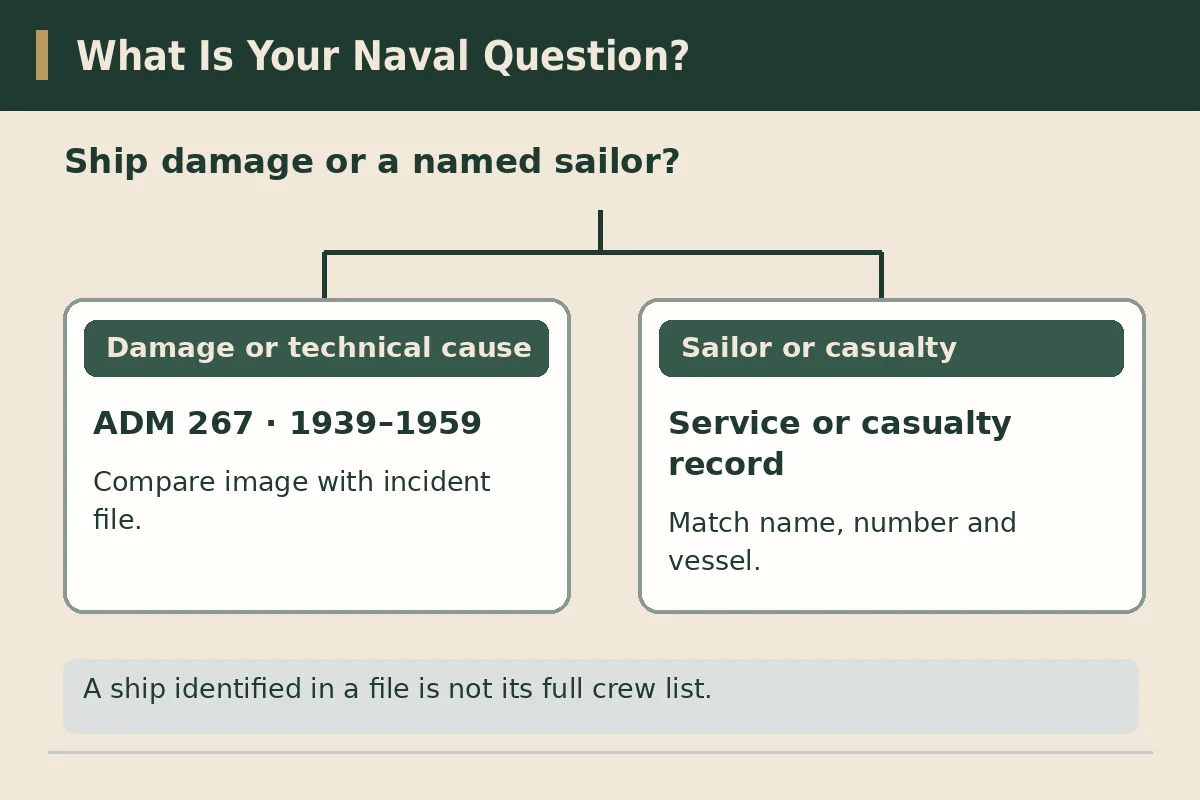
Distinguish a Pictured Defect from Its Reported Cause
An image can show buckled plating, an opening, flooding effects or an altered piece of machinery where those features are actually visible. It cannot automatically distinguish battle damage from an accident, later repair or deliberate test. Scale, orientation, camera viewpoint and whether the pictured compartment was moved or disassembled all matter. Compare any arrows, annotations or captions with the accompanying technical narrative, and note whether an image was taken aboard the ship, at a yard or after a component had been removed.
An engineering report may include an initial explanation and a later investigation with a revised assessment. These are reports made by particular offices, not infallible statements of causation. Quote a report’s conclusion accurately as the investigators’ conclusion, then check whether subsequent evidence changed it. Separate damage observed directly, reported timing and inferred mechanism in three columns. Avoid adding details about weapon type or combat maneuvers when the file simply documents a physical defect.
Hypothetical example: a relative recalls an ancestor “survived damage to the aft hull in 1942.” A search finds an ADM 267 image of a damaged stern, but its caption lacks a crew name. Compare the ship and date, then obtain the sailor’s service evidence independently. The picture illustrates a condition, not a verified biography.

Use the Date of the Incident and the Date of the Photograph
Chronology is essential. A vessel could be photographed immediately after an action, during a dockyard inspection, or while undergoing repair months later. A date printed on a technical folder may cover correspondence and later photographs as well as the event. The same bow or deck structure can look different after temporary patching. Record the original image caption and the source of any later historical label; do not assign the file-level span to every picture without evidence.
An illustrative independent example is HMS Prince of Wales: the HMS Hood Association reproduces selected material from ADM 267/111 about damage on 24 May 1941. Its reproduced passages are extracts, not a substitute for verifying the archive piece and the complete surrounding documentation. They demonstrate the proper need to distinguish a contemporary report, a later selection and the photographic subject. Never attribute the selected account to all naval engagements or treat one file as a general series index.
Find Crew or Casualty Evidence in Its Own Record
Family accounts often begin with “he was on this damaged ship.” ADM 267 can offer valuable context about the vessel and incident but is not a nominal register of every person aboard. A photograph of a ship’s side does not prove that an ancestor was at that station or was injured. Check service numbers, rank, branch, postings, ship books or appropriate service records and casualty records for the person and date in question. Separate service on the vessel from presence during the specific episode.
The same surname may belong to different sailors, and later commemorative lists may include people from multiple incidents. Enter name, number, ship, date interval and source in an identity-matching grid. A report naming a commander or engineer does not list unnamed ratings. If a narrative includes casualty statistics, read how they were compiled and which time period they cover. A recorded estimate or preliminary figure may have been corrected later; do not substitute it for a name-level death or injury record.

Write a Source-By-Source Incident Conclusion
A sound conclusion keeps three layers separate: the photograph depicts a particular condition; the accompanying report attributes it to a reported event; independent crew or casualty evidence places a person on a vessel. Use exact references, captions, report dates and page or plate identifiers whenever possible. If only a catalogue entry or secondary reproduction was consulted, identify that derivative honestly. A detailed photograph may need consultation at Kew or an authorized copy, because many archival images are not freely downloadable.
When an online query fails, search alternative vessel names, hull or pennant identifiers and incident descriptions. Browse the ADM 267 series arrangement rather than assuming every photo has an individual title. Keep a negative-search log with the names and date windows checked. A missing item is not evidence that a ship escaped damage, nor that nobody was present. Such statements would require systematic coverage evidence far beyond one series of technical reports.
Photographs may be persuasive precisely because they appear specific. The safest research habit is to state what a reader can see, what the report says happened and what a separate named record proves, without merging those three statements into an undocumented story.
More Records and Archives Guides
How We Research This Archive Series
This guide starts with the documented evidence in an authoritative source, not a claim that we have inspected a particular person’s private file or a specific original piece. The archival statements here concern the series or research method. A hypothetical example is labelled as such; it is not a newly discovered historical event. We use the Discovery search guidance to distinguish keyword matches from archive holdings and document contents, because catalogue descriptions do not transcribe every word of an original.
For every real candidate, record its historical place or person’s name, the creator, document type, date, full ADM 267 piece or item reference, access restrictions, and the exact claim being tested. The official citation guide explains how to document those references so another researcher can retrace them. An unread document remains a catalogue lead, never proof of imagined details. If a record is missing, preserve the searched terms and dates and examine survival and alternate custodians before interpreting the gap.
Before sharing a conclusion, audit the difference between original source wording and your interpretation. Require independent evidence for any further claim about an individual, property owner, legal effect, or completed action. Respect archival access limits and living people’s privacy. This website also provides an affiliate disclosure; no paid partnership or commercial access is implied by these archival references.
The official guide describes 1939–1959 Admiralty engineering narratives and reports with photographs of naval craft damage and incidents.
No. The photographs are scattered among files and may not be described individually in Discovery.
Not without separate identity and service evidence linking a named sailor to the ship on the relevant date.
They can show a condition; an investigated cause must be read from records and tested against other evidence.
No. Cite a reproduction as such and consult ADM 267 piece context when a precise historical claim depends on it.