
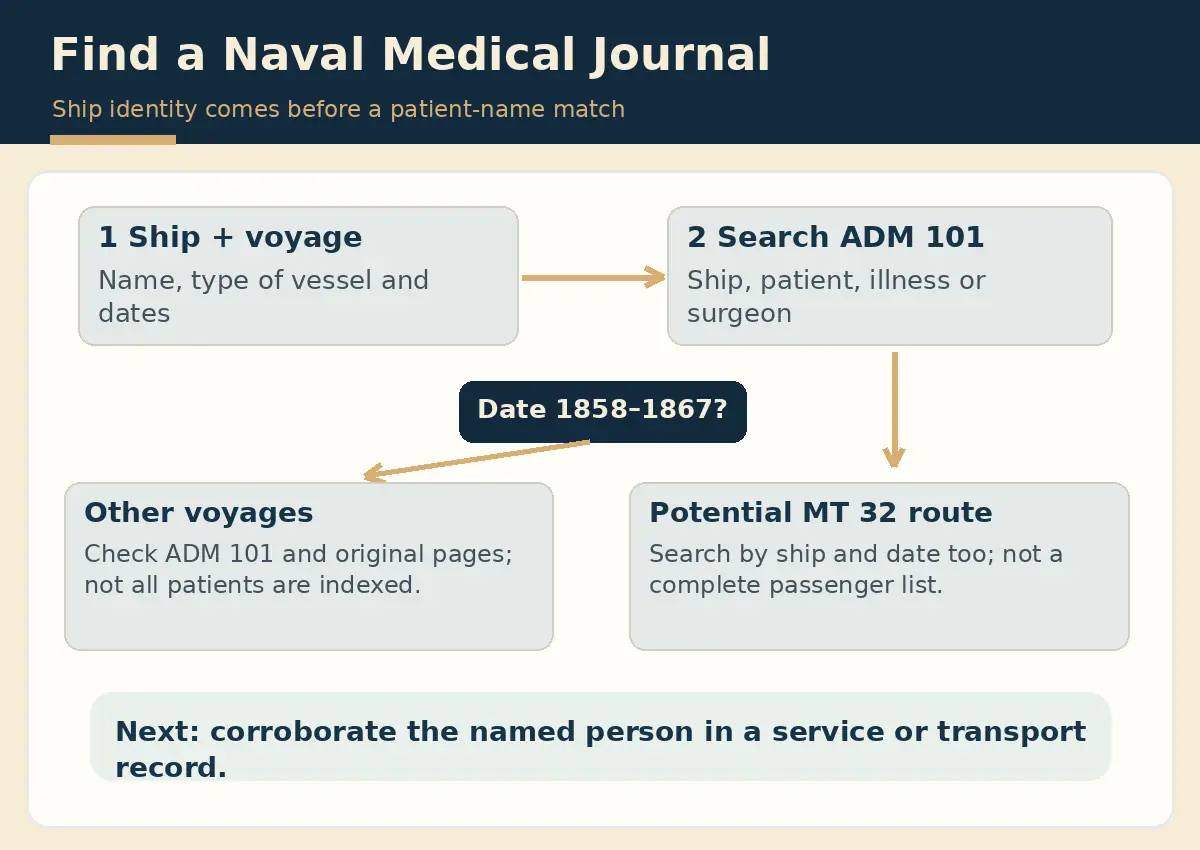
To find a patient in ADM 101, start with the ship and voyage date. Search the medical journal series by vessel and then by a named person, role, illness or surgeon. These are individual health notes, not complete crew or convict passenger lists. Confirm any claimed naval service in separate personnel records. Read our affiliate disclosure for the site’s disclosure policy.
Start With a Ship and a Dated Voyage
The most productive entry point is a known vessel and approximate date, not an unqualified surname. The National Archives’ ship logs guide states that ADM 101 medical officers’ journals can be searched by ship, sick or injured person, complaint, and other keywords. A journal might describe an ordinary warship, a naval hospital, or a hired emigrant or convict vessel carrying a medical officer.
Those contexts have different personnel records. First write down the ship spelling, whether it was a Royal Navy vessel, its sailing interval, and the alleged person’s role. Keep a second column for how each fact was learned. A family story saying “at sea in 1830” is not equivalent to a documented ship posting.
Choose ADM 101 or the Related MT 32 Series
The core catalogued ADM 101 collection covers historical medical journals broadly described for 1793–1880 in TNA’s medical professions guide. Individual volumes have their own dates, sometimes outside a simplified collection headline. The separate MT 32 group includes some 1858–1867 voyage journals.
A person in 1860 therefore does not belong automatically in just one collection. Search the vessel within both relevant series and note the actual date range returned. A search for an illness such as scurvy or an injury may reveal a fully catalogued patient entry, but a result is only a description until its underlying pages are consulted. Always copy the ADM 101 item reference and the ship identity before reading an abstract.
Read the Case Entry Without Inventing a Crew List
Medical entries can record a patient’s name, age, role, condition, date entered on the sick list, observations, treatment, and discharge or outcome. Which details appear depends on the surgeon and the journal. A named man may be a sailor, marine, soldier or transported prisoner.
For example, the official ADM 101/51/4 catalogue entry for the convict ship Mary describes separate cases involving convicts and a private soldier. It is not a uniform list of every person aboard. Transcribe the phrase used for rank or legal status and keep the historical medical terminology as a quotation with a plain-language explanation, not a modern diagnosis inferred from symptoms.
Reconstruct the Vessel’s Time and Place
Create a compact voyage timeline with departure, ports mentioned, dates of sickness, periods at sea, and the next documented movement of the subject. A surgeon might date an entry while the vessel was moving and record a later outcome in a different port.
Compare the temporal context to an independent naval log or transport record rather than assume that all entries on the same ship concern the same journey. TNA’s criminal transportation guide specifically explains that medical journals were kept for convict voyages yet usually identify only treated people. An absence of a patient from the sick list is not evidence that the person never embarked.

Match a Named Patient to Separate Service Evidence
For an apparent Royal Navy rating, seek an independent naval service record or muster with compatible vessel, date, and identifying information. For a transported convict, compare the medical entry with a transport list, court record, sentence and destination record; these sources describe different administrative events.
Ask whether the name is common, whether the reported age fits, and whether the vessel was in the documented location on the relevant day. Record each link in a three-column worksheet: the journal’s explicit statement, the proposed identity, and the other record supporting that proposed identity. If the second source supplies only the same name, hold the identification as tentative instead of a proved match.
Distinguish Injury, Treatment, and Death
A surgeon’s observation of an injury is a contemporary health record, not a determination of its legal cause. Likewise “discharged” might refer to discharge from the sick list, not the end of military service or departure from a ship. Write out the object of the verb before assigning a family-history event.
An entry recording a death is an important lead, but check the date, ship or hospital, and any independent burial or official casualty source. Some case descriptions were abstracted later by cataloguers; those summaries can omit qualifications in the handwritten page. Use the original leaf if access allows, and cite exactly what you have seen.

Cite the Journal at the Right Level
An actionable citation names The National Archives, the Admiralty medical-journals series ADM 101, the exact piece and item, the vessel, journal date range, and folio or image number when available. Preserve a Discovery link and a separate note describing whether you read an image or only a catalogue abstract.
In the Mary example, ADM 101/51/4 is an archival unit, not a surname search result to cite as if it were a complete service file. If access is through a commercial partner, record that viewing context too. Save a transcription of distinctive identifiers, not sensitive inferences about surviving descendants.
Worked Example: One Ship, Two Possible Patients
Suppose a family note places an unnamed sailor on a ship called Mary in 1829. Before searching for a relative’s first name, establish which Mary, which voyage and whether this was a transport or naval posting. The official catalogue entry for ADM 101/51/4 supplies a specific convict voyage to Van Diemen’s Land and named medical cases. Treat those named people as individual patient candidates, not proof that every member of the crew or all passengers appear in the volume.
If a matching surname appears, compare the stated role, approximate age and treatment dates with a separate transport or service source. A researcher might find the same name on a passenger index but at a different departure year. This apparent conflict is a warning to keep records separate until vessel and date are reconciled. Mark the catalogue description as an abstract if the actual folio was not viewed. A negative result for one ship’s medical journal establishes only that no relevant indexed case was located in that item or browse, not that the ancestor did not sail.
More Records and Archives Guides
How We Research Naval Medical Evidence
We begin by independently establishing a ship and voyage window, run a series-limited search for ADM 101 and MT 32 if applicable, and inspect whether a match is an item-level patient description or merely a volume description. We compare vessel names, dates and status descriptions with another contemporaneous source.
Contradictions are written down instead of silently resolved. The resulting finding may prove that a named patient appears in a medical record, but cannot by itself establish an entire career, all passengers aboard, modern disease classification, or a family relationship. We also record the searches that found no surviving journal so a later researcher can repeat the negative search within its actual limits.
Sometimes. Descriptions may include named patients, but a missing name can mean the person was not treated, was not named in a catalogue description, or the journal did not survive.
No. Medical officers recorded sickness, treatment and health conditions; ADM 53 contains many Royal Navy ships’ logs with a different purpose.
No. The National Archives warns that they generally identify convicts receiving medical attention rather than providing a complete transported-prisoner list.
Check ADM 101 and, where relevant, the separate MT 32 medical journal series, using the ship name and dates.
A clearly identified Royal Navy patient entry supports presence in that context; corroborate rank, rating, service number and postings in separate personnel records.