
A Royal Navy surgeon could be recommended for advancement without immediately receiving a new rank. ADM 105 includes medical administration records, including reports on surgeons for promotion and pay or promotion memoranda in the early nineteenth century. The distinction between recommendation, approval, formal rank and assignment is essential. Build an evidence sequence from the original report and seek a separately created service or seniority record before asserting that a promotion took effect.
Surgeon, surgeon’s mate, naval medical officer and other terms need their historical context. The records should be grouped by function, not swept into one generalized “service file.” A report discussing eligibility, a pay memorandum and a seniority list answer different questions. The aim is to make the evidence as clear as possible: what happened, what was merely proposed, which office recorded it and what document would confirm the next stage.
What ADM 105 Adds to a Surgeon’s Career
For an early nineteenth-century Royal Navy medical officer, professional assessment can survive apart from a formal service register. A detailed naval record reference published by the University of Exeter identifies ADM 105/1–9 as reports on surgeons considered for promotion in 1817–1832, and ADM 105/10–19 as memoranda about pay and promotion in 1822–1832. Those distinctions matter: a report written about promotion is not necessarily a completed promotion, and a memorandum on pay does not automatically establish when a commission changed.
The useful question is narrow: what administrative step was being discussed, by whom and on what date? If your family tradition describes a man as “surgeon to the fleet,” do not first search every ADM 105 volume as if it were a nominal roll. Identify a ship, date or named officer through an independent source, then use the appropriate ADM 105 document type to test the claimed career episode.
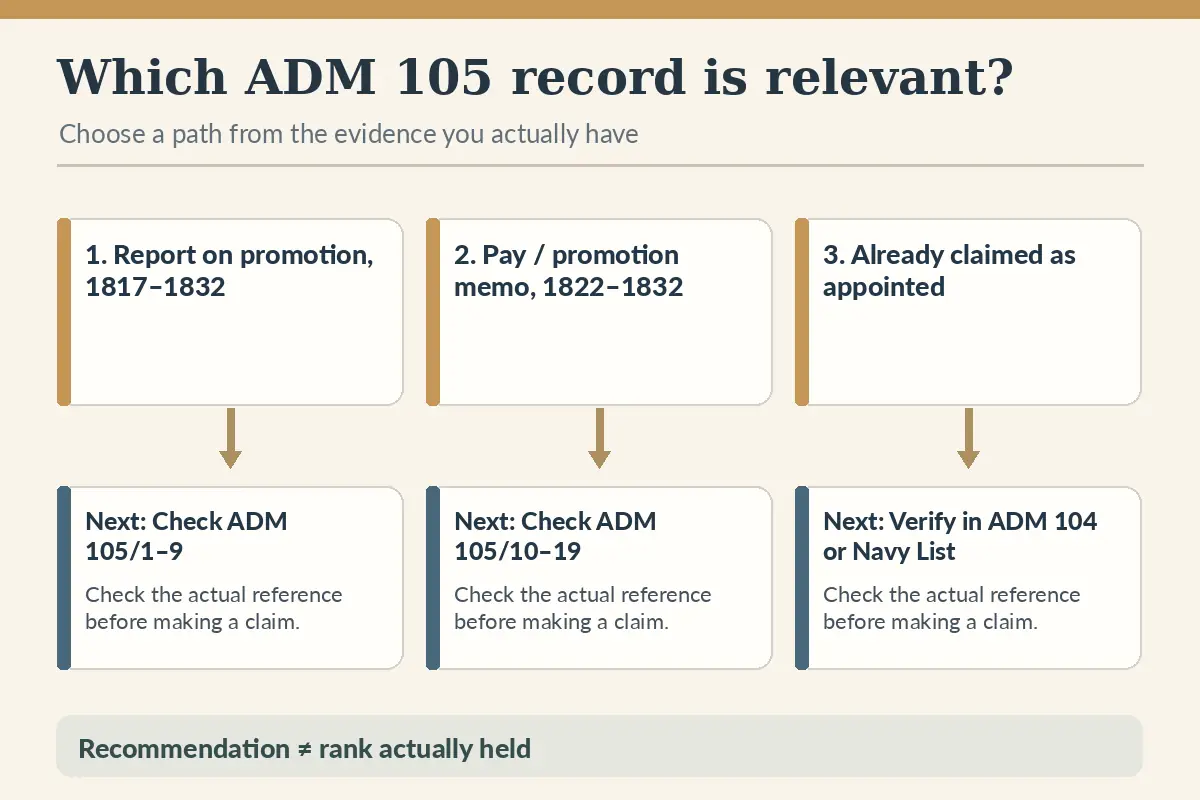
Route the Search by Document Function
Divide the task into a report pathway and a pay or memorandum pathway. For an assessment made between 1817 and 1832, investigate ADM 105/1–9 using volume descriptions and exact dates. For a pay or promotion memorandum from 1822–1832, start with ADM 105/10–19. Confirm what each physical piece actually contains; a series range reported in a reference guide is not a promise that all years or officers appear continuously.
Write down the officer’s rank as it appears in the contemporary record. Royal Navy terminology changed, and the National Archives distinguishes commissioned and warrant officers, with surgeons among earlier warrant ranks. Never impose a later rank structure retroactively. Use vessel names, medical department location and dates as cross-checks, but distinguish the person who authored a report from the officer it describes.
Read Recommendations as Administrative Evidence
Extract the sender, recipient, report date, subject, specific recommended action and any handwritten response. A recommendation uses conditional or advisory language; approval or an executed appointment may require a later dated instrument. If a report praises medical work, do not infer an award or promotion simply from positive wording. Likewise, criticism may not mean dismissal. A useful transcription preserves phrases such as “recommended,” “approved,” and “appointed” exactly as written.
Keep the date of the report separate from the date a rank might have taken effect. A letter may summarize earlier service, while its filing date reflects receipt at an office. The officer’s career can have multiple simultaneous administrative dates: assessment, formal approval, notice, first payment and posting. Mixing these into a single event generates the familiar genealogical error of claiming someone held a rank earlier than evidence allows.
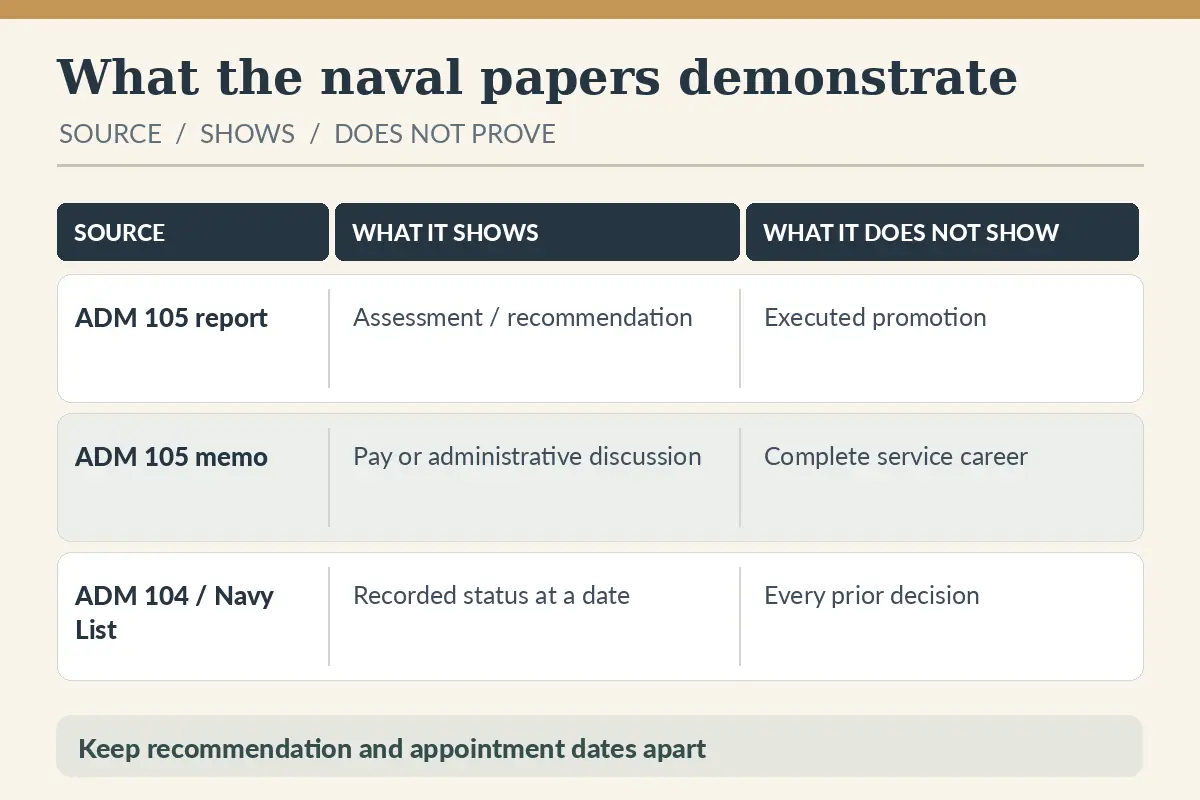
Corroborate Rank, Service and Pay
The National Archives directs researchers to ADM 104 for records of surgeons and assistant surgeons, including ADM 104/51–87 seniority lists for medical officers. A seniority list or service entry may provide a stronger test of whether a rank was formally recognized. The general Royal Navy officer service guide also warns that earlier records are incomplete and points to alternative sources. Do not assume a missing service record disproves a documented report.
When a ship or station appears, search a suitable Navy List for the officer’s name and the relevant year, noting whether it is a contemporary printed directory rather than a personnel file. The naval records guide identifies additional ADM 97 correspondence for medical administration in nearby years. Compare original contexts: a surgeon mentioned in a disciplinary case is not automatically the person with the same name on a seniority list. Preserve full initials and service context.
An Example of a Proposed Promotion
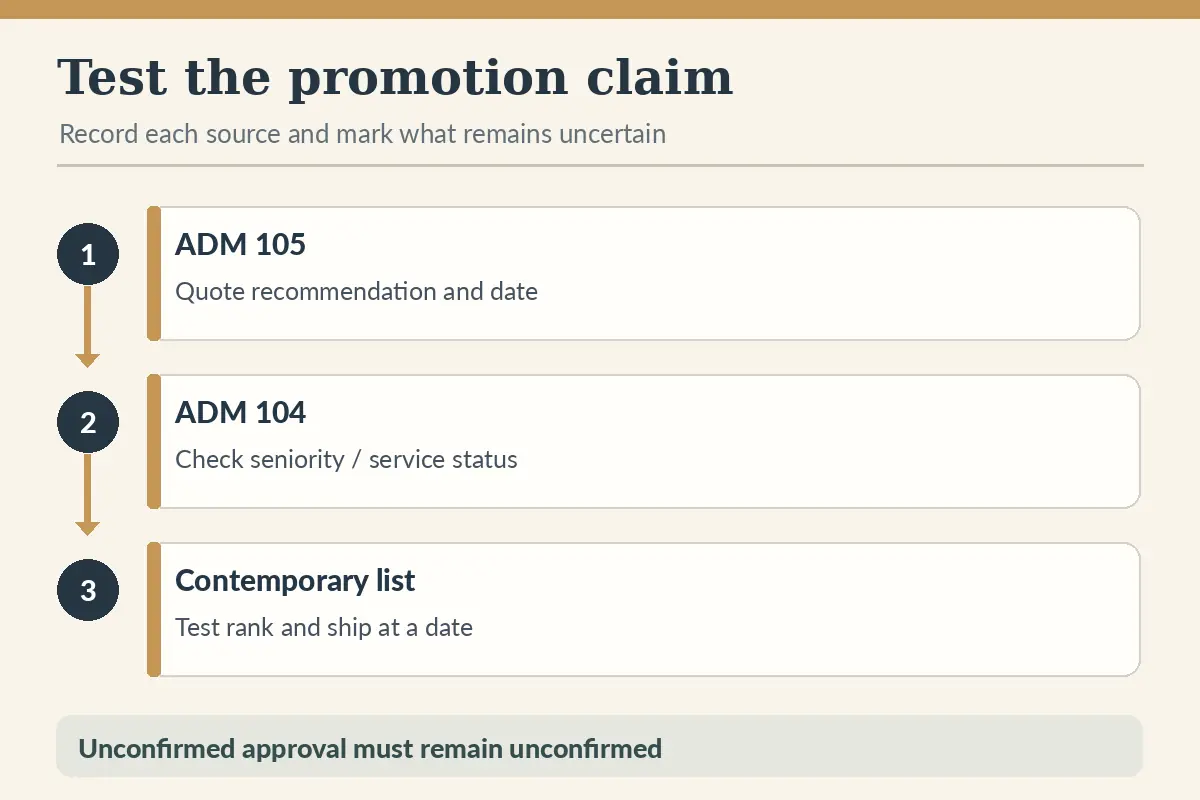
Imagine a family letter stating that James Latham “was to be advanced” in 1826. An ADM 105 report from that year recommends advancement for a surgeon of the same name. That document would support the fact of a recommendation. It would not establish his new rank or the date it began. Search an appropriately dated ADM 104 list and contemporary Navy List to see whether the appointment followed, keeping both positive and negative findings in a chronological table.
Suppose the name is absent from the next annual list but appears two years later. This does not tell you whether approval was delayed, the name was omitted or a different officer is involved. It creates a focused next question. Investigate any additional correspondence or original annotations in the relevant file, and avoid assigning a cause for the gap without an explicit source. A transparent tentative conclusion is stronger than a fictional smooth career.
More Records and Archives Guides
How We Research Early Naval Careers
We distinguish the type of Admiralty document before treating it as biographical evidence. We verify specific sub-series references, transcribe verbs of authority, and maintain separate columns for report, approval, commission, pay and posting dates. We require a personal identity match across at least two independently created records and acknowledge missing early nineteenth-century service coverage, rather than assuming a complete continuous chronology.
We use the National Archives officer research guidance and service-record guidance for verification routes. The University of Exeter guide to naval records documents the ADM 105 piece ranges and their administrative functions. The result is a sourced event sequence, not a rank inferred from a letter’s tone.
Editorial disclosure: Our reference links point to archival catalogues and research guidance, not paid endorsements. Read our affiliate disclosure. When a third-party scan requires a subscription or an archive record requires a copy order, check the access terms before paying; a search snippet alone is not the original document.
A naval records reference guide identifies reports on surgeons for promotion covering 1817–1832.
Those pieces are described as pay and promotion memoranda for 1822–1832, not simply a duplicate set of promotion reports.
No. Look for an executed appointment, seniority entry or another authoritative later record.
The National Archives identifies ADM 104/51–87 as medical officers’ seniority lists for the appropriate period.
No. Verify the posting in a relevant service source or Navy List for the period.