
A prison employee’s name in a Victorian record is not, by itself, a complete employment history. The HO 160 prison staff appointment books preserve particular administrative events in a restricted period, 1887–1898. They can help establish an appointment, transfer or dismissal when the original entry actually records it, but they do not prove every posting or the reason for departure. The practical method is to search by a dated event and build a conservative personnel timeline.
The search is not a simple name lookup: many details of prison service are scattered across books made by different offices. First make an event card with a date, institution and exact occupational title. Then test whether HO 160 covers it and whether another source confirms the correct person. When the dates fall outside the books or entries are missing, say so; a negative search is not evidence that your relative never worked in prison service.
What the HO 160 Books Actually Record
The National Archives identifies HO 160 as appointment books for prison staff covering 1887–1898. This is a narrow record set: it is not a general index to prisoners, a full census of employees, or a substitute for an officer’s personnel file. Its useful information is chronological and administrative. Treat an appointment, transfer or dismissal as a dated action that may identify the employee and establishment, and never silently convert a single action into uninterrupted service.
Before searching for a surname, write down the claim you hope to prove. “My ancestor was working at a particular prison in 1891” is different from “my ancestor first entered prison service in 1889.” The first claim asks for evidence of presence around 1891; the second requires an appointment or earlier engagement. An HO 160 entry might address one claim but leave the other unresolved. Preserve the precise wording of each record rather than compressing both into “prison officer.”
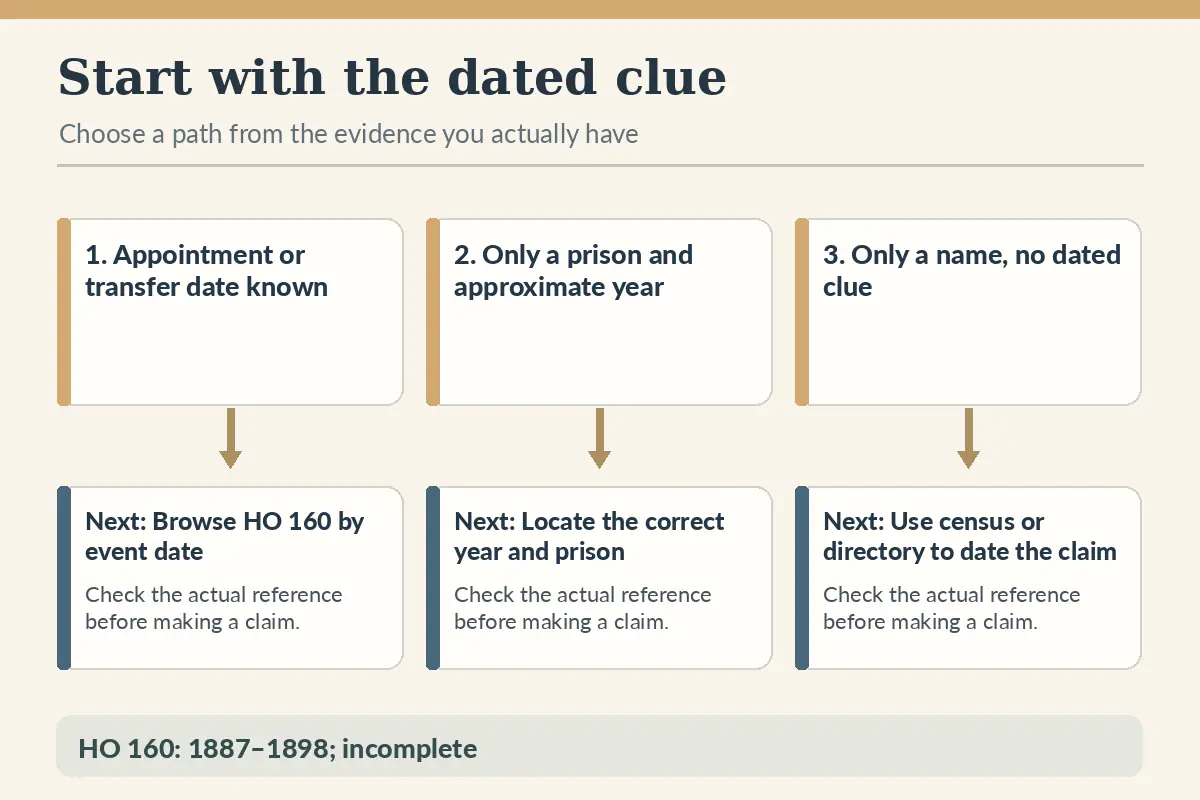
Choose a Date Before Choosing an Employee
Start with a dated clue in a civil record, directory, household census, burial notice or family letter. Put the prison name and its historic spelling next to the clue, then identify the relevant HO 160 volume by its chronological coverage. Where you know only a year, search surrounding volumes if available and record what years you actually examined. A vague family story without a year should first be narrowed through independent local evidence; it is not a reason to claim every staff book is name-indexed.
The date on a transfer may reflect an administrative decision rather than the actual day someone moved house. A dismissal record may not reveal misconduct; departure could have many causes, and the exact entry must be read before a reason is attributed. If the book is not online, use the catalogue reference to plan an archive visit or ask about a copy. The National Archives cautions that the books are incomplete and offer little further personal information.
Extract the Employment Event Without Overreading
Build an event transcription with five fields: exact date as written, employee name, described grade or role if stated, prison or establishment if stated, and the operative verb. Add a sixth field for uncertain handwriting. Recording a transfer as an appointment or a departure as a dismissal can produce a false career story. Where an entry is copied from a later register, preserve the copy’s date separately from the event date.
Do not treat a catalogue heading as a person-level entry. A volume that spans a prison and a year proves that records for that context survive, not that your ancestor appears in them. If an index result supplies a name, inspect the underlying page to discover whether it is the intended employee or a namesake. Cross-check occupation, address and nearby dates against census returns or contemporary printed staff listings where genuinely available.

Compare the Appointment with Other Series
The National Archives separately lists PMG 28 superannuation and retired-allowance registers for prison staff. They are retirement-payment evidence, not a second copy of the appointment book. A pension record may help link a later identity to earlier employment, but a similar name does not automatically establish the link. Note the retirement date and the institutional label, then ask whether service dates and locations are compatible with HO 160.
For broader administrative staffing decisions, search the prison name with PCOM 7 or PCOM 9 and relevant Home Office material when the period fits. Those files can discuss staffing policy, conditions or pay without listing every employee. If a separate staff register survives for an establishment, identify who created it and whether it independently records the same person. Two catalogue summaries referencing one original register are not two independent witnesses.
A Worked Career-Claim Audit
Imagine a census describing Ellen Carter as a prison matron in 1891. HO 160 contains a similarly named employee transferred between establishments in 1890. That is a plausible lead, not a confirmed match: both the census and the transfer need a compatible identity, institution and period. If the names are common, an address, age, marriage record or a further employment document may distinguish two different women. Do not insert an invented date of entry into service.
Suppose a retirement allowance later appears for an E. Carter. Compare original entries to determine whether the award relates to the same institution and career. If initials alone remain ambiguous, leave the identity in a “candidate” column. Conclude narrowly: “An HO 160 transfer was recorded,” “the census reported the occupation,” and “the proposed link is unproven.” Readers should be able to reproduce that cautious conclusion from the references.

More Records and Archives Guides
How We Research Prison Staff Claims
We separate dates of employment actions from dates of residence, because they are recorded by different authorities for different purposes. We check the official series guidance first, confirm the actual coverage of a particular volume, and transcribe the operative words before building a timeline. When an entry has a possible match, we seek independent evidence rather than assuming staff books are complete or that a transfer accounts for every intervening year.
Our source trail begins with the National Archives guidance on prisons and prison staff, then compares the separate prison personnel research guidance. The evidence log records what the original page says, what it cannot establish, who created it and whether access is online, at Kew, or through a copy order.
Editorial disclosure: Our reference links point to archival catalogues and research guidance, not paid endorsements. Read our affiliate disclosure. When a third-party scan requires a subscription or an archive record requires a copy order, check the access terms before paying; a search snippet alone is not the original document.
No. The National Archives warns that the surviving appointment books are incomplete and cover 1887–1898.
No. A transfer is an administrative event; it does not by itself establish when service began.
No. Read the original language and corroborate a cause independently before asserting one.
PMG 28 contains prison staff superannuation and retired-allowance registers, but a pension entry still needs an identity match.
Try a chronological browse by the known appointment or movement year, record the exact coverage, and seek local staff evidence.