
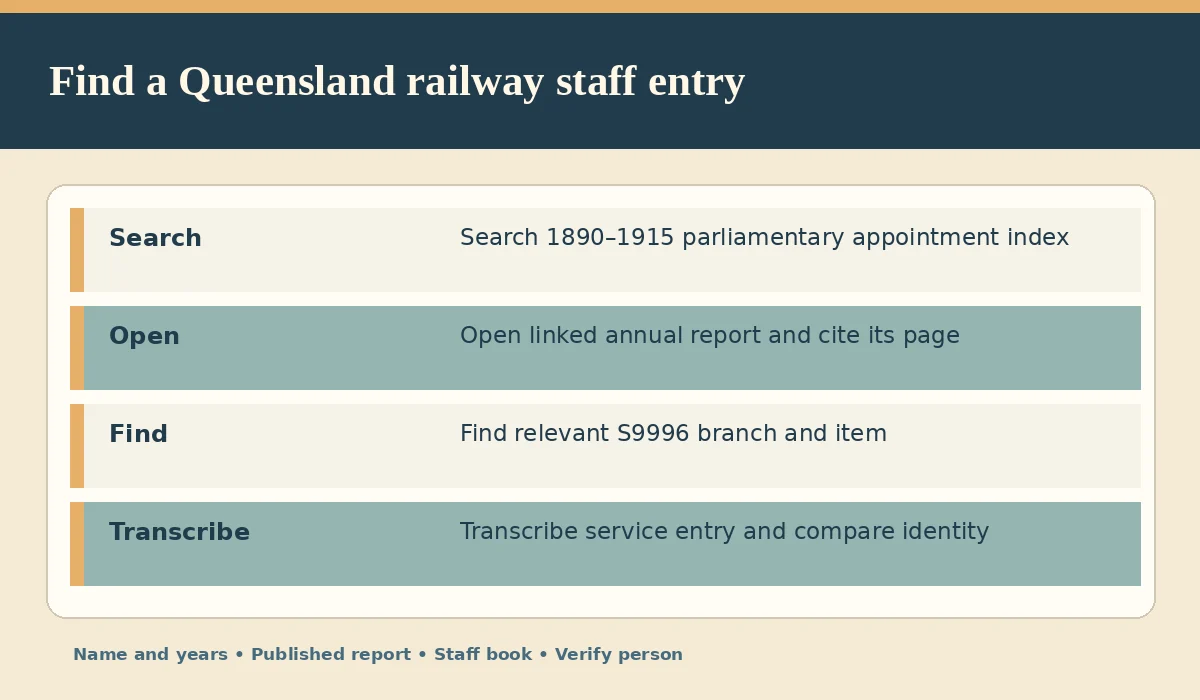
Queensland railway staff books can identify an employee’s railway service, but a station posting does not prove where that worker’s spouse or children lived. Begin by finding a name and approximate years in Queensland’s railway employment lists, then identify the relevant S9996 staff book or branch record held by Queensland State Archives. The State Library’s open dataset indexes appointments and removals reported in parliamentary papers for 1890–1915; S9996 is a separate original staff-register series. Document the job, date, branch and book locator, and resolve any namesakes against civil, directory or other records before extending a family tree.
Separate parliamentary appointment notices from personnel books
Queensland’s open government dataset collects employee names from annual railway appointment and removal information published in parliamentary Votes & Proceedings for 1890–1915. The index links to digitized source reports. It is a useful first surname search but does not replace a staff service book. Parliamentary notices record selected administrative actions, whereas an individual staff entry can provide a different chronology and context depending on the surviving volume. To go further, our guide “NSW Railway Employee Records” shows how to find service cards and registers.
Read the index description to see precisely which years and acts of appointment it covers. A name missing from a list of appointments could belong to someone appointed earlier, employed in a different capacity, or omitted from a published summary. Save the linked report date, department and printed page before moving to an archive catalogue search. Treat a volunteer-created transcription as a finding aid: check spelling and initials in the original report wherever possible.
Locate Staff Registers S9996 by branch and service years
Queensland State Archives describes series S9996 as staff books recording railway employees throughout the state, including particular divisions, branches and lines. That arrangement explains why a broad name search may not retrieve every potentially relevant volume. Collect the worker’s known location, occupation, employer and approximate service period, then identify a likely staff book rather than ordering an arbitrary register. The staff book series reference alone is not an item citation. Our guide “Western Australia WAGR Service Cards” adds more detail on this.
Record the particular S9996 item, title, inclusive dates, arrangement, catalogue identifier and access status. Some volumes are branch-specific, and changes in agency structure can separate related material. Ask the archive which books cover a suspected period if the catalogue description does not distinguish them. Avoid assuming every railway worker has a single, continuous dossier from hiring to retirement: survival, departmental practice and later transfers can create fragmented evidence.
Build a job timeline without inventing a home address
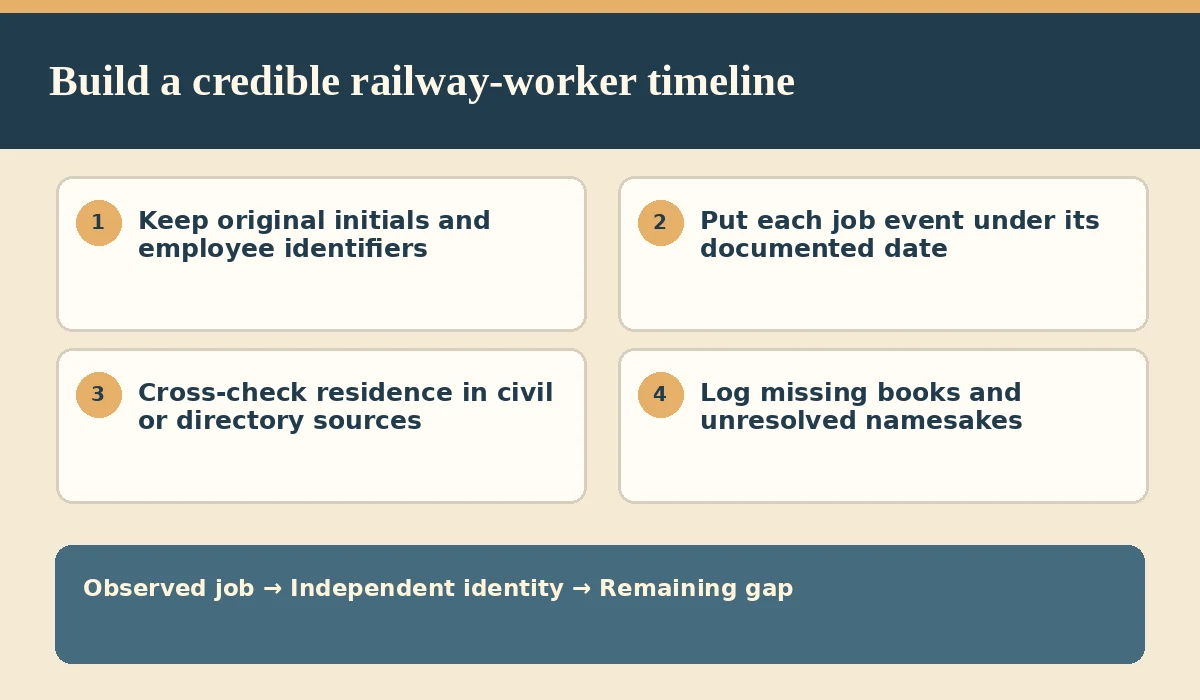
For each entry, transcribe the worker’s recorded name and identifying number if present, the exact date, job or classification, branch or station, and any stated action. Labels such as appointment, removal, promotion or transfer may carry administrative meanings; use the source’s wording before translating it into a narrative. A transfer between railway stations reflects an employment decision and does not automatically establish the residence of an entire family.
Create parallel columns titled ‘workplace or railway posting’ and ‘independent household address.’ Fill the second only with address-bearing evidence such as a dated directory entry, civil registration or electoral listing where eligibility permits. A school admission for a child near a station could be a valuable clue, but cross-check it against the child’s identity rather than inferring that everyone in the household followed the worker immediately.
Resolve initials and common surnames with independent details
Imagine two fictional railway employees recorded as J. Morgan in different branches during the same decade. A surname and the presence of both men on a railway list do not establish which person appears in a family photograph. Compare a complete name where available, an employee number, trade, grade, posting sequence and date against a contemporaneous marriage or death record giving occupation and residence. Keep conflicts visible rather than normalizing them away.
A station described in a family recollection could be one of several places on the same railway line. Search neighboring dates and verify spellings used by the department. Make an identity worksheet that rates each feature as agreement, conflict or unknown. A strong conclusion needs more than one independent identifying characteristic; a plausible occupation combined with a surname can be especially misleading in trades followed by relatives. For the same kind of choice in another place, see our guide “Scottish Lightkeeper Registers, 1837–1921”.
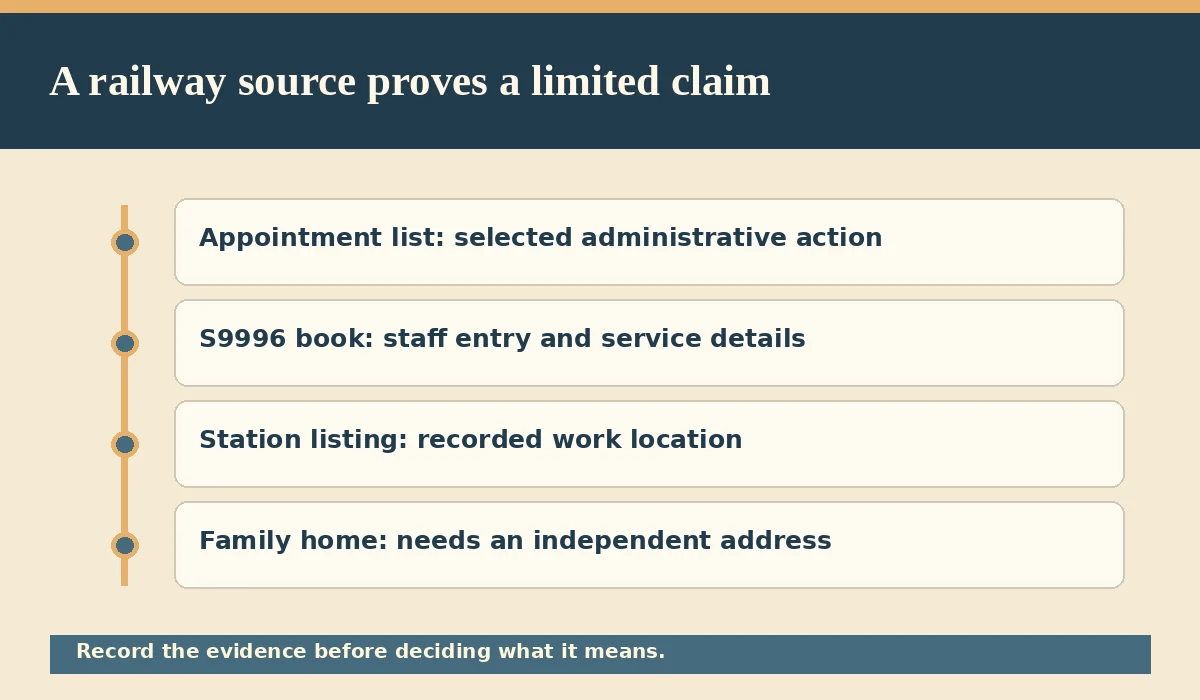
| Research checkpoint | Document a defensible observation | Do not assume |
|---|---|---|
| Appointment list | selected administrative action | The same-name index proves the complete event |
| S9996 book | staff entry and service details | The record proves a family relationship |
| Identity test | Match place, period and independent detail | A matching surname establishes the person |
| Coverage or access limit | Log missing years, item status and search route | A no-hit result proves nonexistence |
Understand incomplete coverage and access conditions
The open employee dataset covers the printed parliamentary material it indexes, not every railway worker who ever served in Queensland. Staff books are another set of holdings, with their own date and branch coverage. The State Archives railway guide identifies additional pathways, including indexes compiled from staff books and entries in government gazettes. These sources may overlap without being identical; record which specific finding aids you have actually searched.
If an item is restricted or not digitized, check the catalogue terms rather than suggesting an unlawful workaround. If a search is negative, state the years, source list, staff book and spelling variants checked. Look for a contemporary union paper, departmental report, directory or family notice as a next clue without presuming those alternatives document the same employee. Index silence is not evidence the ancestor never worked for the railways. Our guide “South Australia Railway Employee Records” adds more detail on this.
Record a fully reproducible employment citation
A good citation names Queensland State Archives, series S9996, the exact volume or item, original book page or entry, the worker’s recorded name and access date. When you used a parliamentary index, cite the State Library’s dataset and the corresponding parliamentary report separately. A page reference within the annual published report is different from a staff-book folio, and mixing the two would prevent another researcher from finding the evidence.
Close with a restrained conclusion: ‘The 1904 notice records a worker with this name entering the Traffic Branch; the S9996 page supplies a station sequence, but a civil record is still required to establish that the worker is our ancestor.’ Note the specific follow-up, such as obtaining a marriage entry with occupation or checking a contemporary residential directory. This retains both the useful employment evidence and the uncertainty about identity.
How We Research Queensland Railway Records
We checked the linked sources on 2026-10-22. Source descriptions are not a substitute for inspecting a specific original manuscript. The worked identities are fictional and intended only to show how to test a record. Rights, fees, privacy rules, digitization and finding aids can change: recheck item-level conditions when requesting or reproducing documents.
More Records and Archives Guides
Original Archive Finding Aids for Queensland Railway Records
Queensland State Archives catalogues S9996 staff books kept for railway employees across branches, divisions and lines (www.archivessearch.qld.gov.au).
Queensland open-data description of railway employee appointments and removals 1890–1915 transcribed from parliamentary Votes & Proceedings (www.data.qld.gov.au).
State Library of Queensland case study of finding names through published indexes and staff registers (www.slq.qld.gov.au).
Queensland State Archives railway research guide identifies staff registers and alternate employment lists (www.publications.qld.gov.au).
This guide contains no affiliate links. Respect restrictions on identifiable living persons, sensitive allegations and copyright when researching or sharing historical sources. See the GenHis affiliate disclosure for our site-wide link policy.
It is Queensland State Archives’ series of staff registers or staff books recording railway workers across divisions, lines and branches.
The State Library of Queensland index transcribes appointments and removals reported during 1890–1915.
No. It documents an employment posting; household residence needs separate evidence.
Published list coverage and original staff-book coverage differ; check branch, dates, spelling and separate indexes.
Give Queensland State Archives, S9996, specific item or volume, page or entry, recorded name and date consulted.