
A South Australian railway employment sheet can show changes of job, salary, leave or service history that a family tree does not reveal. State Records of South Australia offers alphabetical finding aids for GRS 10638, the South Australian Railways’ record-of-employment sheets, and a separate earlier staff register series, GRG 42/131. Search an employee’s name in the appropriate surname group, capture the box and envelope range, and use those references to consult or order the actual record. A railway worker with the right name is not automatically your ancestor; match the employment record against another dated family source.
Choose GRS 10638 or the earlier staff register
The official State Records guide identifies GRS 10638 as employment sheets, with a series generally described as circa 1880 to the mid-1970s. Its companion index PDFs provide a surname-first route to the underlying sheets. The same guide lists GRG 42/131, staff registers extending from the nineteenth into the early twentieth century, as a separate source. Do not assume both series describe the same event or that a worker found in one necessarily appears in the other.
Build a date range for the person before choosing a series. An ancestor listed as a railway porter in an 1870s directory may require an earlier register or correspondence file rather than a later employment sheet. Conversely, a person still employed near the 1975 restructuring may have records created or archived by another agency. Treat each series’ opening and closing years as collection descriptions, not universal career boundaries.
Search the alphabetical employee-sheet indexes accurately
Open the official GRS 10638 index for the correct surname band, such as A–D or I–L. Search both the expected spelling and a variant. A PDF text search can miss a handwritten or differently transcribed name, so browse nearby alphabetical entries when the first query fails. The finding aid records employee names and a box number with an envelope range; those are the practical ordering coordinates for requesting an item.
Copy the name as printed and both locator elements exactly. If two employees share initials and surname, keep both until an original sheet or independent document distinguishes them. An index is not a transcription of all the personnel details inside a file. Do not announce that an employee served for a particular number of years based only on the earliest or latest date in a series description.
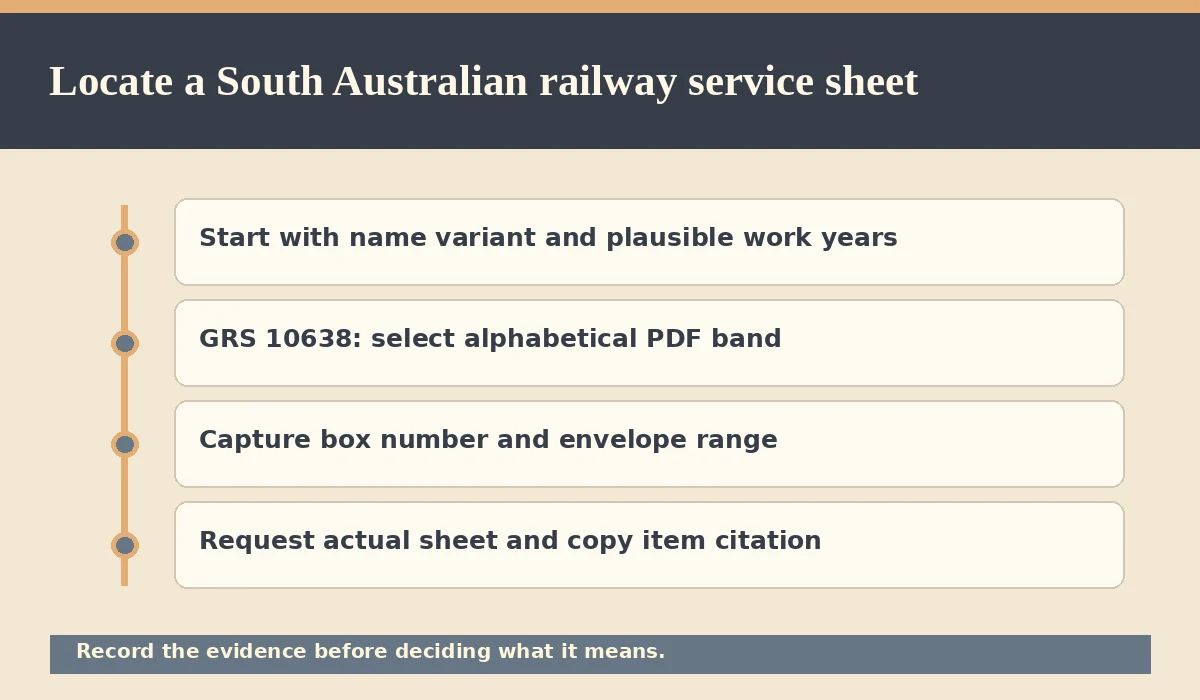
Order an original sheet and read its fields as events
State Records says the employment sheets can include an employee number, name changes for married women, departmental position, pay, leave, examinations, promotions, commendations, reprimands, war service and remarks. These possibilities are not guaranteed in every file. Some details may be sensitive or coded; transcribe headings and dates before interpreting a notation. Ask State Records about viewing the box and envelope in its Research Centre or requesting a copy under its current procedures. To go further, our guide “South Australia Teacher History Sheets” shows how to find service Records, 1915–1965.
Create a dated career ledger with columns for entry date, recorded change, department, location if supplied, exact wording and archival citation. An increment or change of position does not itself prove a move of home. A leave entry need not identify the reason unless the sheet explicitly says so. Do not write a colorful career story from marks that may be administrative or unexplained on the original form.
Understand the custody change around 1975
South Australian Railways were reorganized in 1975, and the official archives guide explains that regional and Commonwealth responsibilities diverged. It states that some employment records remained at State Records while materials archived by Australian National Railways after 1975 may be with the National Archives of Australia. A series prefix can help navigate the catalogue, but present custody should be checked rather than assumed from a historic agency name.
When an employment trail crosses the change, search both institution catalogues using name, department and approximate dates. Record which body actually holds the item and the permission required to inspect it. Do not describe a missing State Records hit as an employee leaving the railways in 1975. The records may simply have followed another administrative pathway.

| Research checkpoint | Document a defensible observation | Do not assume |
|---|---|---|
| GRS 10638 | employee service sheets, later period | The same-name index proves the complete event |
| GRG 42/131 | earlier staff registers | The record proves a family relationship |
| Identity test | Match place, period and independent detail | A matching surname establishes the person |
| Coverage or access limit | Log missing years, item status and search route | A no-hit result proves nonexistence |
Differentiate work assignment from household residence
Consider fictional employee James Porter, appearing in an 1893 employment sheet with a change of duty to a country railway station. A directory for the same year lists a James Porter in Adelaide. These might describe a transfer, a temporary assignment, a different person, or a delayed directory publication. Compare employee number, family members named in civil events, known occupations and an independent address before connecting the two names.
Railway station postings can be valuable clues to where to search school, birth or marriage records, but they do not themselves prove that family members lived nearby. Build parallel timelines for job locations and proven household addresses. A military service note may point to another record repository; it is not a substitute for examining the relevant military file. Separate actual recorded transfers from geographic hypotheses.
Check access, privacy and incomplete survival
The archive states that many personnel records with personal, financial or disciplinary information are generally open after 60 years, while less detailed records may open earlier. Individual items and series may carry different decisions. Confirm access on the relevant catalogue entry and ask the archive about lawful alternatives if a file is closed. Avoid reporting disciplinary claims about people who may be living or directly identifiable from recent records.
If a surname index does not include a person, search the earlier staff registers, available correspondence and published railway employee lists as separate sources. Personnel coverage depends on the creating department, record survival and indexing work. The archive also warns that special lists can contain errors. Negative results should mention exactly which index band, search variants and time spans were checked rather than implying no such worker existed. To go further, our guide “Queensland Railway Staff Books” shows how to find employee service in series S9996.

Cite the employment sheet and build a careful conclusion
A retraceable citation should give State Records of South Australia, the exact creating agency, GRS 10638 or other series, the employee’s recorded name or number, box and envelope range, consulted sheet and date accessed. Cite an index PDF separately if the original was not inspected. If the file is held by the National Archives instead, cite that custodian and its series and control symbols, not the repository where you first read a general guide. For the fuller picture, see our guide “South Australia Police Personnel Records”.
Finish with a short confidence statement. For example: ‘This sheet records a promotion under the name J. Porter, but a dated civil record is needed to identify him as the person in the family tree.’ Keep a next-step list: test the employee number, check the 1900 directory, compare a birth registration, or ask whether associated correspondence survives. That preserves genuine evidence and creates a manageable research plan.
How We Research Railway Family Records
We checked the linked sources on 2026-10-22. Source descriptions are not a substitute for inspecting a specific original manuscript. The worked identities are fictional and intended only to show how to test a record. Rights, fees, privacy rules, digitization and finding aids can change: recheck item-level conditions when requesting or reproducing documents.
More Records and Archives Guides
Original Archive Finding Aids for Railway Family Records
Official SA State Records guide identifies GRS 10638, GRG 42/131, available indexes, employee detail, 1975 custody shift and personal-record access (archives.sa.gov.au).
Official surname index example for GRS 10638 explains box and envelope ranges, employment fields and requesting originals (www.archives.sa.gov.au).
Also, official index guide notes errors and omissions can occur and browsing the original list is important (www.archives.sa.gov.au).
This guide contains no affiliate links. Respect restrictions on identifiable living persons, sensitive allegations and copyright when researching or sharing historical sources. See the GenHis affiliate disclosure for our site-wide link policy.
It is the South Australian Railways series of record-of-employment sheets described by State Records of South Australia.
Record the employee name, box number and envelope range from the correct alphabetical index PDF.
The archive lists GRG 42/131 as a separate staff register series; confirm its years and access method in the guide.
Only if it actually records one. A station assignment or transfer does not by itself establish family residence.
Following 1975 agency changes, some Australian National Railways holdings went to the National Archives of Australia.