
To research South Australian probate between 1844 and 1916, locate the deceased person in a relevant probate index, capture the court reference, then inspect the corresponding probate or administration book and, where available, the underlying case file. State Records of South Australia distinguishes the Supreme Court’s GRS 1334 probate files from copied grants and wills in GRS 16377 and GRS 11585. These documents can name relatives and beneficiaries, but an index hit alone does not establish that the person is your ancestor.
Identify the legal question before searching
Probate research can answer different questions: Did a person leave a will, was administration granted, who was appointed to manage an estate, and what property or relationships did the court documents report? These questions are not interchangeable. A testamentary file may contain the will, affidavits, petitions, bonds and orders, depending on the matter. An administration when someone died without a valid will is a different route. Start from an independently supported death estimate and locality. If you need to establish a relationship, ask whether a named person was described as a child, spouse, executor, witness or beneficiary; the roles have different evidentiary force.
Understand the South Australian series crosswalk
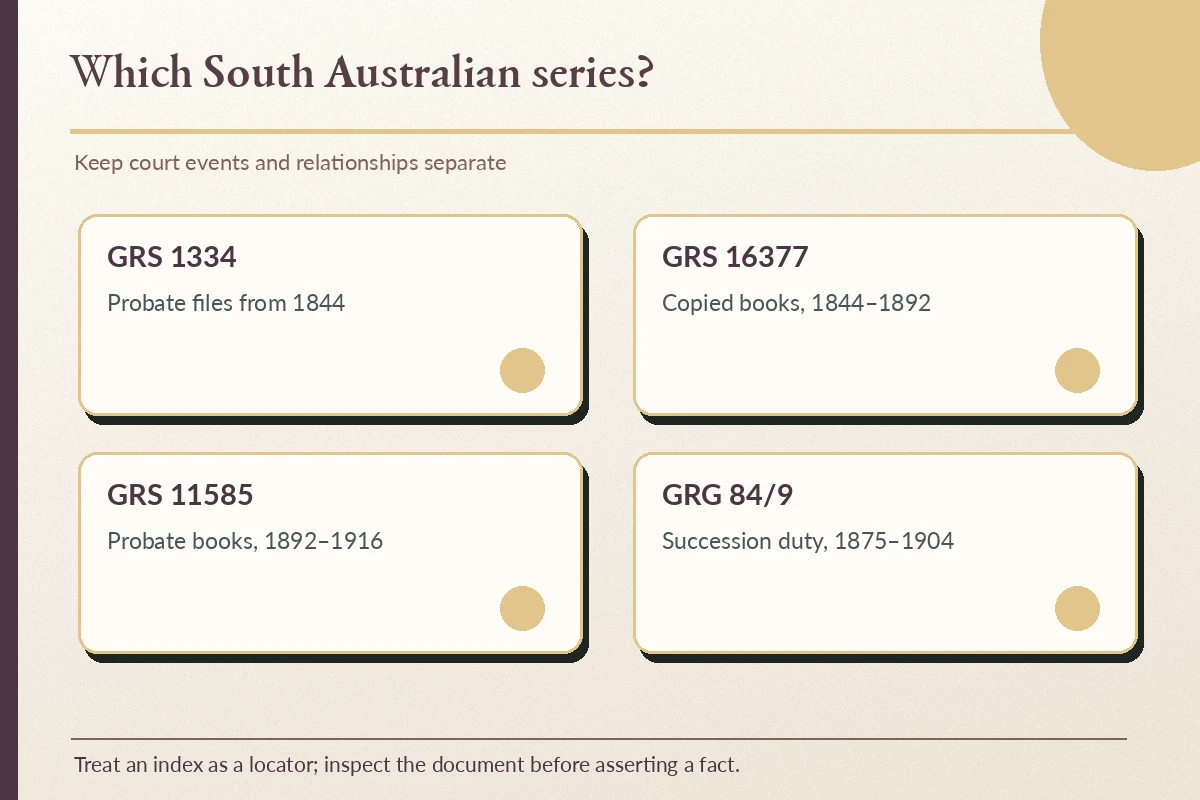
The Supreme Court probate files are held as GRS 1334, beginning in 1844. The archive describes early probate indexes for 1844–1891 (GRS 1334/1) and 1892–1916 (GRS 1334/2). It also identifies copied probate record books for 1844–1892 (GRS 16377) and probate and administration books for 1892–1916 (GRS 11585). These are not simply duplicate websites. The index points you to a legal proceeding; a copied book may preserve the grant or a copy of a will; a file can contain additional supporting papers. Preserve the exact number and series so you do not silently transfer a reference to the wrong document family.

Begin with a documented death window
Use civil death records, a burial register or an independently dated notice to narrow the possible probate period. Probate may occur after the death and may involve more than one stage, so do not force the dates to match. Search the person’s surname and given-name variants, then note place, occupation and any executor or administrator where recorded. Make a candidate list for same-name decedents rather than choosing the first result. Record whether the hit came from FamilySearch, a catalog description or a book image, and copy the repository’s exact form of the probate number. If the number is unclear, do not invent missing digits.
Move from the index into the copied book
The State Records page identifies digitized books accessible through FamilySearch. Navigate to the correct date and book, then compare the name and file or grant number with the index. Read the surrounding headings, not only a highlighted surname. A copied will can be a valuable record of testamentary intentions, but it is not necessarily the signed original or the whole court file. Check whether the entry is a grant of probate, letters of administration or another legal action. If an image is unavailable from home, record the catalog reference and lawful reading-room alternative. Image access and the scope of database indexing are not guaranteed.
Know when the underlying case file matters
The archive’s GRS 1334 description lists petitions, affidavits, wills and correspondence among documents that may survive in a probate file. Such papers may clarify an alias, the basis for an administrator’s appointment, the relationship of a beneficiary, or a disputed estate. The archive says GRS 1334 is generally open after 100 years, while case files from within the last 100 years must be accessed through CourtsSA. Do not interpret a digital copy-book result as automatic unrestricted access to all original papers. Request the specific file only once you can cite its exact index or catalog reference.
Separate estate roles from family relationships
An executor carries out provisions in a will; an administrator manages an estate under the applicable grant; a beneficiary receives or is intended to receive something. A witness may have no family connection. Terms like son, widow or brother appear in historical files, but even an explicit kinship statement is an allegation or assertion within a particular document until corroborated. Draft a role grid with name, exact wording, document, stated relationship and an independent record to check. Resist treating a shared surname or inherited land parcel as proof of biological descent. Distinguish a testator’s instructions from whether the court later acted on them.
Use a fictional two-estate comparison
Suppose a search returns a fictional Thomas Bell, carpenter, and another Thomas Bell, farmer, in the same decade. A wills index alone may leave both plausible. One copied probate book names an executor in Port Adelaide, while the other mentions an inland property. Compare both with independent death registrations and dated residential records. If the known ancestor’s occupation and spouse appear in a second source, mark one candidate as stronger and retain the competing candidate. If both remain possible, label the link unresolved. This scenario is illustrative, not a real South Australian court file or a claim about any named historical family. A similar decision comes up in our guide “New Zealand Probate Records”, which explains how to find wills and unindexed court files.

Check succession-duty material separately
State Records also describes succession duty files, including digitized material for 1875–1904 in GRG 84/9. Tax-related records have their own purpose and can supplement estate research, but a financial assessment is not the same as the will or grant. Determine whether a separate succession file was created and what it actually reports. Be careful with valuations: the estate value may refer to an accounting date, a defined property class or a tax assessment, not the family’s entire wealth. If only a digitized tax index appears, record it as such. Do not generalize from tax liability to household membership or inheritance without the relevant papers.
| Document | Supports | Does not alone prove |
|---|---|---|
| Probate index | Possible estate case and reference | Identity with your ancestor |
| Copy book | Text of a grant or copied will | Complete original case file |
| Estate file | Evidence presented to court | Every reported family link is true |
| Succession duty | Tax / estate assessment details | Full inheritance distribution |
Cite the court event precisely
A strong citation identifies the deceased, document type, probate or administration date if stated, book or file number, GRS series, folio or page, State Records of South Australia and the host through which you viewed it. Transcribe original kinship words accurately; note uncertain handwriting rather than smoothing it into certainty. A grant date is not the death date; the date a will was written is not the date it took effect; a file’s archival series dates do not prove every particular case survives. Keep an image reference or lawful note of the source and write one limited claim per document. For more detail, our guide “Western Australia Probate Records, 1832–1947” looks at wills and administration.
Choose the next proof test
For a beneficiary described as a daughter, locate her civil registration or another independent record that links her to the testator. For an executor sharing a surname, check the exact relationship rather than assuming it. For real estate, compare a land title or transfer with the estate inventory and assess dates carefully. If your objective is merely to locate a grant, stop once the court action is documented; if it is a family relationship, keep going. State Records’ topic and catalog pages are the authority for current series access; the presence of one searchable website result is not a guarantee that the entire probate case is online.
How We Research
We reviewed the State Records of South Australia estates guide, ArchivesSearch GRS 1334 series description, online-records listing, and FamilySearch’s historical probate collection. The article keeps the 1844–1892 and 1892–1916 probate-book series separate and repeats the archive’s explicit 100-year access condition rather than extending online availability to recent files. The two Thomas Bell candidates are deliberately fictional. Our evidence method identifies what each legal role and document proves while reserving kinship conclusions for independently checked records.
More Records and Archives Guides
Primary sources and official archival guidance
State Records identifies probate, administration, book and succession-duty series and periods (archives.sa.gov.au).
The official catalog confirms the probate files series, numbering and century-based access rule (catalogue.archives.sa.gov.au).
FamilySearch describes the South Australian wills and probate index and images (www.familysearch.org).
The archive directs users to digitized probate record and administration books (www.archives.sa.gov.au).
This is historical research guidance rather than legal or inheritance advice. This guide contains no affiliate links. Current court access, copying fees and reproduction conditions must be checked with the lawful custodian. See GenHis affiliate disclosure.
The State Records Supreme Court probate file series GRS 1334 begins in 1844; other related indexes and books cover different periods.
It is the South Australian Supreme Court probate case-file series, with indexes and changing numbering systems.
Digitized copies of certain probate and administration books are available via FamilySearch, but not every original case file is online.
State Records describes GRS 1334 files as generally open after 100 years, with more recent probate files directed through CourtsSA.
No. Record the exact role and wording and verify the parent-child relationship using separate contemporary evidence.