
To research naturalisation in colonial South Australia, establish whether the event occurred before 1848, between 1848 and 1903, or under the Commonwealth system from 1904. The State Library of South Australia explains that early naturalisation could require a person-specific Act, while later colonial procedures differed. Its indexes are finding aids; the National Archives of Australia holds South Australia’s original pre-1904 naturalisation material in its Adelaide holdings. Naturalisation is a documented legal event, not proof that every later nationality or personal detail can be inferred from one index entry.
Establish a timeline before searching a naturalisation name
Start with the ancestor’s birth locality, likely arrival window, residence in South Australia and a spellings list. A person may appear as a subject in a newspaper, government list or family story without ever naturalising. Decide what you need to prove: an application, a granted colonial status, a date, or the identity of a similarly named migrant. That question determines which paper matters most. Record the source for each known date rather than adopting a convenient unsourced birth year.
Do not equate arrival, domicile, property ownership or voting with naturalisation. Rights, qualifications and legislation changed through the nineteenth century. An index that names a person and a year may support a search for the act or file; it does not explain every legal entitlement. Build a chronological worksheet with residence and occupation from an independent record so that later candidate matching is not based on name alone.
Separate pre-1848 Acts from later colonial naturalisation
State Library SA’s immigration guidance says that naturalisation before 1848 was granted by legislation naming the individual. After the legislative change, naturalisation could be granted without passing a separate named Act each time. Search strategies therefore need a date split. For an early case, begin with legislative and government publication context; for a later colonial case, seek the relevant index and original certificate or archival record using the government repository route.
A modern search result may group different kinds of nineteenth-century naturalisation together. Read the actual item title and document type before applying rules from the wrong decade. If the family timeline suggests 1847 but the index yields 1850, do not silently alter the date: record both and test whether the record describes a different procedural stage or a namesake.

Find indexes at the State Library, but originals at NAA
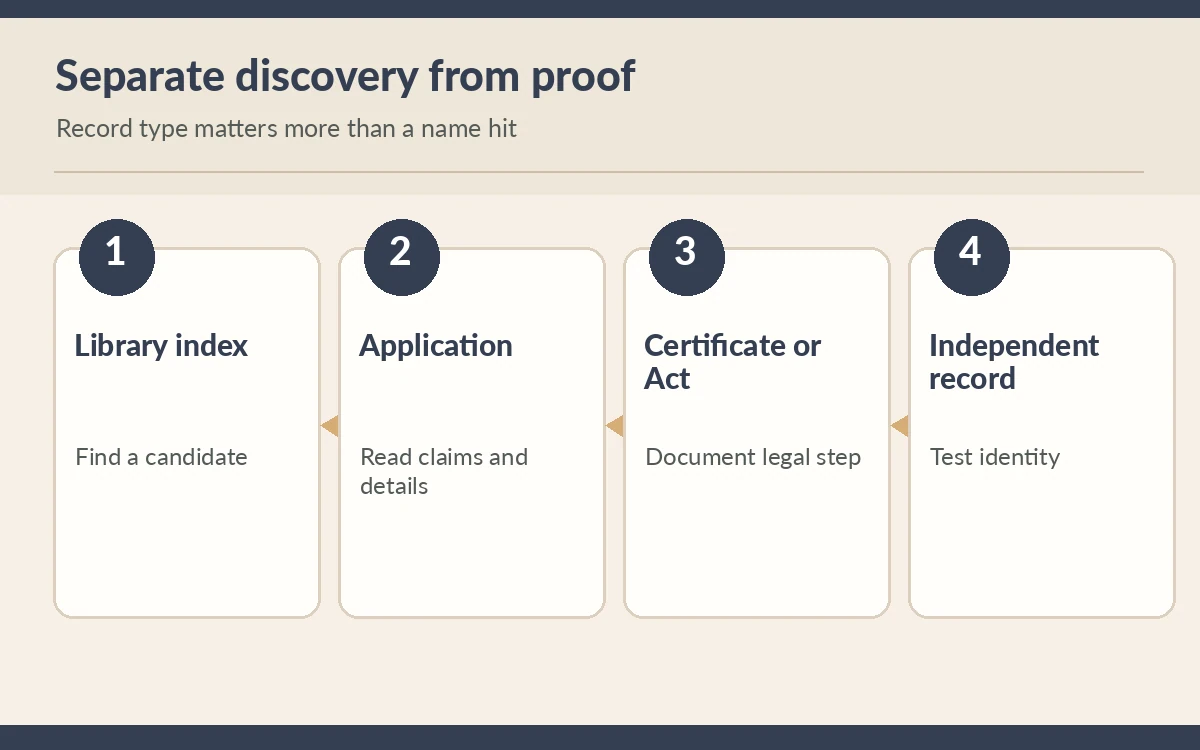
State Library SA identifies indexes such as aliens naturalized to June 1872 and warns that these are indexes only. Its research guides point to original South Australian naturalisation material held by the National Archives of Australia rather than treating a library index entry as the certificate. NAA likewise identifies its Adelaide office as the custodian of South Australian pre-1904 naturalisation records. Keep the two institutions and their roles separate when recording your route. Our guide “Western Australia Naturalisation Records, 1841–1903” covers how to find certificates.
At NAA’s RecordSearch, use the NameSearch approach and the immigration and naturalisation category, adjusting given names and surname forms. Note the file title, series, item control symbol, date range and digitisation or access status. A catalogue title can refer to an individual application, a certificate or an administrative grouping; the original item’s contents must decide what claim it supports.
Do not extend colonial rules past the Commonwealth transition
The National Archives holds Commonwealth naturalisation and citizenship records from 1904 onward. A family member who applied in 1905 should therefore not be searched exclusively under a South Australian nineteenth-century index. A person who had a colonial certificate before Federation might appear in different subsequent records, but those later records do not erase the earlier document. Record both legal system and event date in your timeline.
Modern Australian citizenship did not exist in its present legal form in the nineteenth century. Avoid calling a South Australian colonial naturalisation certificate proof of citizenship under a modern nationality regime. The wording on the original paper and the law then in effect are the proper evidence. If an article or family memory uses the phrase ‘became Australian’, translate it into a specific documented event only when that event can be shown. Our guide “Queensland Naturalisation Records, 1851–1908” shows how to find the original oath.
Extract reported identity clues without upgrading them to facts
National Archives’ citizenship guidance lists kinds of details that historical naturalisation records may supply, such as birthplace, arrival information, occupation, residence and associated family members. The content varies by form and era; do not promise a ship name or parents’ names in every pre-1904 file. Transcribe exactly what the particular document says and identify whether the applicant, a witness or an administrator supplied each item. Reported age or birthplace can be inaccurate.
Treat the certificate and any application as separate sources if both survive. An application may assert a previous residence while a certificate establishes that an official step was completed. Compare the person’s stated nationality or former allegiance with a birth or church record when one survives, rather than turning a national label into a precise hometown. Every identifying claim deserves its own citation.
| Record or clue | Best use | Limit to remember |
|---|---|---|
| Before 1848 | Check individual legislation | Do not assume later procedure |
| 1848–1903 | Use SA index and NAA originals | Library index is not certificate |
| From 1904 | Search Commonwealth NAA records | Different legal system |
| Identity check | Compare residence + occupation | Name alone is weak |
Work a fictional same-name verification example
Imagine two fictional immigrants named Charles Meyer in Adelaide newspaper mentions during the 1860s. A library index lists Charles Meyer in 1867. Before connecting that entry to a family tree, compare the original naturalisation item with the occupation and address in an independently dated directory, then check the person’s arrival or marriage record. A rare name still requires corroboration when sources may repeat one individual’s unverified statements.
If the original document names a different district from the directory, do not explain it away without evidence. Perhaps one person moved, or perhaps two people shared a name. Keep both hypotheses open and seek a second identifier such as occupation combined with a dated place. All people and events in this example are fictional; the value is the verification method, not an invented historical case.
Make a careful original-record request
After identifying a likely NAA item, check whether an image is already available in RecordSearch. If not, review the Archives’ current ordering, access and copy procedures. Do not claim that an item is open, free or already scanned simply because a finding aid lists it. Re-check series descriptions for other linked papers that may include the application or oath and note whether a restriction or lack of digitisation affects the next step.
When communicating with an archive, supply a compact evidence list: person’s exact name and variants, estimated year, district, any State Library index citation, plus the NAA series and item identifier. Explain that you want to distinguish the original record from its index. A broad request for every similar surname can waste time; an actionable citation helps archival staff retrieve the right item.

Cite the certificate and historical legal meaning separately
Cite the State Library index as an index when it was used; cite the National Archives item by creator, document title, date, series and control symbol when read. A legislative Act should be cited as an Act with its date and printed source, not disguised as a personal certificate. Preserve a search log that records whether the original has been inspected. If a library entry conflicts with a document, report the conflict rather than changing one silently.
An ethically sound family history can say ‘this document records colonial naturalisation in a stated year’ without predicting a person’s modern rights or identity. Be careful with terms for migrants that reflected discriminatory nineteenth-century classifications. Quote them only when important and contextualize them. Separate historical evidence, legal interpretation and the researcher’s uncertain conclusions.
How We Research South Australian Naturalisation
We compared State Library SA guides on naturalisation laws, indexes and archival custody with NAA citizenship guidance and its fact sheet on the Adelaide holdings. The 1848 and 1904 boundaries come from those institutional descriptions. Charles Meyer is fictional. No archive is represented as supplying fields, prices or digitized images for every individual record.
More Records and Archives Guides
Original Records and Repository Guidance for South Australian Naturalisation
State Library SA: pre-1848 personal Acts, later law and available naturalisation indexes (guides.slsa.sa.gov.au).
State Library SA: records custody at National Archives and typical identifying details (guides.slsa.sa.gov.au).
National Archives: Commonwealth 1904 transition, colonial holdings and RecordSearch route (www.naa.gov.au).
National Archives distinguishes South Australian pre-1904 records held in Adelaide (www.naa.gov.au).
Editorial disclosure: This article has no sponsored recommendation or paid affiliate placement. Our site-wide policy is explained in the GenHis affiliate disclosure. Historical records are imperfect and access restrictions can change. Consult the original record, avoid unsupported accusations and protect personal information about living people.
The National Archives of Australia identifies its Adelaide office as the custodian of original colonial SA records.
Before 1848 individual legislation named the person; procedures then changed.
No. They are indexes or reference tools leading to original archival material.
Start with Commonwealth naturalisation records at NAA from 1904.
It may report one, but verify the original wording and compare independent sources.