
To confirm a historical New Zealand divorce, search Archives New Zealand’s named divorce files by either spouse and the court that heard the case, then establish whether the papers contain a final decree. A petition begins proceedings; a decree nisi is not, by itself, the final dissolution; the decree absolute is the decisive legal step. Archives New Zealand warns that custody varies by region and that files can be restricted for 100 years after closure. This guide focuses on older cases, particularly before 1926, and never treats a name match or the filing of a petition as proof a marriage ended.
Ask whether you need a petition or proof of dissolution
Write the exact historical question first: Did someone petition for divorce, did the court grant a conditional decree, or was the marriage finally dissolved? Different documents answer these questions. A family narrative may describe two spouses living separately, a new household or a later marriage, but those facts are not a substitute for legal evidence of dissolution. Establish a likely time window and the names used by each spouse at the time, including middle names or spelling changes.
Keep the original marriage date and district separate from the court location. Archives New Zealand cautions that the court that processed a divorce need not be in the district where the couple married or previously lived. If possible, compare a marriage certificate and later legal record without taking an online family tree’s claimed divorce year as certain. Searching for only the respondent’s current surname can miss a file titled under a previous form. To go further, our guide “New Zealand Intentions to Marry, 1856–1956” shows how to find notices and proof.
Find the court and correct Archives New Zealand region
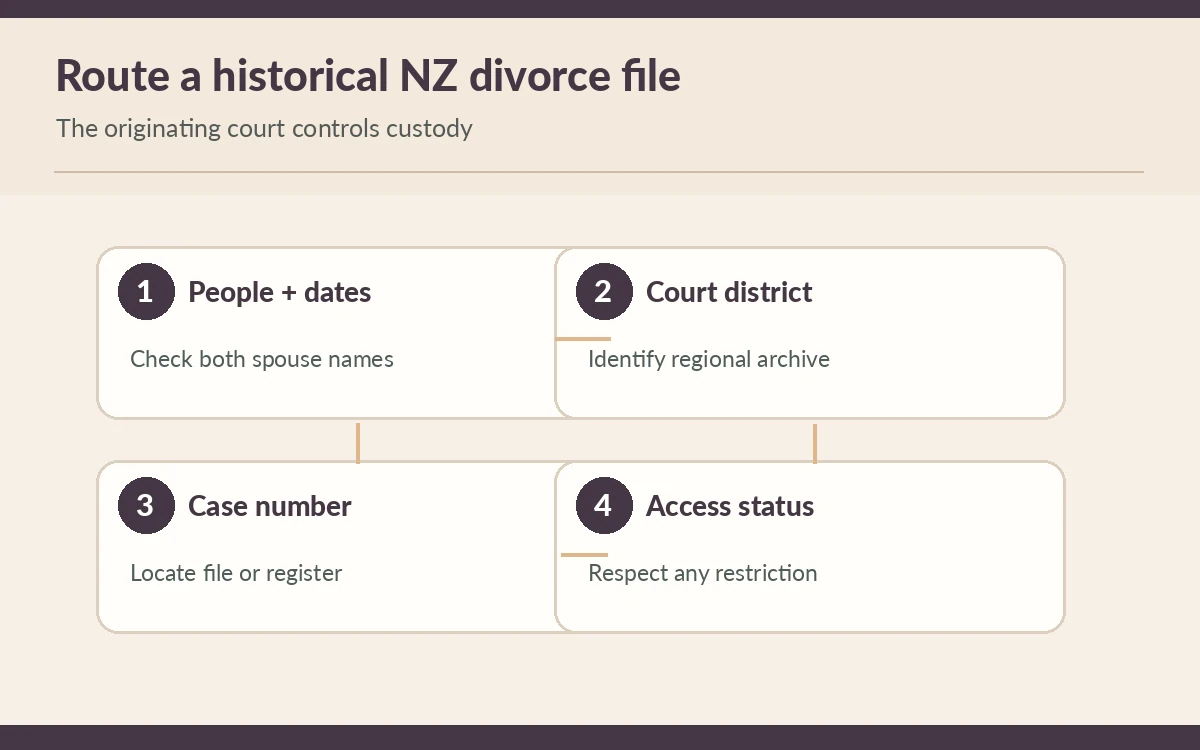
Archives New Zealand identifies its Auckland, Wellington, Christchurch and Dunedin archives as repositories for regional historical divorce papers. The originating court and record date determine custody. Its Collections search can list files by the couple’s names, so search both spouses, then record the precise court and file number. A name result alone is not proof that the same couple is involved. Inspect the description’s date, court, other party and record type. For the same kind of choice in another place, see our guide “NSW Divorce Case Papers, 1873–1923”.
For a case whose file is not returned by name, the Archives’ general guidance describes use of a divorce file number and the National Index of Divorces kept at Wellington’s High Court. The procedural route depends on when the case was heard. Do not substitute a broad modern court search for the relevant historic archive, and do not assume that every pre-1981 file has already been transferred or digitized. For the same kind of choice in another place, see our guide “Queensland Divorce Petitions, 1861–1894”.

Read petition, decree nisi and decree absolute separately
The petition is an initiating court document; it sets out a claim, not an independently established fact. Supporting affidavits, correspondence and responses can present conflicting accounts. A decree nisi records a stage in the proceeding, while the decree absolute establishes that the dissolution became final. Archives New Zealand explains that some files contain a decree nisi stamped to confirm finalisation rather than a separately obvious decree absolute document. Look for that final annotation and its date. Our guide “New Zealand Probate Records” covers how to find wills and unindexed court files.
A case that was begun but withdrawn, dismissed or never finalized should not be listed as a completed divorce. If a database calls a folder a ‘divorce file’, inspect the actual orders before changing a person’s marital status in a family tree. When the decree is absent, preserve the distinction between ‘proceedings found’ and ‘dissolution proven’. It is better to describe an unresolved court process than to invent its outcome.
Use historic registers when the file cannot be located
Archives New Zealand’s Auckland research guide lists historical divorce registers, files and minute books by court and series. Registers may summarize filings, dates and procedural stages even when the full file is missing or inaccessible. A register entry is a separate source with different information from a petition or decree. In an archive catalogue, identify whether the result is a register volume, minute book or file, and cite what you actually examined.
A case may have proceeded under a new number if earlier proceedings ended and were later restarted, according to Archives New Zealand’s identity guide. Preserve each number with its own dates and parties. Do not merge two files only because the same couple appears. Where the regional court or record group is unclear, ask the archive with your evidence and any known file number rather than guessing a catalogue item reference.
Follow the documented restriction rather than assuming access
Archives New Zealand’s current guidance describes a 100-year restriction from file closure for divorce files and a requirement for appropriate permission to view a complete restricted file. Whether a specific item is accessible depends on its own dates and conditions, not simply the word ‘historical’ or the year the petition was lodged. Check the item’s access field before placing a request. An open register can have different restrictions from the associated file. Our guide “New Zealand Register of Aliens, 1917” goes into more detail.
Do not recommend circumventing restrictions, using another person’s identification or publicly reproducing names from a closed case. The archive explains that copies of particular decrees and access to whole files have different procedures and documentation requirements. Prices and processes can change, so consult the current official page before ordering. Researching an ancestor does not automatically provide the legal right to view sensitive evidence about other people.
| Record or clue | Best use | Limit to remember |
|---|---|---|
| Petition | Shows proceedings began | Claims may be contested |
| Decree nisi | Shows intermediate order | Not always final |
| Decree absolute | Establishes final dissolution | Check date and parties |
| Register | Find case progress and number | May omit full evidence |
Separate allegations, testimonies and verified findings
Divorce files can describe occupations, addresses, children, marriage details and allegations about conduct. These are valuable clues but may derive from competing parties and need careful attribution. A petitioner’s statement about a date or another person’s behavior is evidence that the statement was made, not necessarily proof it is true. Keep a claim-level ledger: who said it, in which document, at what stage and whether another original source supports the point.
If a case names children, do not assume every named child was a biological child of both parties. The court’s immediate legal purpose is not the same as a genealogical proof exercise. Historical forms may contain graphic, defamatory or hurtful language. Quote sparingly and avoid linking unverified allegations to the identities of living descendants. A final decree establishes legal status, not the truth of every assertion in the preceding petition.
Test a fictional pair before assigning the file
Imagine a fictional Alice and Robert Fraser mentioned in a family recollection about a 1905 divorce, while Archives NZ lists a Fraser versus Fraser file from 1906. Verify the first names of both parties, place of marriage when supplied, court location and documented occupations against an independent marriage entry. Do not assume the one-year difference is a transcription error; it might reflect petition versus final decree dates, or a different couple entirely.
After identifying the file, check the last legal order instead of using the petition date as the dissolution date. If only a decree nisi survives in the file description, look for an appropriate final stamp or independent civil notation. The example names and events are invented to show an identity check. It is not evidence that a real Fraser couple divorced in that period.

Cite the court file and final order precisely
For an original document, retain the court creator, parties as styled in the record, file number, series or archive reference, item date, individual document title, page or folio and Archives NZ location. Cite a register independently if it provided a clue; do not present a catalogue index as if you inspected the full petition. Specify the decree’s effective date separately from filing, hearings or a later certificate copy date.
An appropriate conclusion might be ‘a petition was filed in 1905; final dissolution not yet established’ or ‘a decree absolute dated 1906 appears in the inspected file’. Where access is restricted, record the restriction and what can be verified from an open source. Respect court permissions and do not create public biographical content about allegations or private individuals solely from an archive search result.
How We Research Historic Divorce Court Files
We checked Archives New Zealand’s current divorce record page, its life-events research guide and the Auckland regional series guide. Our procedural discussion deliberately distinguishes a petition, a conditional order and final dissolution; the privacy rule refers to file closure and must be verified per item. Alice and Robert Fraser are fictional. No private file was accessed and no restricted-person details are reproduced.
More Records and Archives Guides
Original Records and Repository Guidance for Historic Divorce Court Files
Archives NZ: finding files, pre-1981 location, file numbers, 100-year restriction and decrees (www.archives.govt.nz).
Archives NZ: petition versus decree nisi and decree absolute, regional search and privacy (www.archives.govt.nz).
Also, Archives NZ: Auckland and related court register series and historical access distinctions (www.archives.govt.nz).
Editorial disclosure: This article has no sponsored recommendation or paid affiliate placement. Our site-wide policy is explained in the GenHis affiliate disclosure. Historical records are imperfect and access restrictions can change. Consult the original record, avoid unsupported accusations and protect personal information about living people.
No. Confirm a decree absolute or appropriate finalization annotation.
An intermediate court order; it is not always evidence that the marriage was finally dissolved.
Archives NZ regional branches hold transferred files from their courts; some records remain with courts.
Check the closure date and item-specific access conditions; current rules require permissions for restricted files.
Check variant names, court and dates, then use the relevant file-number and archival guidance.