
To locate a historic divorce in Victoria, choose the correct Public Record Office Victoria search route before entering a name: Melbourne cases from 1861–1942 can be searched by surname; Melbourne cases from 1943–1950 require an index lookup for the case number; regional cases from 1890–1950 have a separate surname search. Then inspect the cause book or case file and check whether the proceeding resulted in a decree. Filing a petition is not the same as a completed divorce.
Know what Victorian divorce records cover
Public Record Office Victoria describes divorce files and cause books for 1861–1950, with records from Melbourne and regional courts including Ballarat, Bendigo and Geelong. This is a historical court-record route, not a search of modern family-law matters. State Library Victoria notes the legal significance of the Divorce and Matrimonial Causes Act in 1861 and the later transfer to Commonwealth family-law courts. Before searching, write down the approximate year and whether the couple lived in Melbourne or a regional jurisdiction. Do not assume the petition was filed where the marriage occurred; a court venue is a legal fact to verify, not merely a family residence. Our guide “Victoria Wills and Probate Files” adds more detail on this.
Choose one of three PROV search paths
PROV explicitly separates Melbourne divorce cases for 1861–1942, Melbourne matters for 1943–1950, and regional divorces for 1890–1950. For earlier Melbourne cases, surname is the initial search key. For 1943–1950 Melbourne cases, researchers must find the case number in the original or digitized index before entering case number and year. Regional cases have their own surname box. Run the likely route first, but check alternatives if the couple moved. Avoid treating a missing result in the first box as a comprehensive negative search across Victoria. Save the exact search parameters and case number. Our guide “Victoria Insolvency Records, 1842–1928” shows how to find a case and read its debts.

Use cause books as the navigation layer
PROV identifies VPRS 5334 Divorce Cause Books, 1861–1950, and related court books. A cause-book entry can guide you toward a named proceeding and a file identifier. Read the index heading, date, parties and role labels as they appear; do not assume OCR or database transcriptions are perfect. If a common surname yields multiple proceedings, capture each possible case rather than importing every result into a family tree. A cause-book reference helps locate a court record, but may not supply every fact about a marriage, children or final decree. Note whether you viewed the original image or a typed extraction.
Inspect the petition and other filed papers
The archive says a case file may include the petition, affidavits, an answer by the respondent or co-respondent, court orders concerning costs and a praecipe associated with a formal decree. Not every file contains every paper. A petition explains an allegation and legal claim; an affidavit records someone’s sworn account; a response may dispute it. Historical court pleadings can contain intimate, stigmatizing or inaccurate assertions. Transcribe relevant statements neutrally, note who made them and when, and do not repeat sensational accusations as established truth. Privacy and reputational care remain important, especially for living descendants. If you want the full process, read how to find historical U.S. court records for genealogy.
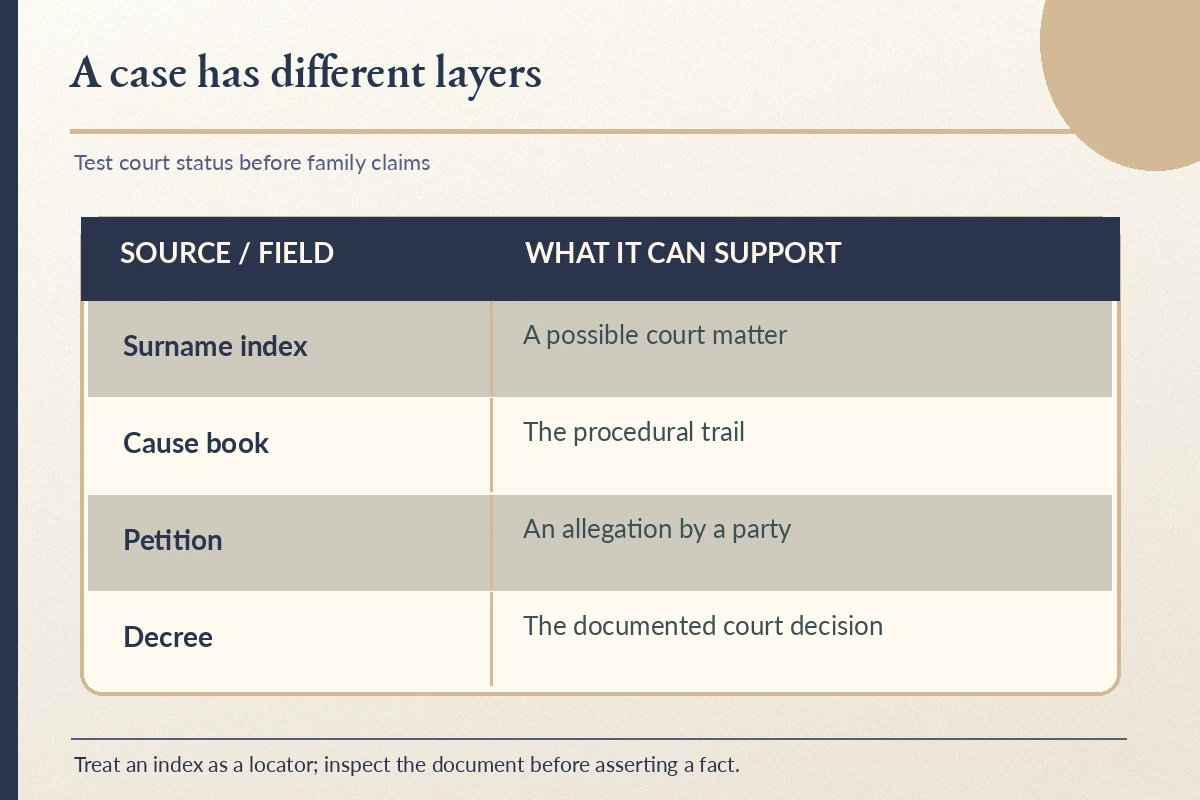
Distinguish a filing from a final outcome
A filing date proves a case entered a process, not necessarily that a marriage ended. PROV explicitly cautions that some cases were withdrawn before hearing or settled in other ways. Look for a final order or documented decree and identify its date and terms; do not infer a decree from a petition, a cause-book listing or a newspaper summary. If the file lacks a final disposition, search the linked court minute or jurisdiction book as directed by the archive. Even a documented divorce does not by itself establish a later remarriage; that event must be verified separately with a marriage registration.
Search carefully for the right two people
Historical surnames, initials and given-name variants can mislead. Search either spouse’s surname, as PROV recommends, then cross-check the respondent and petitioner, approximate marriage, residence, and independent evidence of the couple’s identity. Someone appearing as a co-respondent is not automatically a spouse or a confirmed partner. Where two couples share names, compare dates, addresses and surviving civil registrations rather than merging identities based on a single online result. Keep each candidate’s case number separate. A woman may appear under a married name, but do not assume a particular name change without documentary support.
Try a hypothetical allegation-versus-decree audit
Consider a fictional couple, Helen and Robert Price, who appear in a Melbourne divorce index. The petition accuses one party of misconduct; a newspaper notice mentions the filing; the cause book points to later activity. Record the petition as an allegation by a named litigant and the newspaper as a secondary report. If no decree has been located, the status is pending or unresolved for research purposes—not divorced. Only a court’s final judgment justifies a claim that the decree occurred. These names and details are teaching devices, not quotations from an actual Victorian case.

Use newspapers as leads, not replacements
Victorian newspapers may report hearings and orders, and State Library Victoria specifically recommends searching historic newspaper collections, including Trove. A published account can provide a date, court venue or variant spelling that helps relocate a case. It cannot replace the official court outcome, and press coverage may be selective or sensational. Search by both spouses’ surnames and court venue, then compare the article date to the court record. Preserve the issue and page. If a newspaper declares a divorce but the located file lacks a decree, describe the conflict and seek the minute book rather than silently siding with the press.
| Source | Records | Still to verify |
|---|---|---|
| Surname index | Possible litigants and case | Correct same-name couple |
| Cause book | Court number and progression | Original filed allegations |
| Petition / affidavit | Statements by parties | Independent truth of assertions |
| Final decree | Court outcome if present | Subsequent remarriage |
Build a case-level evidence worksheet
Make columns for names as written, procedural role, case number, jurisdiction, date, document class, claim and outcome status. Separate direct court actions such as orders from testimony about past events. Use one source citation per claim and distinguish original images from transcript indexes. PROV’s civil-court topic listing identifies several relevant series, but not all material is automatically viewable from home. Note whether an item can be ordered or inspected in a reading room. For a family narrative, quote sensitive passages sparingly, avoid details about living individuals and remember that legal proceedings can be incomplete. To go further, our guide “Victoria Petty Sessions Court Registers” shows how to find and interpret a case.
Write a conservative conclusion
An appropriate conclusion might read: “A divorce petition naming these two people was filed in a Melbourne court in the reported year; a final decree has not yet been confirmed.” If a decree exists, cite the actual court order or relevant cause-book entry and state its date. Do not claim an earlier marriage never occurred, that a spouse was unfaithful or that either person subsequently remarried without additional evidence. Record the exact VPRS series, case number, item, page and repository. The UVU is the proof gate between allegations, court navigation and final status, rather than simply a list of divorce-search websites. For the fuller picture, see our guide “Victoria Inquest Files, 1840–1985”.
How We Research
We checked the current PROV divorce files and cause books guide against State Library Victoria’s specialist divorce-record instructions, PROV’s broader court-series catalog and the National Library’s family-history overview. The three search routes and the year 1943 index-number exception are drawn from the archive, not guessed. Helen and Robert Price are fictional. Our article-level fact check preserves the central distinction between statements in a petition and an actual court decree. Readers should recheck PROV access and protective restrictions before quoting sensitive cases.
More Records and Archives Guides
Primary sources and official archival guidance
PROV defines record ranges, Melbourne and regional search routes and the nature of court files (prov.vic.gov.au).
State Library Victoria explains the historical divorce system, cause books and search indexes (guides.slv.vic.gov.au).
PROV lists divorce series among civil and other noncriminal historical court holdings (prov.vic.gov.au).
National Library of Australia distinguishes historical divorce holdings from civil BDM sources (www.library.gov.au).
Independent historical commentary, not legal advice. No affiliate or sponsored links are present. Court allegations may harm reputations if repeated without attribution; do not reveal sensitive information about living people. See GenHis affiliate disclosure.
PROV and State Library Victoria describe historical Victorian divorce records beginning in 1861.
For 1943–1950 Melbourne matters, first find the case number in the relevant index, then search by case number and year.
Yes. PROV provides a regional surname search for cases dated 1890–1950.
No. Some proceedings were withdrawn or resolved without a final divorce decree.
Not automatically. Petitions and affidavits contain statements that must be attributed and corroborated, rather than presented as unquestioned fact.