
Victorian land selection files can connect a person to an application for Crown land, a particular allotment, payments, improvements and sometimes later transfer or purchase. The most reliable route begins with the historical parish and allotment rather than a surname-only search. Locate the Crown description on a parish or township plan, record any land selection file number and identify the applicable land district and series. For selections under sections 19 and 20 of the Land Act 1869, PROV describes files in VPRS 625 and later district-organized VPRS 626. These records concern land administration, not proof that an application succeeded, that an applicant lived there permanently, or that a parcel became private freehold immediately.
Locate the historical parish before guessing a file number
Begin with the property’s present locality, likely nineteenth-century parish, and the period when a selection took place. Public Record Office Victoria (PROV) recommends searching parish and township plans by place name using its Map Warper or plan finding tools. These cadastral plans show allotment boundaries and Crown descriptions, and can carry names and references to associated files. Record the plan title, its date or edition, section and allotment numbers and any marginal annotations. Some parishes use multiple sheets or successive editions; a grantee noted on a later plan may not be the original selector in your target year.
Understand what sections 19 and 20 of the 1869 Act meant
The land files associated with sections 19 and 20 describe an administrative path from selection and licensed occupation toward possible lease or purchase, subject to statutory conditions. Contemporary claimants might be required to improve land and meet payment rules. The existence of a selection application is therefore an event at the beginning of an uncertain process, not a certificate that title passed. Note whether your document is an application, agreement, inspection report, payment record, transfer or final grant. If the file covers multiple applicants or later tenants, separate each person’s dated role before assigning a family property.
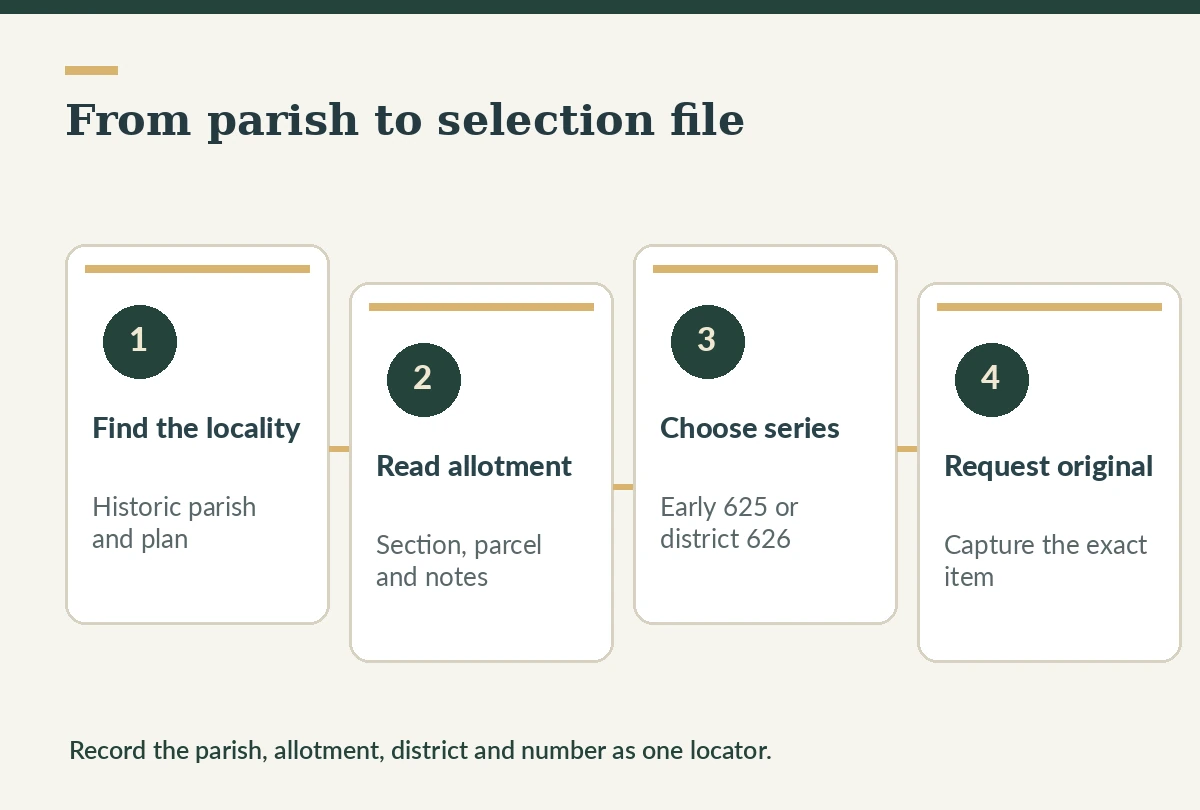
Route 1870–1874 files to VPRS 625
PROV’s historical lands research identifies VPRS 625 for land selection files under sections 19 and 20 for the earlier period, approximately 1870–1874. When a parish plan gives a fractional file reference, copy all digits and the section marker exactly. Locate the matching collection description and check the file’s administrative date before deciding it belongs in this series. An archival series date span is a description of its known holdings, not proof that every application from that period survives. If the file is unavailable or undigitized, preserve the reference and follow the archive’s order or enquiry process. For a related choice, see our guide “Queensland Land Selection Files”.
Route later selections to the correct VPRS 626 land district
After the organization of land selection work by district in 1874, VPRS 626 is described as files arranged by Land District under the 1869 Act. The district matters because file numbers may repeat across districts: a fractional reference without the corresponding land district can point to the wrong parcel. Use PROV’s parish and township guidance to identify the land district applicable to the plan, then search the district with the selection reference and land section. Keep any subsequent administrative transfer or renumbering as a separate event. This district-first step is the article’s key safeguard against matching a relative to another selector’s file.
Read the fractional file number as an archival locator
A historical notation resembling 2098/19 can be a file number tied to a particular section of a land law, not a street number or lot number. Conventions varied across laws and periods, so use the record’s own register or catalogue description to interpret it. Record the number as printed rather than expanding it from memory. The number alone is insufficient without the parish, allotment and—where applicable—land district. Compare any similar reference on a later parish plan: a later file may document a different transaction, not necessarily a continuation of the same family’s original selection.

Build a land-selection event ledger, not a simple owner list
For each document record date, applicant or correspondent, administrative action, parcel description, payments or improvements when stated, file reference and evidence status. Some files include schedules of improvements, rent accounts, maps or correspondence that illuminate how a person attempted to hold or farm Crown land. Not all categories are present for every case. A payment is not necessarily proof of full title; a note about fencing or crops does not alone prove a permanent residence. Your evidence ledger should distinguish ‘applied,’ ‘licensed to occupy,’ ‘leased,’ ‘transferred,’ and ‘Crown grant recorded’ rather than flattening them into ‘owned.’
Illustrative case: one parish, two selectors
Imagine a fictional parish plan showing a numbered allotment with one early applicant notation and a later entry for a second person. A family story says the first applicant ‘owned the farm.’ Your next task is to find the selection file using the section reference and the correct land district; then look for a dated transfer, lapse, forfeiture or grant. If the first applicant paid rent but a later individual received the Crown grant, neither the family story nor the plan should be rewritten to erase the change. The example is invented to illustrate the reasoning, not an authentic parcel or person. Our guide “NSW Conditional Purchase Registers, 1862–1911” covers a related question.
| Finding | Supports | Still requires checking |
|---|---|---|
| Annotated parish plan | Location and file clue | Identity of every occupant |
| Selection application | Requested Crown land | Approval and final ownership |
| Rent or improvements | A dated administrative action | Permanent farm residence |
| Crown grant evidence | Recorded initial alienation | Later title transfers |
Corroborate ownership with grants and other land evidence
A recorded Crown grantee on a suitably dated plan supports a different claim from the selector applicant named in a preliminary file. Where legal ownership matters, compare formal Crown grant or later title references as appropriate, and account for surveying or legal changes. Council rate books can suggest an occupier or rated owner, but they use different administrative definitions and can reflect a tenant. An agricultural schedule may describe work without establishing who held title. This careful separation reduces the common genealogy error of treating every ancestor listed near an allotment as a proprietor or family member.
Recover missing files without inventing an ownership story
If no matching file appears, reconfirm the parish spelling, historic district, land law section, archival numbering and plan edition. A locality could change administrative district while the underlying allotment remains in place. Check whether another plan copy holds a clearer annotation, and search the relevant applications register or the related collection family. PROV advises that many land records are more effectively searched by location than individual names. Log each failed series and reference, and ask the archive a narrow question using the plan and file number. An unsuccessful online search does not prove a landholding never existed.

Cite the plan and selection file as separate sources
A sound citation identifies the map’s series, parish, plan number or edition, the particular allotment and its annotation; then cite the selection file by VPRS series, land district, file number, dates, item and access platform. Do not use one plan citation to support a supposed sentence found only in correspondence. For disputed assertions, show a simple chronological chain of original documents and mark any gaps explicitly. If a file’s handwriting is ambiguous, preserve an image and a literal transcription separately from an interpreted modern location name. This makes the family land account reproducible.
How We Research Victorian selectors’ records
We compared PROV’s current parish-plan and land research guides with its published archival explanations of selection records and the roles of plans. We separated the recorded series distinctions from workflow advice and invented the example solely as an illustration. File survival, digital availability and copyright permissions can differ by item. The two-series route applies to the stated 1869 Act sections, not every Victorian land transaction; unrelated Crown schemes need their own series choice and cannot safely be routed by this simplified decision aid.
More Records and Archives Guides
Victorian Crown land selection and parish-plan guides
PROV instructions for finding parish or township plans, Crown descriptions and annotations pointing to later land files (prov.vic.gov.au).
PROV statewide land-and-property research guidance explaining location-first searches and archival file types (prov.vic.gov.au).
Also, PROV historical research on selectors under the 1869 Act and the evidence retained in selection files (prov.vic.gov.au).
PROV archival account of parish plans and their role in tracing Crown land selection references (prov.vic.gov.au).
Editorial and affiliate disclosure: GenHis is an independent family-history publication. No archive or government agency has sponsored or endorsed this article. Historical records can contain sensitive or inaccurate personal allegations; apply repository access rules and verify claims before sharing them. Our affiliate disclosure explains our approach to commercial links; none of the archival citations here implies an affiliate relationship.
Start with the historic parish plan, Crown allotment description and any file number; then route it to the relevant PROV series.
VPRS 625 relates to earlier 1869 Act selection files; VPRS 626 organizes later sections 19 and 20 files by Land District.
File numbers can recur in different districts, making a number alone an unsafe identification.
Not by itself. An application or occupation licence must be distinguished from the later Crown grant and any title transactions.
Not reliably. It can identify a land transaction or file reference, but kinship requires independently supported connections.