
Historical New Zealand primary-school admission registers can identify a pupil’s reported birth date, admission date, parent or guardian, address and progress through a school. The strongest search begins with the school’s historical name, approximate attendance years and responsible Education Board—not just the student’s surname. Archives New Zealand holds many Education Board records but does not have a complete run for every school: some records stayed with schools or moved to libraries and museums. The archive’s Education guide describes registers of admission, progress and withdrawal alongside other class lists. Treat a school entry as evidence of what an administrator recorded, not automatic proof that the stated adult was a biological parent or that every date was independently certified.
Identify the school in the right historical district
Begin with a family residence, approximate enrollment year and the most likely public primary school. A school could change name, merge, move, or close, and the Education Board boundary relevant in one decade may not reflect the modern region. Archives New Zealand explains that the Education Act 1877 established a regional board system; school records were largely administered by those boards until their abolition in 1989. Check old street directories, regional histories or education reports to locate the school and its historical name. Make a working note of the board rather than assuming every school item is cataloged by the pupil’s name.
Search the Education Board before the pupil surname
Archives New Zealand holds many regional board records in its Auckland, Wellington and Christchurch archives, alongside some school transfers. Its Education guide says holdings are not comprehensive and that some school archives remain with local institutions. Search the archive’s Collections catalog using the school name and board identifier, then look for register or class-schedule series. The archived record may be listed by school and date range with no student-level name index. Record the collection, series and box or volume even when no online images are attached. Without this location step, a failure to find a name is not evidence of nonattendance.

Read an admission, progress and withdrawal register
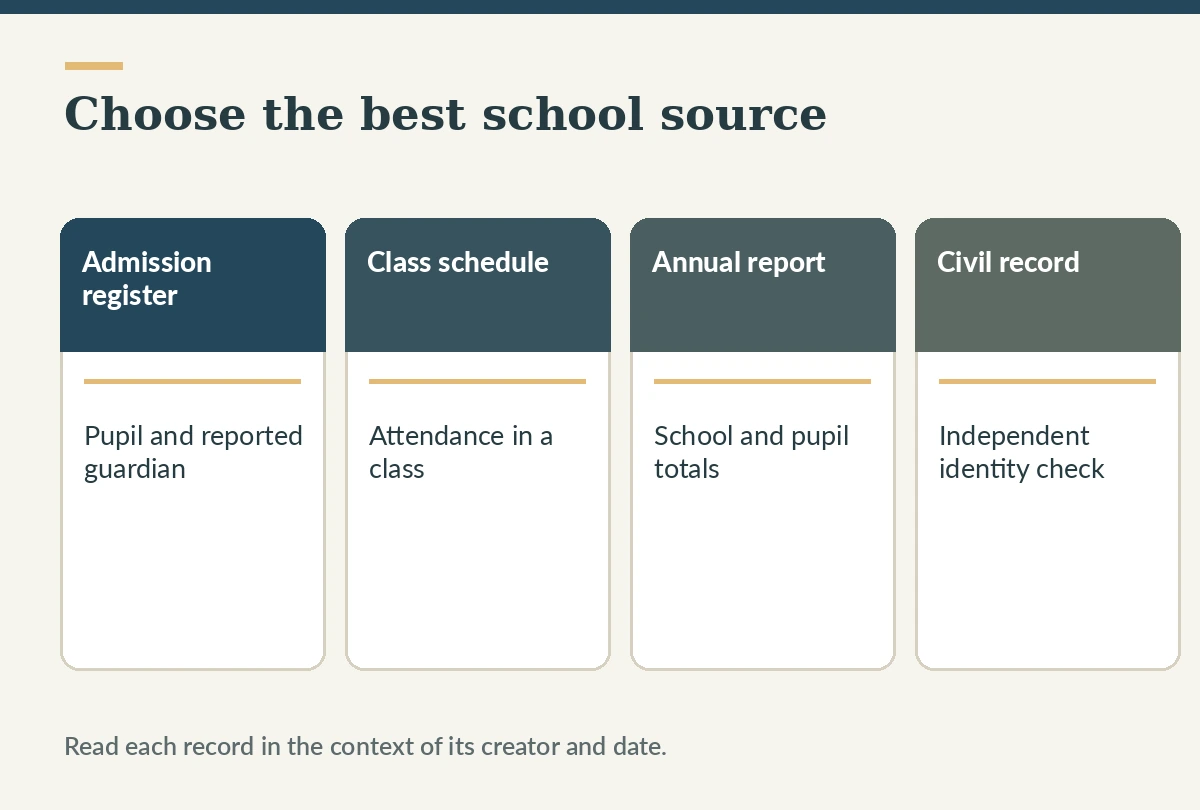
The common Register of Admissions, Progress and Withdrawal may record the pupil’s reported birth date, admission date, name and address of a parent or guardian, successive school classes, and sometimes preceding or next school. Transcribe all column headings from the actual register before extracting facts. A guardian listed at an address may be a foster parent, relative, employer or legal caretaker; do not label that adult the child’s biological parent without another source. A date of birth could be supplied by the household rather than checked against a civil certificate. Compare it with a birth registration or baptism when a precise date matters.
Use class schedules when a register does not survive
Archives New Zealand describes classification lists, examination reports, class and school rolls, inspection returns and proficiency schedules among the annual school records. These often identify pupils and classes, sometimes ages, teachers or marks, but do not always contain addresses or guardians. For a child known to be at school in a particular year, a class list can be a valuable corroborating snapshot. It should not be written up as a full admission record if it lacks the required fields. Note whether the document concerns a classroom, a whole school or an examination cohort, and use each period’s grading terminology without translating it into a modern credential. For a comparable plan elsewhere, our guide “Tasmania School Admission Registers” shows how to find pupils and schools.
Understand regional gaps and alternative repositories
Archives New Zealand notes that its Dunedin archive does not hold the Otago Education Board collection: relevant Otago records are at the Hocken Library, while Southland Education Board records are at Invercargill Public Library. This is an important custody difference, not a general statement about every southern school. Some independent or religious school records are held elsewhere, and only small amounts of early provincial pupil information survive. If a national catalog search fails, identify the school creator and check the correct regional archive, local museum, current school or successor. Ask whether a register exists and whether access is permitted before requesting personal details.
Use the 1878–1924 education reports as a school locator
The Archives New Zealand guide points to annual Education Department reports in the Appendices to the Journal of the House of Representatives for 1878–1924 as a way to identify schools, teachers and pupil numbers. These reports can confirm that a school existed in a district at the time a family lived there, but summary enrollment figures do not name the child. When the reported school name differs from a later local history, record both and identify the dated source. Use the report to narrow a repository search rather than to infer that a child attended simply because the household lived nearby. Our guide “Victoria School Pupil Registers” covers a related question.
Illustrative entry: guardian is not proof of parentage
In a fictional 1902 register example, a pupil named E. Bennett is admitted to a school and an adult with a different surname is listed as guardian at a nearby address. A later family history calls that adult the child’s mother. The register supports an administrative guardian relationship at the reported date, not the biological relationship. Seek birth registration, civil marriage, guardianship or independent household evidence before adopting that explanation. An additional school transfer entry may help trace residence without answering the parentage question. This example is deliberately fictional, not a description of an actual pupil file.
| Document | Useful clue | Do not infer |
|---|---|---|
| Admission register | Pupil, date, reported guardian | Biological parentage |
| Class schedule | Class and reported age | Full enrollment history |
| Education report | School existed in that year | That a specific pupil attended |
| Transfer notation | Reported next school or address | Confirmed family migration |
Treat sensitive student information and access carefully
School records can contain personal or potentially sensitive information, especially when they extend into the period of people who may still be alive. The archive has specific access arrangements for some educational collections, and permission may be required. Follow restrictions and do not attempt to identify living pupils in closed volumes. Archives New Zealand also warns that some older collections contain offensive historical terminology, including in Māori school records. Reproduce only necessary wording with appropriate contextual framing; do not treat colonial administrative categories as accurate statements of identity, whakapapa, or cultural affiliation. Our guide “New Zealand Census Records” goes deeper into why household returns are missing and what to use.
Confirm a pupil across school and civil records
Build a dated matrix with school name, exact pupil name, reported date of birth, guardian, address, admission and withdrawal date, and the original source reference. Compare these clues with civil registration, local directories, a family letter or another class schedule. A pupil moving between two schools can be a hypothesis for a family migration, but a transfer notation should be checked for the names and dates it actually supplies. Do not equate an omitted next-school column with the child leaving education entirely. Retain separate candidates when siblings or cousins share similar names. For a comparable plan elsewhere, our guide “South Australia School Admission Registers” shows how to find pupils and families.

Cite the volume, not only a search-result title
A recoverable citation identifies the school and creating Education Board, register or schedule title, date span, original page and admission number where present, archival series or accession, repository and image or reading-room reference. Include the literal name on the page and a separate note for the spelling you use in a family tree. If only a catalog entry was consulted, say that the register’s availability was located but no pupil information was verified. For a lineage conclusion, point to independent evidence linking any named guardian to the child’s parents. This preserves the difference between discovery and proof.
How We Research New Zealand education archives
We checked Archives New Zealand’s Education guide and its digitization descriptions against current Ministry of Education guidance about permanently retained school registers. The research route separates institutional custodians from evidence actually written in a particular pupil entry; the hypothetical example is not a historical transcription. Online availability and privacy status depend on the item, not a universal open date for every school. Where records concern Māori schools, the archive’s warnings and community context require additional care before sharing sensitive genealogy.
More Records and Archives Guides
New Zealand Education Board and school-register guides
Archives New Zealand guide to historical Education Board holdings, pupil registers, class schedules and incomplete survival (www.archives.govt.nz).
Archives New Zealand description of selected digitized Māori school records and the register series among them (www.archives.govt.nz).
New Zealand Ministry of Education guidance on permanent retention of school admission, progress and withdrawal registers (www.education.govt.nz).
Editorial and affiliate disclosure: GenHis is an independent family-history publication. No archive or government agency has sponsored or endorsed this article. Historical records can contain sensitive or inaccurate personal allegations; apply repository access rules and verify claims before sharing them. Our affiliate disclosure explains our approach to commercial links; none of the archival citations here implies an affiliate relationship.
Archives New Zealand holds many Education Board records; some are instead at schools, local libraries, museums or regional repositories.
Often yes, but treat it as reported information and corroborate it with civil records.
No. The adult’s exact recorded role must be respected and any biological relationship independently established.
Search its Education Board, school name and register series; the volume may be organized by school and years rather than pupil name.
No. Access conditions differ by record and date, especially where personal student information is involved.