
Tasmanian school admission registers can document an ancestor at a particular school on a particular date, but no single online index lists every Tasmanian pupil. Libraries Tasmania holds registers and other education records from schools throughout the state; its smaller education subset in the Tasmanian Names Index represents only specified schools and years. The strongest search begins with either a known school or an independently documented town and attendance window, then follows the actual register rather than treating a search result as a complete history of the child’s family.
Begin with a school name and its historical locality
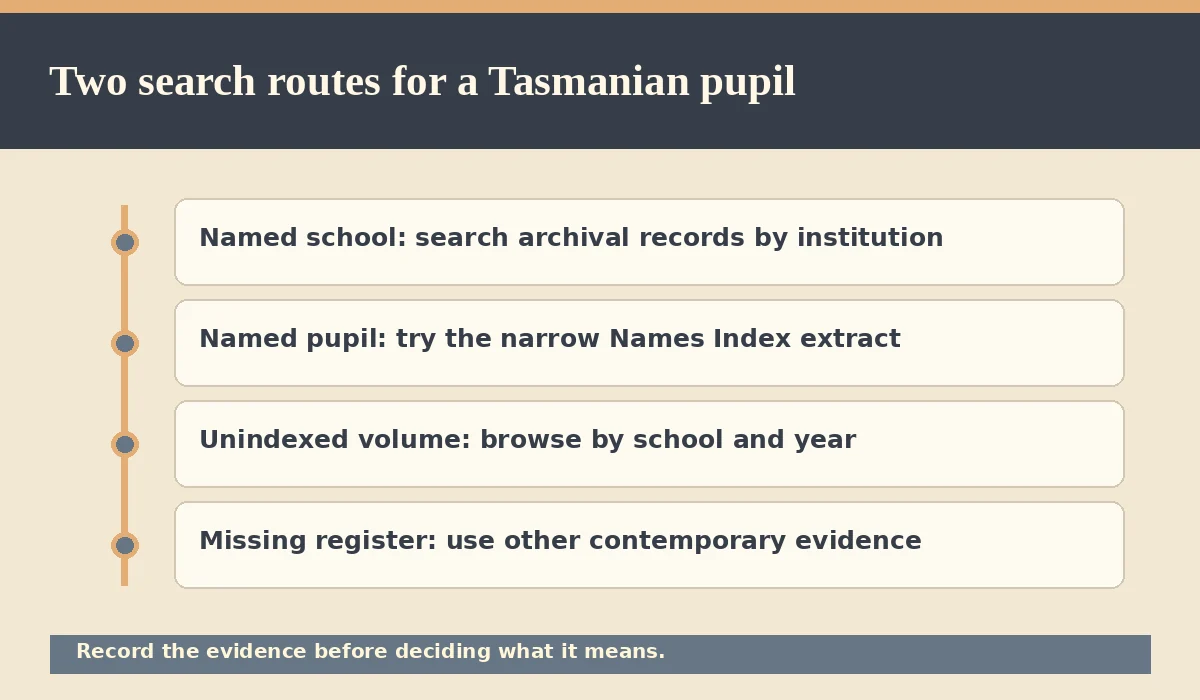
Collect clues from a family letter, residence record, newspaper prize notice or a later occupation file. Record the school name exactly as used at the time; a school may have been renamed, amalgamated or moved. Libraries Tasmania recommends searching a school’s name in its archives and reviewing the resulting records, including admission books and inspectors’ reports.
When you know only a town, research which schools operated there during the child’s school-age years. A nearby school today may not have existed at that date. Keep public, private and denominational schools distinct, since their records may be held by different institutions. Do not infer that a pupil attended a particular school simply because the family lived close to its site.
Understand what the Tasmanian Names Index does and does not cover
A Libraries Tasmania data description calls its 1846–1908 education subset a record set derived from early Hutchins School admission registers and Charles Street Primary School entries. It contains more than 1,400 indexed records. That is a useful shortcut for people represented in those specific collections, not a statewide pupil index for the nineteenth century. For a comparable plan elsewhere, our guide “New Zealand School Admission Registers” shows how to find pupils through education boards.
Search variant spellings and partial names, then capture the original register link or archival identifier shown by a result. A no-hit result may mean the school is outside the indexed sample, the record has not been digitized, the name was recorded differently or the entry did not survive. Move to a school- or series-level search before deciding that the person did not attend school.
Find an original register through the archives catalogue
Libraries Tasmania provides separate search routes for archival records, the Names Index and its library catalogue. Use the Archives tab or a series search when you want the underlying admission book, not a printed school history. Identify the creating school or education office, the date span, the series or item number and whether a digital image, microfilm or reading-room order is offered. Our guide “Tasmania Queen’s Orphan School Records, 1828–1879” goes into more detail.
An archive catalogue description may summarize a volume with hundreds of pupils, and it may not list them individually. If the volume is not searchable by pupil name, use the expected year to locate a page or chronological run of admissions. Keep track of dates browsed and the actual format used, because an archived book and its modern catalog entry support different statements.
Read guardian and transfer clues carefully
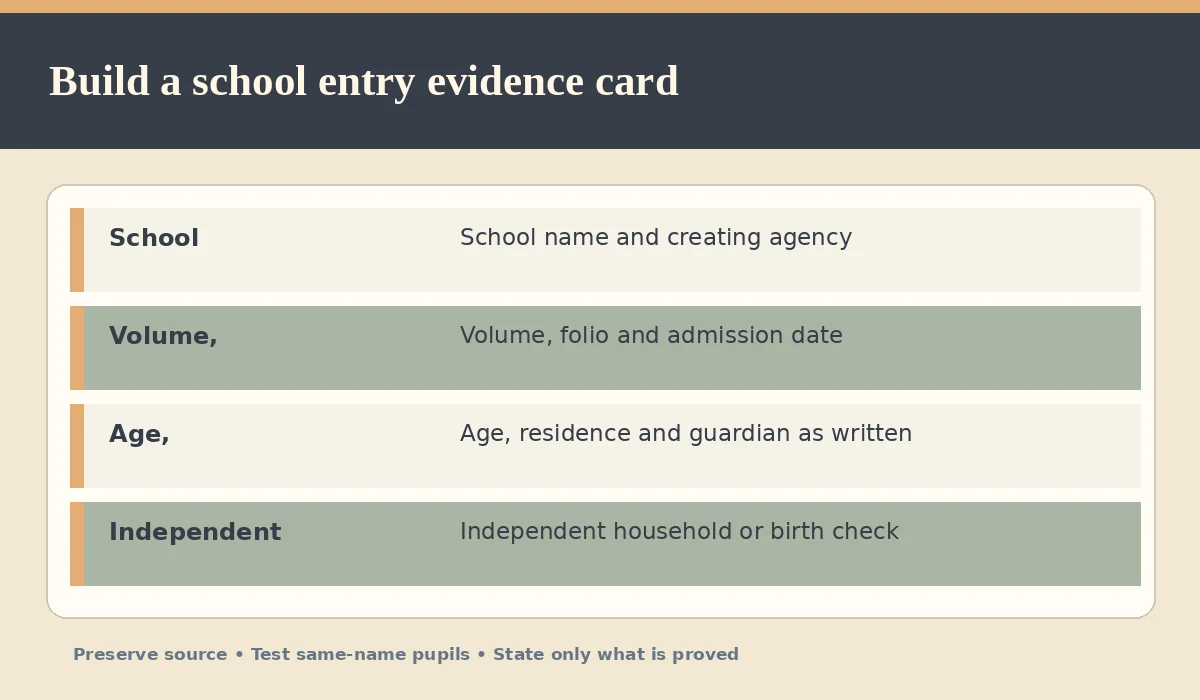
Depending on the school and volume, an admission register may include pupil name, admission date, age, residence, parent or guardian, previous school or leaving information. Do not assume that every register has all those columns. Transcribe the original heading before taking a name in a guardian column as evidence of a biological parent.
A guardian could be a relative, foster caregiver, employer or other responsible adult. Likewise, a previous school written in one entry might identify a transfer, but it does not by itself prove a residential move for the entire family. Check an independently dated census substitute, rate book, electoral source or civil record for context. Different ages across school years may reflect reporting, rounding or clerical error.

| Research checkpoint | Document a defensible observation | Do not assume |
|---|---|---|
| Admission date | attendance recorded on a date | The same-name index proves the complete event |
| Guardian name | not automatically a parent | The record proves a family relationship |
| Identity test | Match place, period and independent detail | A matching surname establishes the person |
| Coverage or access limit | Log missing years, item status and search route | A no-hit result proves nonexistence |
Use inspectors’ reports and teacher applications for different questions
Libraries Tasmania’s education guide also describes school inspectors’ reports for particular year ranges and teacher applications, some of which have digital access. Inspectors’ reports can help establish the operating condition, staffing or curriculum of a school, but usually are not full lists of the pupils who attended. Teacher applications document adults’ teaching careers, not a child’s enrollment.
Use those records when your question concerns the school environment or a teacher ancestor, not as substitutes for an admission entry. A school inspector’s favorable comment cannot establish a specific child’s academic achievement without the child being named. Label any contextual description as school-level evidence and avoid assigning it to a pupil’s personal biography.
Respect restrictions and reproduction conditions
Libraries Tasmania notes that an item may be open, restricted, digitized, microfilmed or available for reading-room order. Item-level restriction and copying conditions matter even when the school itself is historical. The institution’s school-research guidance explains how to request reproductions or permission to publish collection material; do not assume that viewing an image permits unrestricted republication.
Keep recent pupil information and personal details of living people private. When access is not open, use the archive’s stated request route rather than looking for circumventions or circulating copies of a restricted register. For an older open record, quote only what serves a specific historical claim and preserve the context of the page.
Separate two fictional pupils who share a name
Imagine a fictional Florence Reid admitted to a Hobart school in one year and another Florence Reid appearing at a different school several years later. A family-tree search might merge both. Make separate rows for each original entry with the register date, school, age, stated guardian and place, including all uncertainty from hard-to-read handwriting.
To test whether these are the same pupil, compare a civil birth record or baptism, dated household address and possible transfer entry. A plausible age progression is supportive but not sufficient. If one school’s guardian name conflicts with the independently known family, investigate care arrangements and namesakes without silently changing the child’s parentage.
Cite the book you actually consulted
For an original admission, cite Libraries Tasmania or the named holding institution, the school, volume title, admission date and pupil entry, series and item number, image or folio and access date. If only the Names Index entry is available, identify it as an index and note that the manuscript has not yet been inspected. Cite inspectors’ reports separately if used for background. If that is your next decision, our guide “Tasmania Assessment and Valuation Rolls” explains how to find owners and occupants.
Close with a one-sentence supported finding such as “the register records a pupil of this name admitted on this date,” then state whether the identity matches independent records. Log missing years, incomplete pages and the next source. This makes a narrow school record useful without claiming that it proves an entire childhood or family relationship. Our guide “Queensland School Admission Registers, 1878–2001” shows how to find pupil records.
How We Research Tasmania School Records
We checked the linked sources on 2026-10-22. Source descriptions are not a substitute for inspecting a specific original manuscript. The worked identities are fictional and intended only to show how to test a record. Rights, fees, privacy rules, digitization and finding aids can change: recheck item-level conditions when requesting or reproducing documents.
More Records and Archives Guides
Original Archive Finding Aids for Tasmania School Records
Libraries Tasmania identifies school admission registers, inspector reports and teacher applications as separate source categories (www.libraries.tas.gov.au).
The school research guide describes catalog searches, reading-room access, copies and citations (libraries.tas.gov.au).
Libraries Tasmania open-data description shows the Names Index education extract covers Hutchins School and Charles Street Primary School, not all schools (researchdata.edu.au).
The archives search guide differentiates Names Index, archival series and published resources and describes item-level restriction flags (libraries.tas.gov.au).
This guide contains no affiliate links. Respect restrictions on identifiable living persons, sensitive allegations and copyright when researching or sharing historical sources. See the GenHis affiliate disclosure for our site-wide link policy.
No. Its described 1846–1908 education extract includes specified Hutchins and Charles Street school records; other admission books require catalogue research.
Search Libraries Tasmania archives by the historical school name and check series-level admission register descriptions.
No. Fields vary, and a named guardian or responsible adult should not automatically be treated as a biological parent.
No. Some are online, others require microfilm, reading-room access or a reproduction request.
It can document a reported pupil connection at a date; longer residence and relationships need corroboration.