
Queensland State Archives has a school admission register inventory spanning 1878–2001, but that range is a description of holdings, not a promise that every school and every student is searchable by name online. A practical search starts with the name of a particular school, its locality and an estimated attendance window. Registers may include an admission date, a child’s age, parents’ or guardians’ names and a departure date, but the exact columns depend on the original volume. Preserve the admission number and image reference before deciding whether an entry belongs to your ancestor.
Identify the right school rather than only the pupil
Begin with a school named in a family letter, old photograph, report card or local directory. If the school later closed or changed its name, note the contemporary name and its locality. A suburb’s present school catchment tells you very little about the enrolment options of a family in 1905. Establish the child’s approximate age and years of residence, then select a plausible attendance window rather than searching every available decade.
State Library of Queensland explains that Queensland State Archives holds admission registers from state schools and that many have been digitized. The government open-data inventory describes the relevant 1878–2001 series and chronological admission numbers. Use that inventory to locate the *record set*, not to infer that a child is indexed merely because the school’s name appears there.
Separate the archive inventory from pupil indexes
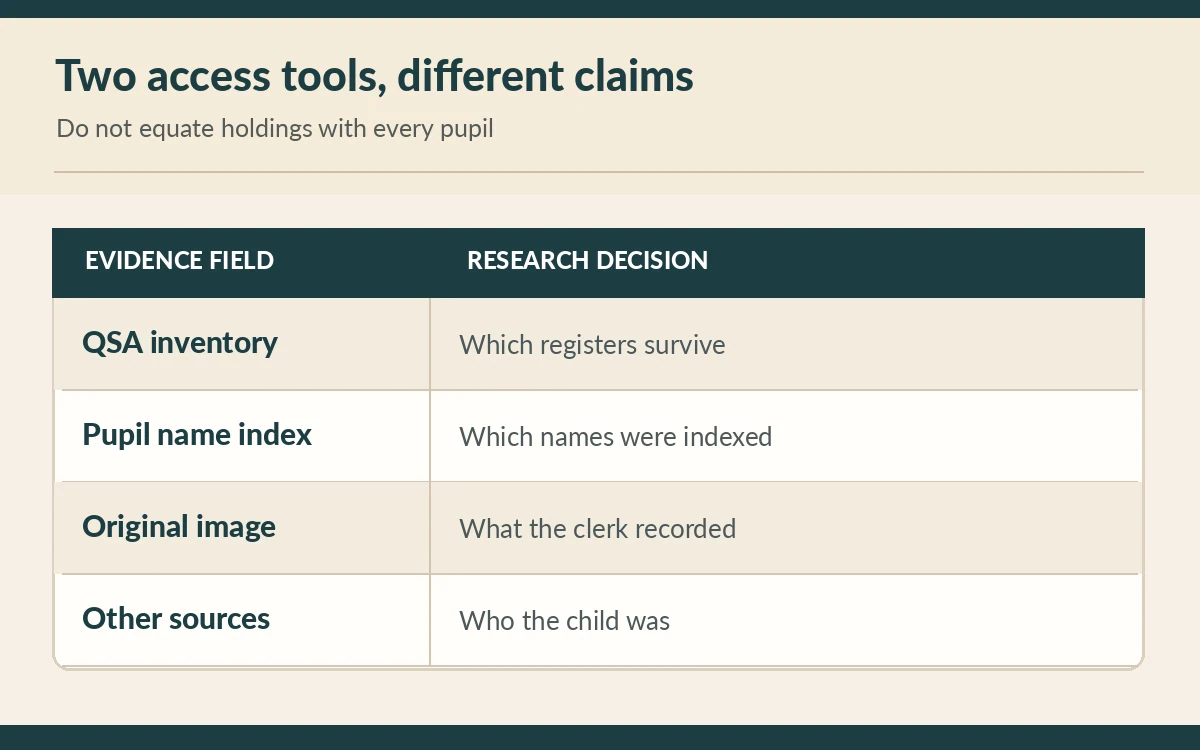
The Queensland government dataset compiles holdings of school admission registers. The separately published Queensland School Pupils Index draws names from several types of material, including school histories, anniversary publications and admission records, according to State Library guidance. A positive pupil-index result might therefore originate from a secondary commemorative publication rather than the actual administrative register. Capture what the result identifies as its source.
When possible, move from a name hit to the original school volume through Queensland State Archives’ catalogue. If the index gives a school and year but not an admission number, search the appropriate chronological volume rather than assuming a page number. Do not report that ‘all Queensland school pupils are indexed’; not every surviving name appears in every access tool.

Read the register entry field by field
A historical admission line may give the pupil’s name, date of enrolment, age or birth date, parent’s or guardian’s name, occupation, religion, address, date of leaving or later return. State Library notes these fields as possibilities, not an unchanging template across every volume. Record the actual headings and indicate blanks. Some registers use sequential admission numbers that can remain valuable even when page order or transcription is confusing.
Copy all entries for a child’s repeated admissions rather than choosing the first one. A child could transfer, return after an absence or be recorded under a spelling variant. Do not convert a school-reported birth date into a confirmed civil registration or treat a nominated guardian as an automatically proven biological parent. A school register is often a strong residence clue, but addresses and dates still need correlation.
Reconstruct a family move without inventing one
Imagine a fictional child, Edith Morgan, listed at one Queensland school in 1912 and at another in 1914. The dates can suggest a change in schooling; they do not, by themselves, prove that the entire family migrated together. Compare the named guardian, occupation, address and any date of withdrawal. Then seek a contemporary electoral roll, directory, birth registration of a younger sibling or other independently dated record in the second locality.
If the second admission carries a different guardian’s name, consider several explanations: a relative may have taken responsibility; an official may have entered an employer; or there may be a second Edith Morgan. Record all options until an independent source rules them out. The Edith example is fictional and should not be mistaken for a real pupil identified in the archives.
Use an admission number as a verifiable identifier
The government dataset says each chronological admission receives a sequential number. Record that number with the exact school and date; identical numbers in different schools are not evidence of the same child. Note the register’s start and end dates, which are often more informative than an index’s broad year range. Photograph or cite the source page only where permitted, including the header that explains the columns.
Keep a locator row with school name, historical location, register date span, admission number, page or image and repository reference. If the child’s name is common, add one or two independent identity features, such as age range and a guardian’s occupation, before declaring a match. This makes the search reproducible even if the archive’s online interface changes.
| Record or clue | Best use | Limit to remember |
|---|---|---|
| QSA holdings inventory | Find school and volume | Not a pupil-by-name census |
| Admission page | Date and school-level clues | Guardian is not always parent |
| Pupils Index | Discover possible names | Mixed underlying sources |
| Civil or residence record | Cross-check the family | Separate document required |
Diagnose an apparently absent pupil
A no-result name search can stem from spelling errors, indexing gaps, a privately operated school, an unknown school name or a child outside the surviving volume’s dates. Test those explanations separately. Search the school’s catalogued registers and browse the plausible chronological interval. Then examine local school histories or the Queensland School Pupils Index as *additional leads*, not as substitutes for the administrative entry.
If there is no matching volume, do not claim the child did not attend school. The State Archives inventory tells you which series it holds, not all educational records ever created. Queensland State Archives specifies a 15-year restricted-access period for school admission registers. Check the exact item and protect information about living people. Keep the tested school-year combinations in your research log.
Pair school information with stronger family evidence
An admission register can place a child in a locality at a particular time and may identify a responsible adult. For a parent-child relationship, compare the entry with civil certificates and household documents; for a family move, compare successive dated addresses or rolls. School histories and class photographs can support context but may not identify each individual with certainty. School terminology may also reflect historical exclusions or discriminatory practices.
Build a three-column table: literal register wording, what it directly documents, and what requires corroboration. For instance, ‘guardian: J. Morgan’ documents an entry using that label; it does not establish which J. Morgan was involved. If an occupation is reported, preserve historical wording rather than replacing it with a modern profession.

Cite the volume and protect pupil information
A useful citation names Queensland State Archives, the school and register series, the volume’s date span, page or admission number, digital image or catalogue reference and access date. A separate citation should document the Queensland School Pupils Index if it supplied the discovery lead. Without these details, another researcher may search the wrong school or another generation’s admission book.
School records can involve children, personal details and potentially living people. Follow current archival restrictions, avoid publicly reproducing sensitive pages wholesale, and share only the historical facts needed for a family-history conclusion. A missing birth date or guardian name must remain a blank, not an invitation to complete it from an unrelated family tree.
How We Research Queensland School Registers
We checked Queensland government’s admission-register inventory, the Queensland State Archives schools guide and the State Library discussion of the separately compiled Queensland School Pupils Index. We treat 1878–2001 as the holdings inventory period, not universal pupil-name coverage. Edith Morgan is a fictional example. For each real case, verify the school, date span, admission number and lawful access conditions.
More Records and Archives Guides
Primary Archives and Research Guides for Queensland School Registers
Queensland government open-data inventory of school admission registers 1878–2001 (www.data.qld.gov.au).
State Library: typical register fields, QSA digitization and separate Queensland School Pupils Index (www.slq.qld.gov.au).
Queensland State Archives: school records and related administrative collections (www.qld.gov.au).
Editorial disclosure: This article has no sponsored recommendation or paid affiliate placement. Our site-wide policy is explained in the GenHis affiliate disclosure. Historical records are imperfect and access restrictions can change. Consult the original record, avoid unsupported accusations and protect personal information about living people.
No. The government dataset describes register holdings rather than a complete statewide pupil-name index.
An entry within the relevant school register; it should be cited with the school, date and volume.
No. The named responsible adult may not have been a biological or legal parent.
Check the actual school catalogue and date span, spelling variants and other school histories.
Check archival access conditions and protect the personal information of living people.