
Choose the Correct Stockholm Population Source
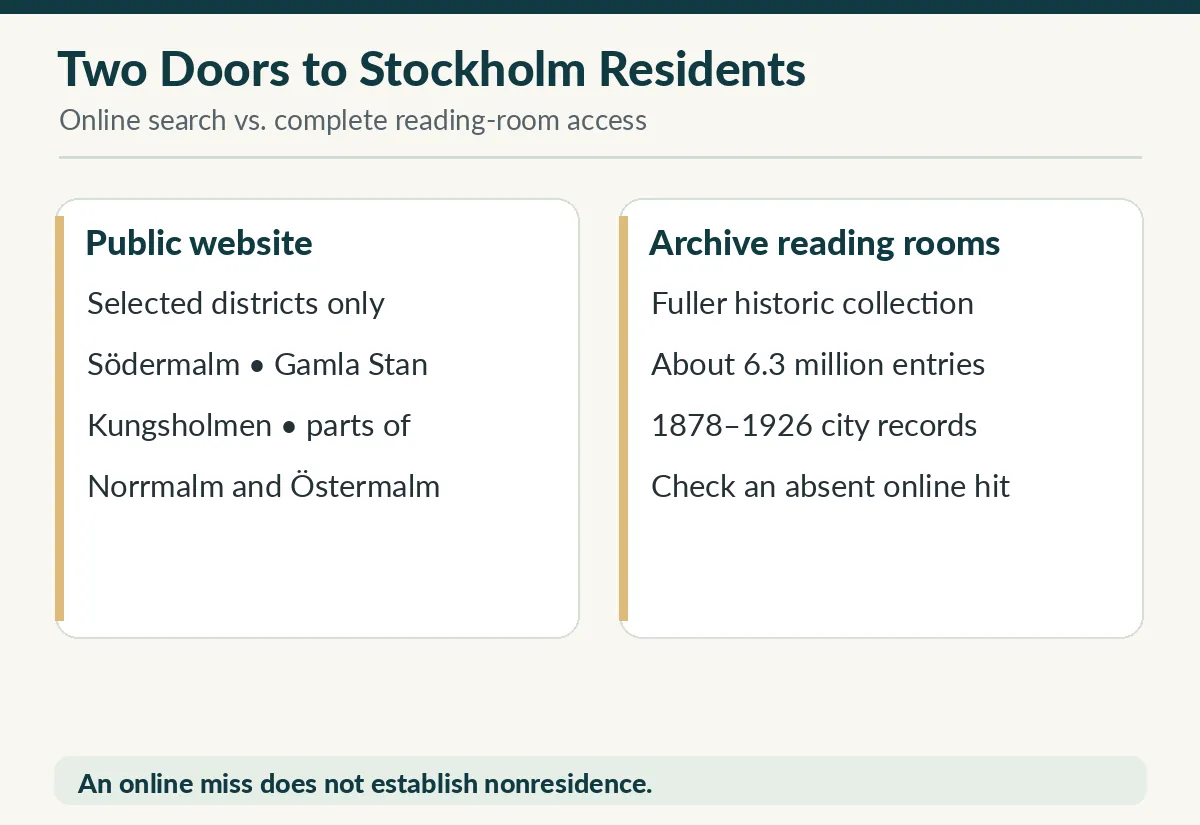
Search the Stockholm Rotemansarkivet for people living in the city between 1878 and 1926, but treat the current public website as only a partial doorway into the collection. The Stockholm City Archives explains that much of the historical population is absent from its online version. The fuller Rotemansarkivet can be consulted on reading-room computers. A failed surname lookup therefore cannot establish that a family never lived in the city.
The institution divided Stockholm into rotar, administrative registration districts monitored by a roteman. Those administrators noted residents at individual properties rather than composing genealogical family trees. The distinction matters when someone moves repeatedly between rented rooms, changes occupations, or appears with a different family name. First establish whether the target is within the 1878–1926 period and within the actual Stockholm city registration system; then choose the online or in-person route instead of searching every Swedish parish indiscriminately.
Identify the Public Search Coverage Before Entering a Name
The archive’s database description names Södermalm, Gamla Stan, Kungsholmen and parts of Norrmalm and Östermalm among the areas represented on the public website. It says the fuller collection has approximately 6.3 million entries accessible on computers in its reading rooms. These are entries, not 6.3 million distinct people: one resident can generate multiple registrations as addresses and circumstances change. Never turn that entry total into a population count or an identity count.
Begin with a surname variant and an approximate birth date or place, if known. Swedish spelling, patronymics, changed surnames and transcription choices can make an exact-name query too narrow. Remove a middle name, broaden the year, or try a location field rather than taking an empty screen literally. Record the date of the search, the fields used, the district selected, and whether the search covered only the online subset. The difference between “no match online” and “searched every surviving district volume” is crucial.
Read the Entry as a Property and Household Record
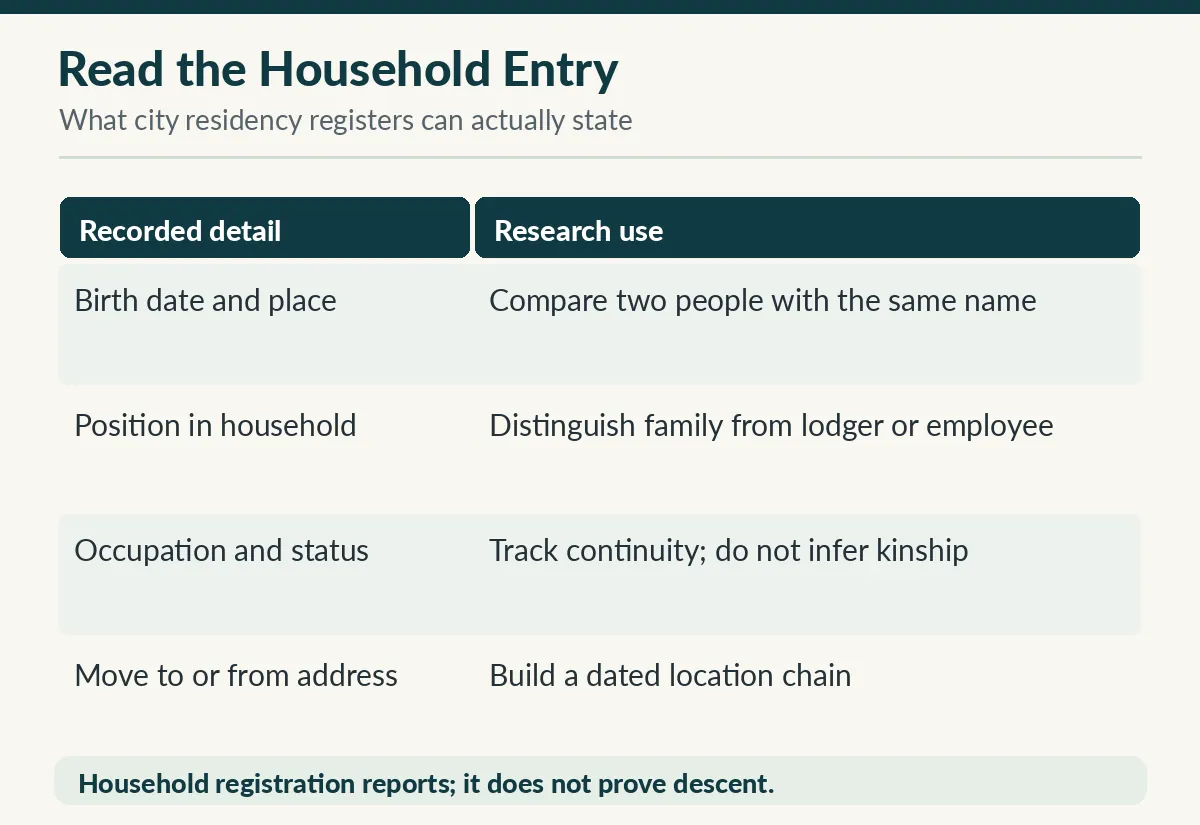
The roteman’s mantalshäfte could note name, occupation or title, birth date, birthplace, marital status, position in the household and moves into or out of a property. If a resident is marked as an employee or lodger, that label is a stronger clue about the household arrangement than an assumed surname relationship. Even an explicit recorded relationship should be assessed as an administrative report, not an independently demonstrated biological connection.
Capture the original Swedish term wherever possible alongside your English translation, especially for household role, place, and movement. A birth date may help distinguish one Johansson from another, but the record was created for municipal registration rather than at the birth event. A movement note identifies a reported transfer; it may not show the person physically arrived on the same day. For a child, follow the person across entries rather than assuming every adult listed in the same building is a parent.
Reconstruct Moves Without Inventing Relatives
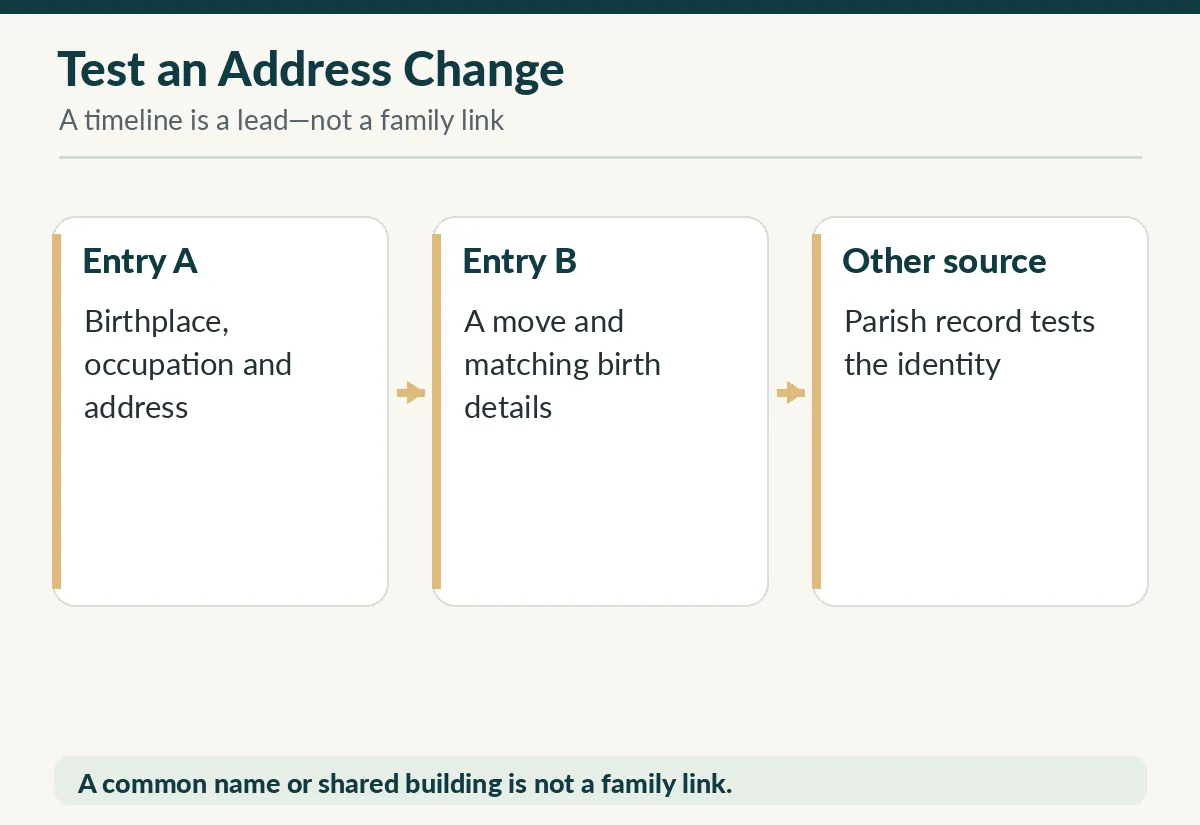
Build a dated address ledger with separate columns for district, property, registered move, occupation, and cited entry. A person might be listed in a workshop district at one date and in a boarding household at another. The sequence supports a residential history only when birth date, occupation, and explicit move references agree. Repeated common names make a single matching birthday insufficient if there are conflicting spouses, professions, or origins.
For a worked method, imagine two unrelated residents named Anna Andersson. One reported a birthplace in Uppsala and worked in domestic service; the other came from a different parish and had a child in her household. If a later record agrees on the occupation but not the birthplace, preserve both candidates. Do not join them with a confident arrow merely because each appears on a Stockholm street map. This fictional comparison demonstrates a test, not a claim about a historical individual.
Resolve a Missing Result Through the Archive
When the public site does not show the person, identify the likely district from an address directory, a parish entry, or a family document. Then ask whether that district and period were included in the online extraction. If the answer is no or uncertain, use the City Archives reading-room route or ask staff how to consult the fuller registers. The archive describes a new database called Stockholm’s Population 1878–1926 planned for spring 2027; that is a future plan as of this guide, not current comprehensive online access.
If the place lies outside Stockholm city, route the search to the correct parish and national or regional archive rather than assuming a city-wide Rotemansarkivet entry exists. An absent registration could also reflect a short stay, spelling, incomplete extraction or wrong dates. Classify each negative result by search scope in your log. A proper negative finding requires knowledge of what was searched and how that source was organized; a web interface that openly omits large groups cannot prove nonresidence.
More Records and Archives Guides
How We Research Stockholm Household Identity
Our source hierarchy begins with the City Archives’ official collection description and search-access notes. We record the exact consulted interface and its coverage before extracting any person-level field. We then compare each proposed identity with an independent parish birth, marriage or moving record, rather than silently merging administrative housemates. The route is repeatable because it retains place, date, recorded wording and whether the image or search result was actually viewed.
A sound finished note states what the register reports, what other records confirm and what remains unresolved. Cite the collection, the relevant district or rote, the viewed item reference and retrieval date; if the online screen lacks a stable link, preserve the identifying search details. Our affiliate disclosure explains site relationships and does not change the evidentiary standard. Keep alternate spellings and incompatible birthplaces in the research notes instead of smoothing them away.
No. The City Archives calls its current public Rotemansarkivet search incomplete. A negative result online should be followed by district checks or reading-room access to the fuller dataset.
It was an administrative district used by Stockholm’s roteman for population registration. District boundaries and numbers changed over time, so record the period as well as the district.
The municipal register can include occupation, birth date and place, civil status, household position and moves; availability depends on the specific entry.
No. Households could include lodgers, employees and unrelated residents. Test a stated relationship against a parish or civil record.
As of October 2026, Stockholm City Archives announces a new Stockholm population search for spring 2027. Recheck the archive before relying on a future interface.