
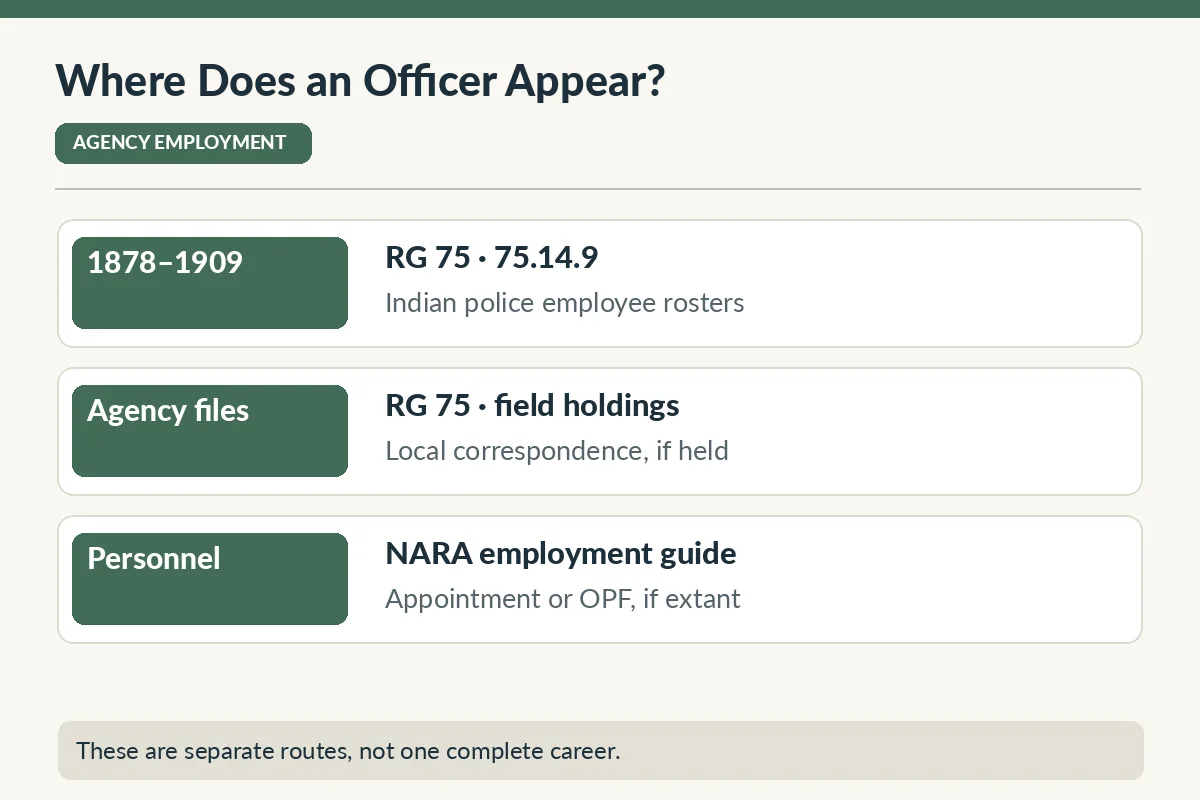
The National Archives lists rosters of ‘Indian police,’ 1878–1909, among the Bureau of Indian Affairs Employee Section records in RG 75, section 75.14.9. The quoted term is the historical federal record label, not a claim that all Native communities used the same police structures or that the label expresses an individual’s own identity. A name in such a roster can be an important employment clue. It does not, by itself, establish a person’s involvement in any arrest, particular dispute, tribal enrollment, or later criminal case.
Begin by selecting a year and an agency, then treat every possible name match as provisional until supported by additional identifying details. Federal agency jurisdictions, spellings, naming conventions, and local communities changed over time. Some records describe federal employment rather than tribal governance; others were made in environments shaped by coercive policies. Read them as historically situated administrative sources. The goal is to identify a person and their documented role while preserving community context, not to construct a dramatic biography from a single entry.
Locate the Employee Section Before a Field Agency
RG 75 section 75.14.9 describes rosters of Indian police spanning 1878–1909 alongside other employee rosters for agents, school workers, and agency staff. That grouping matters: the records were described as employee documentation. Start a request with the complete series wording, date or likely fiscal year, and agency if known. Do not begin by searching modern criminal-case databases for a matching surname. The roster may have been organized administratively; name searching alone can miss a person whose record is filed under a changing agency or historical designation.
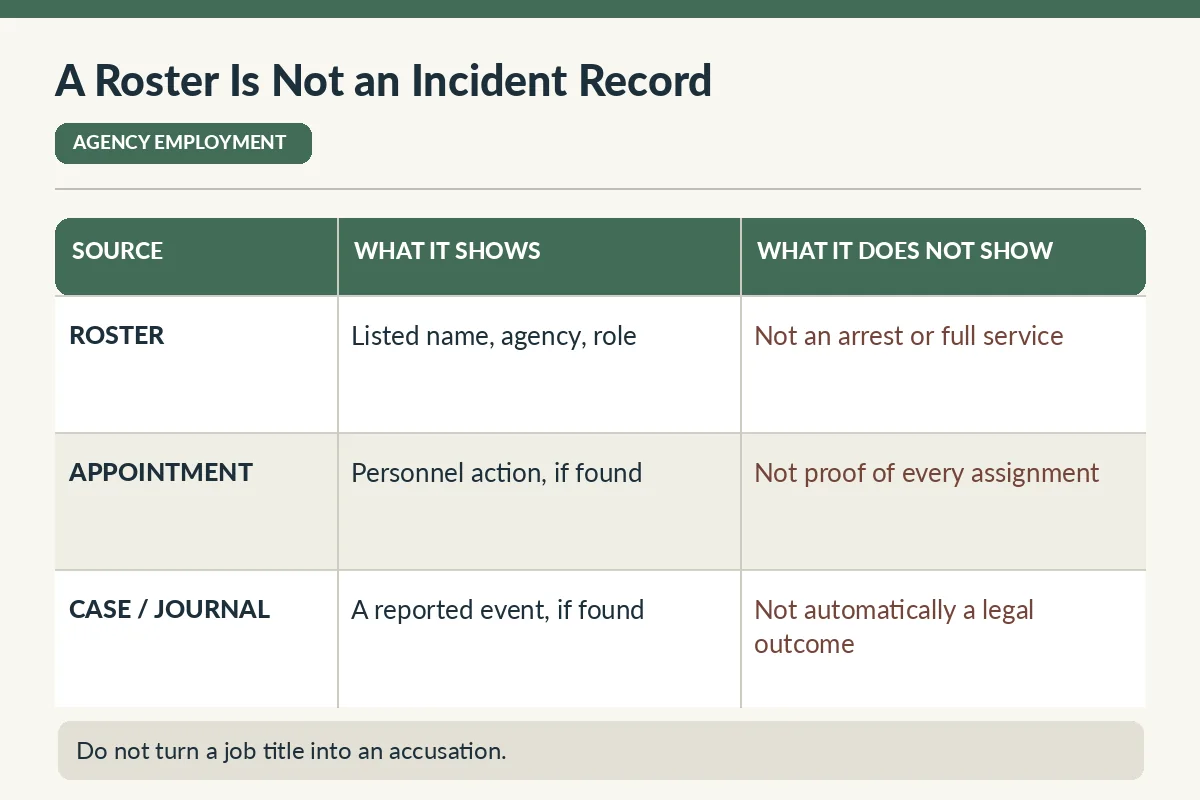
The NARA employment guidance separately describes BIA employee appointment sources, wider employee rosters, and official personnel folders. These are related pathways, but they are not interchangeable. Appointment documents may address a hiring decision; a roster may show an employee listed for a period; a personnel folder can contain a longer service history when one survives and is accessible. None of these guarantees that a police officer made a specific arrest. Identify which administrative office produced the paper before assigning meaning to its date.
Use Historical Agency Names Carefully
Make an agency-history table with the period name, location, affiliated communities if documented, and changes in administration. Avoid projecting a current tribal government’s boundaries backward onto every federal agency. The same location might appear under different agency names or jurisdictional arrangements across decades. A researcher who compares 1880 and 1905 without checking that change can mistakenly merge two people or overlook a transfer. Use agency records and authoritative jurisdiction information to connect the two dates.
A historical federal term appearing in a roster should be transcribed accurately in a citation while explained respectfully in current prose. Racial categories, imposed classifications, and administrative descriptions in older files can reflect the record maker’s assumptions. They should not be treated automatically as accurate statements of a person’s community affiliation, identity, or family relationships. For questions of tribal citizenship or belonging, rely on the relevant community’s authoritative process and records, not a federal employment label.
Evaluate the Name Match and Service Dates
Copy the recorded name exactly, including initials, variant spellings, agency, title, period, and any other identifier the actual roster supplies. Do not assume that every volume includes the same fields. Build a comparison with independent documents such as contemporaneous censuses, family correspondence, local directories, or an appointment or personnel record. A very common surname in the same general region is weak evidence. A more persuasive link combines date, agency, occupational role, and details corroborated elsewhere.
If a roster includes a date or period of service, describe it in the terms used by the document. An annual listing is not necessarily a continuous appointment from January to December, and an absent name in the next surviving roster does not establish death or dismissal. Different fiscal-year conventions can shift what appears to be the end of service. Record the date of the document as well as its stated reporting period, and leave uncertain starts and separations as ranges or open questions.
Do Not Infer an Arrest From an Employment Listing
An Indian police roster is not a docket, incident report, arrest book, disciplinary file, or witness statement. It identifies employees within its administrative purpose; it does not provide an exhaustive account of field actions. A family story about a dispute needs a separate record that identifies the event, participants, date, and jurisdiction. If an agency journal or correspondence file discusses an incident, read the whole passage and distinguish a reported allegation from an official outcome. Legal terms may have different meanings across historical authorities.
Federal files are often one perspective on conflicts within and around Native communities. If a question involves a specific event, ask whether tribal records, oral history, contemporary Native newspapers, or locally held archives can provide relevant context. Do not use the mere existence of police employment to assume collaboration, wrongdoing, or public acceptance. A record’s provenance is part of its evidentiary value. Respect access restrictions and culturally sensitive material even when a descriptive catalog record is publicly visible.
Create a Service Ledger That Shows Uncertainty
Build one row per confirmed appearance, with the source identifier, agency, roster date, exact name form, recorded position, and supporting identity documents. Use separate rows for appointment, transfer, pay, or separation if independently documented. This is more reliable than combining snippets into one continuous career. A gap may mean missing material, agency reassignment, filing differences, or a simple failure of the search; do not assign a cause without evidence.
Present a conclusion at the strength of the record: ‘the 1892 employee roster lists [recorded name] in the police category at [agency]’ if that is what the page says. Do not add a patrol route, family connection, rank, or case without a corresponding source. Where the identity remains uncertain, state the competing matches and what would resolve them. A precise evidence ledger makes historical employment research useful to families and communities without asking a federal roster to answer questions it was not created to answer.

More Records and Archives Guides
How We Research BIA Police Employment
We checked NARA’s RG 75 Employee Section listing for the 1878–1909 police rosters and its Native American employment research guide for distinctions among rosters, appointments, and personnel folders. Those pages verify the research path, not any individual’s identity. We use historical source labels only when explaining provenance, and we do not infer tribal citizenship or participation in an incident from a federal employment entry. Names and incidents require their own corroboration.
The research pathways and dates in this article are grounded in NARA RG 75 Guide, NARA Native American employment guidance, NARA Catalog guide. An archival guide describes material and may not supply a scanned item or a person-level finding. Read our affiliate disclosure; no paid source or affiliate relationship is required for this method.
NARA lists Indian police rosters in RG 75 section 75.14.9 for 1878–1909.
No. It is employment evidence, not a case or arrest log.
No. It is a historical federal archival label and does not replace a community’s own authoritative records.
Absence may reflect missing coverage, reassignment, name variation, or a different filing system; it does not prove discharge.
Compare the agency, year, name variants, role, and independent documents before joining records to the same person.