
Record Group 42 includes Washington-area Park Police Division records about police officers, arrests, ill and injured citizens, and motor vehicle accidents from 1899–1925. These administrative materials can lead to an incident or an officer’s documented work, but an arrest entry is not a conviction and an injury report is not a medical diagnosis. Start with the type of event, approximate date and historic park location. Then seek court, employment or medical sources only when the question requires that distinct level of proof.
The NARA RG 42 guide, section 42.3.4, places the Park Police Division under records relating to public buildings, monuments and parks in the National Capital. The National Park Service history traces the force through earlier park watchmen and changing administrative control. Use the historical creator named on the actual document: a modern agency name does not mean an event from 1902 was recorded under today’s organizational structure.
Select Officer, Arrest, Injury, or Accident Records First
The RG 42 description groups several functions under the Park Police Division. An officer’s appointment or duty assignment asks a personnel question. An arrest record asks about a particular law-enforcement action. An injured-citizen entry may show that assistance was recorded, and a vehicle accident file may establish reported circumstances or damage. Their evidentiary value differs, and the guide does not promise that every category survives as a complete named index.
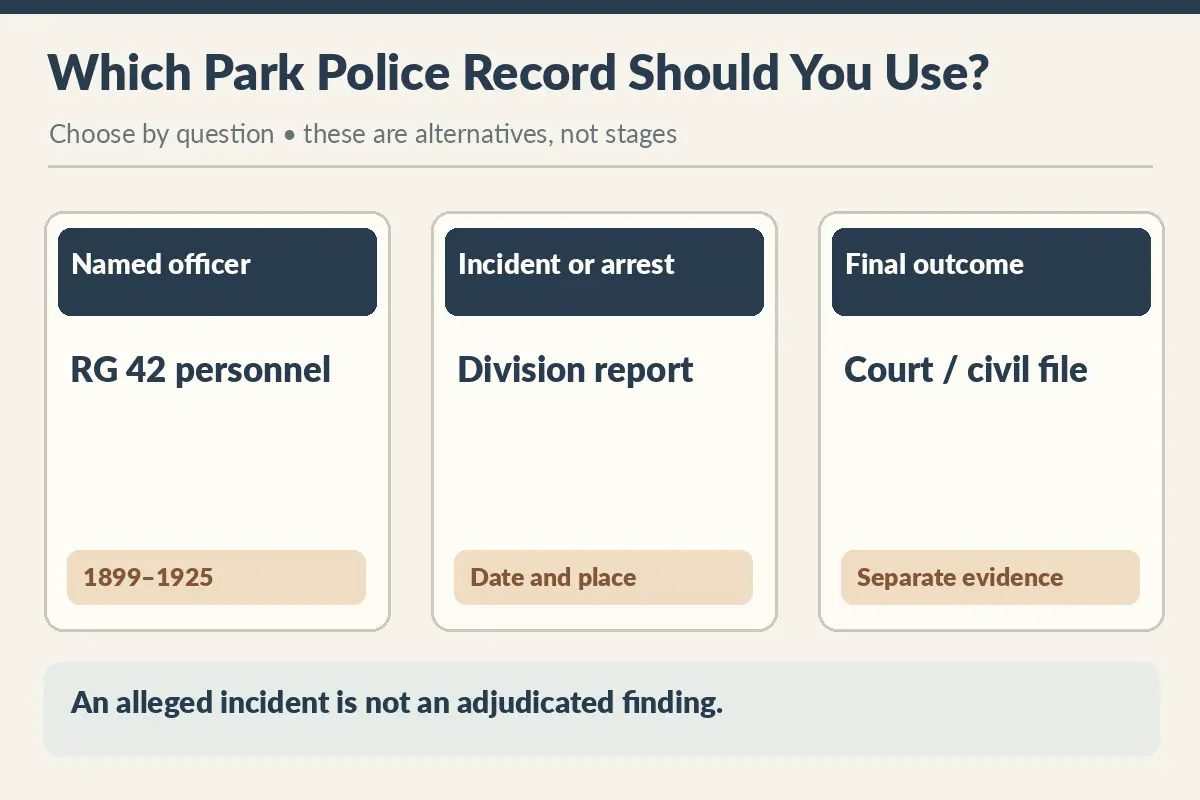
Define the question before searching. If a family remembers a park policeman in 1911, begin with name, rank, agency terminology and years employed, not a random arrest register. If a family tells of an accident in the Mall in 1922, begin with location, date, and the relevant accident record series. A record group number identifies the creator’s archival context; the specific series and page will determine what a particular document actually says.
Identify Historic Jurisdiction and Place Names
Park control and policing changed across administrations before the modern National Park Service structure. NPS explains that the force began as park watchmen and evolved over the years. Do not assume a historic “park police” reference has the same territorial jurisdiction as present-day officers. For each event, check the place name used by the source, contemporaneous park maps and any agency heading printed on the form.
Washington streets, park boundaries and memorial sites changed over the decades. A modern map pin can help orient readers, but should not be treated as the location stated in an old report. Record the physical landmark or intersection and its period spelling. If a report uses only a broad designation such as public grounds, do not infer the exact bench or crossing. Historical location is a question to be researched, not a coordinate to be invented for convenience.
Keep an Arrest Record Apart From a Court Outcome
An arrest report may document that an officer recorded an apprehension or allegation. It does not by itself establish prosecution, guilt, conviction, punishment or even the final identity of the person concerned. To determine an outcome, locate a relevant court docket, charging paper or later disposition. A reported offense category is the recorder’s contemporaneous wording, not an established finding by a court. Preserve that attribution when quoting or paraphrasing.

For an example, suppose a family letter says an ancestor was “taken in by park police” and an archive entry uses a similar name. Compare age, residence and date before identifying the person. Even after a secure identity match, the arrest and any later court action must be cited separately. If no court records survive, state only that the arrest was recorded. Do not supply a conviction from silence or assume that a report represents the final facts of the incident.
Interpret Injury and Motor Vehicle Reports Cautiously
NARA identifies records concerning ill and injured citizens and motor vehicle accidents within this Park Police Division material. A report may describe a response, location, participants or circumstances as understood by the recorder, but the published description does not specify mandatory fields on every form. Inspect the original record before saying a diagnosis, license number or witness statement appears. A contemporary report may also repeat information that was never independently verified.
For an alleged injury in a public park, ask whether the entry is a call for aid, an officer’s observation, a claimant statement or a later official summary. These are not synonymous. Medical facts require a suitable medical or vital record, subject to access restrictions; property damage may require insurance or court records. A vehicle description should not be turned into proof of ownership without a separate registration or title source. Separate location, event and named-person identity.
Trace a Police Officer Without Assuming Every Assignment
An officer’s name on a report can prove authorship, signature or a role on that particular date, if the original page confirms it. It may not reveal the full employment period or every park assignment. Seek official appointment lists, pay records, annual reports, directories or personnel material for a continuous career reconstruction. Watch for identical surnames, initials, promotions and shifting administrative titles. Record each duty statement only at the time it is documented.

A badge number or rank inferred from a later source should not automatically be assigned to an earlier record. A park policeman may have performed different duties from an officer documented in a modern NPS account. If a named individual appears as an accident witness rather than a police employee, keep the roles separate. A single administrative entry is a useful lead; the complete career claim belongs to a chain of dated personnel evidence.
How We Research National Capital Park Incidents
Our first ledger records event category, historic place, exact date, reporting office and document citation. We then distinguish officer observation, witness statement, administrative action and case outcome. A person’s identity is checked with independently dated information. For arrests, the next step may be a court docket; for employment, a personnel record; for an accident, another contemporaneous report. The path is selected by the research question, not by an assumption that all later records exist.
The RG 42 description identifies the categories and years, while the NPS historical account helps avoid anachronistic agency labels. Confirm holdings in the current archive catalog before claiming availability of a particular register. The diagrams are original educational charts, not facsimiles of arrest or injury forms. See our affiliate disclosure.
More Records and Archives Guides
Frequently Asked Questions About These Records
NARA describes records about officers, arrests, ill and injured citizens, and vehicle accidents for 1899–1925.
No. Confirm charging and disposition in appropriate independent court records.
No. Earlier park watchmen and Park Police functions passed through different federal administrations.
Not necessarily. Read its actual fields and seek separate registration or title evidence.
No. Use dated appointment, pay or personnel records for career claims.