
Answer the Research Question Before Searching Names
World War I aircraft production drew on spruce harvested in the Pacific Northwest. The U.S. Army’s Spruce Production Division left a trail of district correspondence, squadron papers, organizational records and even camp infirmary material. National Archives Record Group 18 describes these holdings, including records maintained in Seattle. The quickest valid search begins with a dated camp or district, not with a blanket assumption that everyone who worked around the timber industry served as an Army soldier.
The National Archives dates establishment of the division to November 15, 1917, transfer to the Bureau of Aircraft Production to May 20, 1918, and transfer of functions and properties to the U.S. Spruce Production Corporation to November 1, 1918. These distinctions matter because a family letter dated 1920 and a squadron record from early 1918 may belong to different administrative streams. A place name and an occupational story are promising leads, but neither by itself proves enlistment, unit assignment, employment or a continuous career.
Route the Search Through District, Unit, or Corporation

First transcribe the historical wording of the place: a logging camp, district headquarters, Vancouver Barracks, a privately owned mill or a transportation line. The RG 18 guide names Spruce Production district records associated with Clatsop, Coos Bay, Grays Harbor and Willapa Bay, Puget Sound, Vancouver Barracks, and Yaquina Bay. These are record-creating districts, not a complete modern directory of every worksite. Ask which office could have generated the document that would answer your question.
If a letter gives a Spruce Squadron number, preserve it exactly before searching a personal name. The NARA guide identifies records of provisional regiments, a casual detachment, and Spruce Squadrons covering numbered units. A unit record can establish administrative activity at a date, but may not individually name everyone present. A corporation invoice or timber contract, by contrast, may describe property or trade after the administrative transfer. Do not merge these separate record types into one supposed personnel register.
Use Agency Changes as a Date Gate
The chronology is an important practical filter. An August 1917 wood-production question starts with the predecessor Wood Section; a late-1917 or 1918 military unit question may point to the Spruce Production Division; a later property or liquidation issue may involve the successor corporation. Its records include general correspondence, meeting minutes, contracts and field survey notebooks in RG 18 section 18.7.9. A surviving contract may refer to a camp long after a soldier departed.
Date the document itself, not just the event remembered decades later. A 1919 report can summarize 1918 operations; a later caption can describe an earlier scene; a corporation record may reuse a military place name. Maintain separate columns for event date, document creation date, and administrative creator. When those dates diverge, search more than one section of RG 18 rather than forcing the whole story into a single agency label.
Read Camp Records Without Inventing Individual Service

RG 18 section 18.4.3 lists medical records from 1917–1919, including camp hospitals and infirmaries associated with numbered Spruce Squadrons. This is evidence of a surviving category, not a claim that every patient has a searchable case file. Medical papers can be incomplete, selectively preserved or subject to access rules. A medical reference may document treatment at a facility while leaving enlistment, civilian status, exact unit, or subsequent movements unresolved.
For an actual person, use the strongest available identifier: full name with variants, unit or squadron, a specific date, and independent civilian context. Military personnel documentation, local directories, census records, employment material or contemporaneous correspondence may assist, depending on what survives. Treat apparent spelling matches as candidates. A person near a spruce camp is not necessarily the soldier in a same-name squadron list, and a soldier at a headquarters was not necessarily a logger.
Separate Timber Output From a Person’s Work History
Production statistics, shipping correspondence and photographs are excellent for reconstructing how a lumber operation worked. They do not identify the person who felled a particular tree, drove a wagon, or operated a saw. The National Park Service describes the Vancouver Barracks mill and the movement of lumber through the production system. Such history places a family narrative in context, but it is not a substitute for a dated personal record.
Create two timelines: an operational timeline for the camp, mill, district and successor organization, and a personal timeline with records naming the target individual. Mark each entry “direct,” “contextual,” or “unverified.” Only draw a connection when a record actually places the person at that specific unit, facility or employer on a relevant date. If the lines do not meet, the responsible conclusion is a plausible association needing proof, not a confirmed assignment.
Build a Camp-to-Person Proof Ledger
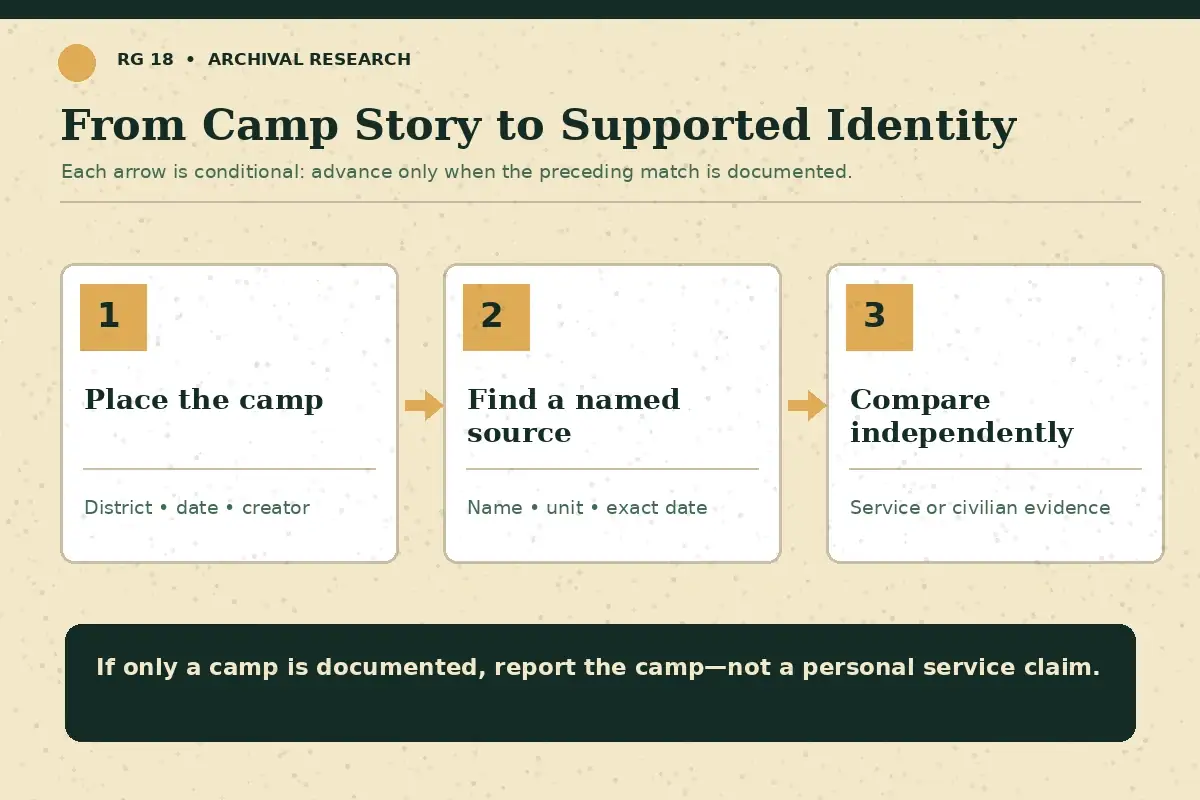
Record the National Archives record group, section, creator, local office, dates, and precise reference as you find it. Copy the exact quoted name of the camp or squadron. Next, attach the strongest independent source for the individual and compare spellings, rank or occupation, and chronology. A strong identity match requires more than agreeing geography: two men may share a surname, and one person may move between a field camp and a town without leaving a full paper trail.
A useful stopping rule is simple: if you have only administrative correspondence, write “this camp or district operated” rather than “this ancestor worked there.” If an independently sourced person record matches the unit and interval, state that narrower verified fact and note what remains unknown. Preserve negative search results by recording the exact series, name variants and date span inspected; a missing catalog result is not evidence the person never served.
More Records and Archives Guides
How We Research This Archival Record Group
We reviewed the official National Archives guide to RG 18 for the creating office, identified record categories, date ranges and the limits that make this search different from a broad keyword search. Its descriptions establish that particular materials are held or described, not that a proposed file, named person or unexamined document is already verified. We preserve distinctions between a series, a file unit and an item, and do not invent a catalog identifier where the source gives none.
We also cross-checked NARA guidance on using the Catalog and additional subject context from the sources documented for this page. Availability, digital access and processing arrangements can change; researchers should confirm the current custodian and request instructions. For reproducibility, cite the creator, RG number, series, file identification, exact date and where the original was consulted. If a link offers only an overview, say so instead of claiming to have read a specific manuscript page. See GenHis’s affiliate disclosure; this research route does not require a paid partner.
NARA describes substantial RG 18 records at Seattle, including district, squadron, and camp-related records; confirm present access arrangements.
No. Military units, contractors and civilian workers had different roles; verify a person’s status with an individual-level source.
The guide describes medical files as a record category, not a complete searchable register of all patients.
The division’s functions and properties passed to the U.S. Spruce Production Corporation, affecting which record creator to search.
No. Production figures document operations, not an unnamed worker’s identity or specific tasks.