
Answer the Research Question Before Searching Names
The Civilian Conservation Corps–Indian Division appears in National Archives Record Group 75 among Bureau of Indian Affairs records. Its general files, enrollee-program materials, narrative and pictorial reports, and maps can help reconstruct federally documented conservation and infrastructure projects in the 1930s and early 1940s. But a federal project photograph or an agency summary does not automatically name the people who worked, describe how a Tribal community understood the project, or establish a particular individual’s enrollment.
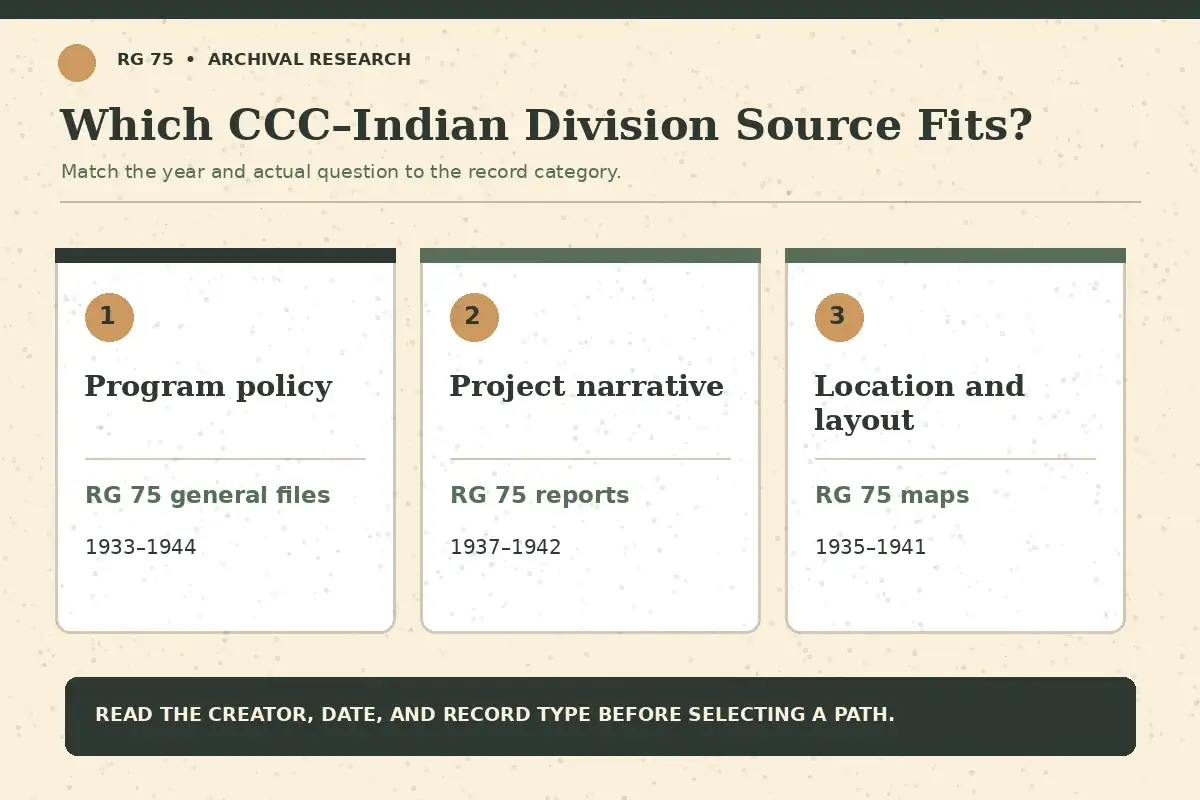
NARA describes CCC–Indian Division records from 1933–1944, specific enrollee-program material from 1937–1942, narrative and pictorial reports from 1937–1942, and a small cartographic group from 1935–1941. The differences in coverage matter. Start with a named agency, place and date; identify whose perspective the record represents; and distinguish administrative statements about a project from independently documented personal or community history. Tribal sovereignty, preferred community names and privacy deserve care throughout the research.
Identify the Agency Before Interpreting the Image
The Bureau of Indian Affairs produced and collected records through a changing network of agencies and regional offices. A CCC–Indian Division photo may have been assembled for a national or regional report rather than made as a personal portrait. Record the image’s caption, creator, date, associated narrative and archival context before identifying a worksite or person. A federal caption may be incomplete or use terminology that a community would not use today.
RG 75 section 75.14.12 distinguishes general records from specific enrollee-program records and pictorial reports. Those are related administrative categories, but they answer different questions. A general memorandum may explain a policy or budget, while a project report may describe work planned or claimed. If a photograph appears in a report, inspect adjacent pages for the project title and reporting period. Do not infer that every person pictured was an enrolled worker.
Use Year Ranges to Avoid Searching the Wrong File Type
The RG 75 guide gives general CCC–Indian Division material a 1933–1944 range, while it describes enrollee-program papers and narrative/pictorial reports specifically from 1937–1942. That does not mean no project activity occurred outside the narrower years; it means this particular archival description cannot be stretched to promise comparable files for every earlier or later year. If a family story is dated 1934, a 1939 pictorial series is not automatically the proper primary source.
Create a dated availability grid: question, likely creator, described records, date limits and next alternative. Keep the program’s administrative existence separate from what documents survive. A missing name in a catalog description has little evidentiary weight because many archival summaries describe boxes or series rather than individuals. Confirm a file’s date span before deciding whether a negative search is meaningful.
Compare Project Reports With Maps and Place Evidence

For spatial history, the guide describes 23 manuscript, annotated or published map items dated 1935–1941. These can help locate a reported project, but a drawn route, proposed road or marked improvement may represent a plan rather than a completed undertaking. Match the map scale, its date and its locality to the narrative report. Record whether the annotation states a proposal, existing condition, or completed work; if it does not say, the status remains unresolved.
To verify a completed project, search for dated completion reports, later photographs, local government material or community archives where appropriate. A present-day landscape cannot automatically validate a 1930s agency claim because roads and boundaries change. When using historical maps of Tribal lands, recognize that a federal depiction of a boundary or place name is not itself a complete expression of Tribal jurisdiction, knowledge or preferred naming.
Keep Federal Reporting Separate From Tribal Perspectives
An agency report records the perspective and administrative priorities of its author. It may emphasize production figures, program successes and federal classifications while underrepresenting local experience, disagreement or community goals. Quote official terms accurately when they are essential to identifying a file, but explain their historical origin instead of applying them uncritically to people. Do not substitute a single federal report for a Tribal history of the same project.
If the research concerns a particular Tribal community, seek its publicly available cultural or historical resources and follow its guidance about names, sensitive locations and sharing practices. Avoid treating the presence of a federal agency on a landscape as proof that the agency’s report is the only authoritative narrative. Separate verified documentary observations from interpretive claims and cite each source in its own voice.
Test a Named Person Through Independent Records
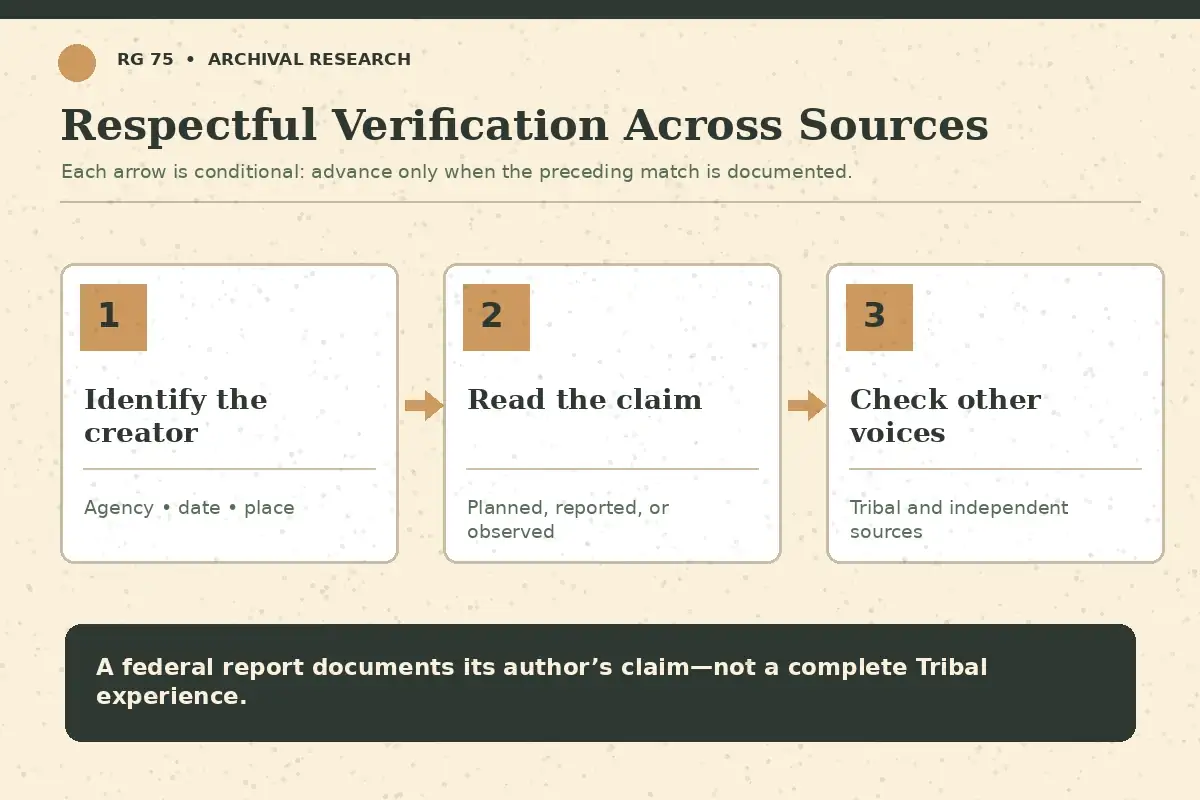
The guide’s mention of enrollee-program material does not guarantee that a complete named roster survives or is accessible online. To investigate one individual, start with name variants, dates, location, agency and any family-held letter or photograph. Request the relevant individual-level record only after identifying the likely series and its access rules. Check whether a named individual appears as an enrollee, supervisor, contractor, visitor or person merely mentioned in a report.
Use an identity ledger with three columns: what the federal item states, what other evidence independently verifies, and what remains unknown. If a report names a project but not its workers, the correct conclusion is that the project was documented; no worker can be added by inference. Where person-level sources include potentially sensitive living-family or community information, share only with appropriate permission and preserve context.
More Records and Archives Guides
How We Research This Archival Record Group
We reviewed the official National Archives guide to RG 75 for the creating office, identified record categories, date ranges and the limits that make this search different from a broad keyword search. Its descriptions establish that particular materials are held or described, not that a proposed file, named person or unexamined document is already verified. We preserve distinctions between a series, a file unit and an item, and do not invent a catalog identifier where the source gives none.
We also cross-checked NARA guidance on using the Catalog and additional subject context from the sources documented for this page. Availability, digital access and processing arrangements can change; researchers should confirm the current custodian and request instructions. For reproducibility, cite the creator, RG number, series, file identification, exact date and where the original was consulted. If a link offers only an overview, say so instead of claiming to have read a specific manuscript page. See GenHis’s affiliate disclosure; this research route does not require a paid partner.
NARA describes the division’s general records from 1933–1944.
The RG 75 guide lists narrative and pictorial reports for 1937–1942.
Not by themselves. Check whether the map shows proposed or completed work and seek independent documentation.
No. Captions and project reports may not name everyone shown or even establish formal enrollee status.
Federal reports reflect their creator’s viewpoint. Tribal accounts can supply essential perspective, names and context.