
Start With the Camp, Not a Family Legend
A Civilian Conservation Corps camp name is a geographical and administrative clue, not proof that a particular relative worked there. The National Archives places camp directories for 1933–1942 in Record Group 35, alongside organization records and Army corps area status reports for 1941–1942. To make the question testable, write down the company number if known, a likely camp town or forest, and the smallest defensible date range. Record precisely which detail came from a family story and which came from a dated document.
A camp could have a postal address, an operating site and a unit designation that changed independently. If a relative remembered “the mountain camp,” that phrase cannot safely become an exact company assignment. Start with a state and broad year, then compare the directory listings for adjacent periods rather than assuming a company stayed in one place throughout the program. An empty or ambiguous search is a reason to inspect additional directory years, not to create a missing company number.
Select Directories or Late Status Reports by Date

RG 35 §35.2 describes general correspondence and camp directories from 1933 through 1942. Those directories are useful for identifying how a camp or company was officially described in a particular period. The same section separately identifies Army corps area camp status reports for 1941–1942. They answer a different question: what an administrative office reported about camp status, not who lived in each barrack. A researcher seeking a location should start with the directory; a question about late operation may need a status report.
Do not read the two record types as a continuous annual register of the same facts. A company might have moved, been reassigned, or been described under a different administrative region. Note the exact issue or report date and the level of description. If you identify a likely directory entry, preserve its spelling and number as printed. Then search for surrounding dates to determine whether the camp place and company association remained stable during the period relevant to the person.
Record Company Numbers Before Matching Names
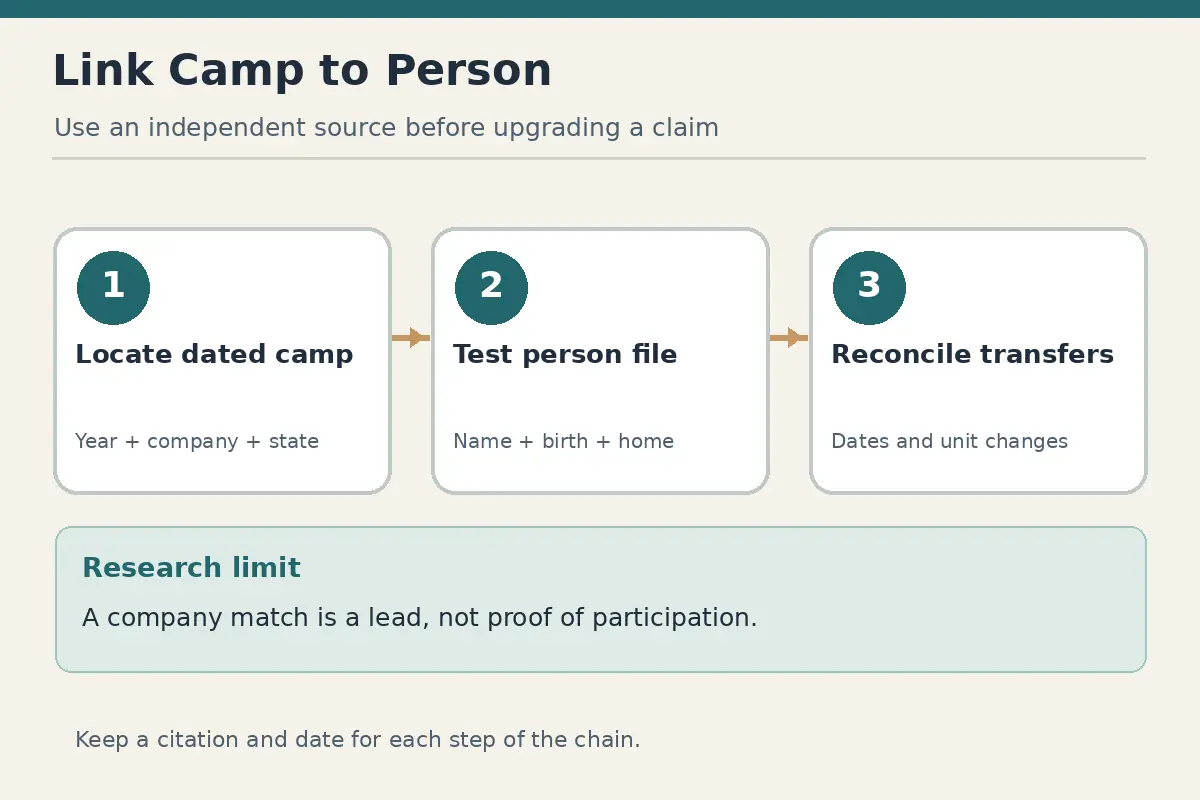
Construct a three-column crosswalk: reported company number, documented camp location and source date. Add a fourth field for the original reference, including the RG 35 series or file-unit citation. This arrangement prevents two entries with a shared place name from being silently merged. When a directory gives an unfamiliar town or forest name, verify the locality historically before converting it into a modern county or mailing address. A modern map can orient the search but cannot supply missing historical dates.
Company numbers are particularly useful when a surname is common. They remain evidence of a company rather than evidence that every man associated with the place served in that company. A person might have worked for a contractor, lived nearby, or visited without enrolling. Treat each proposed identification as a hypothesis with its own source. If a name appears in an image caption or local newspaper, transcribe what the source actually says; do not substitute a roster that the directory does not contain.
Find the Separate St. Louis Enrollee Route

The National Archives at St. Louis explains that individual CCC enrollee records are requested through a different process from RG 35 administrative research. Its guidance asks for the full name used during service, birth details, home address, parents if known, dates of service, company number, camp location and position. These items help distinguish people with similar names; they are not a promise that every field is present in every surviving file. The public access arrangements are subject to change, so consult the current official page before requesting copies.
An individual record may supply an assignment or discharge clue that is absent from the camp directory. Use it to test whether the person and the listed camp were connected on compatible dates. If the personal file describes a different company, investigate a transfer instead of choosing the directory entry you prefer. Family photographs, letters addressed to the camp and dated local press items can provide independent supporting evidence, but their dates and identification quality must be evaluated separately.
Build a Dated Assignment Timeline
A strong CCC timeline holds at least three parallel tracks: where the camp was listed, which company or administrative unit was associated with it, and what a person-level source says about the enrollee. Use specific dates where possible; use labeled ranges when a directory is only an annual edition. Avoid making a single date out of uncertain opening and closing periods. Distinguish “present on the map,” “listed as operating,” and “person documented here” as three different claims.
For a hypothetical family account placing an enrollee in one state in 1938, a 1938 directory entry with the correct company is a promising location lead. A personal file recording the same company in 1939 is not automatically proof of an unbroken 1938 assignment. Add a search for a transfer, discharge or re-enrollment before combining the two. If the sources disagree, reproduce both verbatim in the working notes and explain what additional record might resolve them.
Use Other Federal Record Groups Carefully
NARA identifies related CCC holdings in agencies such as the Forest Service, National Park Service and Bureau of Indian Affairs. Their files may document conservation projects, site management and administrative decisions. A project completed near a camp does not establish which specific company carried out every task, and a company assignment does not establish an individual worker’s part in one photograph. Specify the creator, project and time period for each cross-reference rather than treating all CCC records as one undifferentiated database.
Photographs are especially tempting evidence. Captions can identify a place, company or photographer without reliably naming every person shown. If you have a labeled portrait, seek the original caption, photographic series and date before linking it to an enrollee. If it only says “CCC boys in camp,” record that narrow description. An independent letter or identified enrollee file may later add identity evidence, but similarity of appearance or a shared last name should not be enough.
Request and Cite the Exact Item
The RG 35 finding guide is an entry point, not an online index of every camp directory page. Search the NARA Catalog for the named series, then identify the file unit or volume that covers your target date. Note the repository or contact details in the current catalog description before making an inquiry. Ask for the relevant directory entry, report or series reference; do not assume an item is scanned because its group is described on the website.
Cite the creator, RG 35, exact series or item title, date and repository, with a link or archival locator when available. For the enrollee file, cite the St. Louis record separately. If you end with only a camp entry, the defensible conclusion is that the camp or company was recorded there on the listed date. Leave the person’s service as unconfirmed until the individual-level evidence supports it.
More Records and Archives Guides
How We Research This Archival Question
We checked the archival description for RG 35 and its relevant series, then distinguished what the official source explicitly documents from what a researcher might infer. The date spans on this page describe the listed holdings or survey, not a claim of complete digitization or coverage for every locality. We assessed each map, report, directory or inventory at the level of the individual item needed for the research question, rather than treating a series heading as a personal record.
We also compared this route with the relevant repository access guidance and use the National Archives Catalog guidance when a particular file unit or digitized image remains to be located. Evidence limits, alternative explanations and missing dates are named rather than silently filled. Our informational articles contain no confirmed affiliate offer; our affiliate disclosure explains the site policy.
No. RG 35 camp directories describe the camp and company; St. Louis maintains the separate individual enrollee record pathway.
The NARA guide lists directories for 1933–1942 and separate Army corps area status reports for 1941–1942.
No. A name or location identifies a possible camp; match the person through individual records and dated independent documents.
Keep a date-specific company and camp crosswalk and check adjacent directory issues before making a continuous assignment claim.
Use the current National Archives at St. Louis CCC enrollee guidance and include as many identity and assignment details as you can verify.