
Start With 2,200 Aviation Slides, Not a Flight Log
NARA describes approximately 2,200 lantern slides under RG 18 AH covering the history of military aviation from 1903 through 1927, including persons significant in aviation history. These slides are valuable visual entry points for early aircraft, training grounds, and aviation personalities. A historical collection is not a day-by-day flight log: one slide may reproduce a portrait, another may picture a machine on the ground, and neither necessarily identifies who flew it on a specific date.
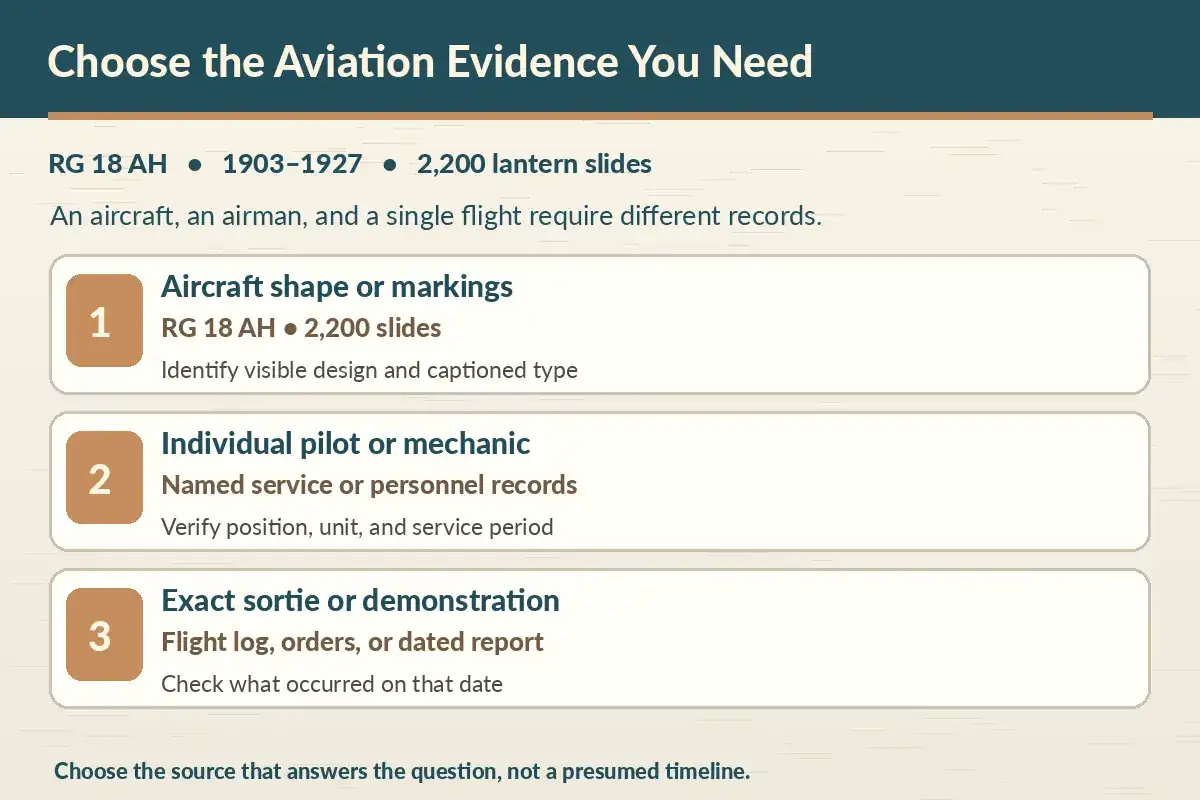
For a reliable family or local aviation history, split the research claim into three questions: what aircraft is visible, who is named in the original source, and what independently dated record documents a particular flight or duty. The dates 1903–1927 define the guide’s historical subject span, not the exposure or assembly date of each slide. Keeping these distinctions prevents dramatic aviation stories from outrunning the archive.
Locate the AH Lantern Slides Within RG 18
The NARA federal records guide lists AH as a lantern-slide group in the Records of the Army Air Forces and its predecessors. The series entry counts 2,200 images and specifies early aviation history rather than a single wartime squadron. Use AH as the precise series code; a search for RG 18 alone will also retrieve airfields, training, moving images, and later air-force records with quite different purposes.
An item log should record the slide identifier, original caption, image type, any on-mount notes, and the source of its assigned date. If only a reduced copy is available, mark its identification provisional until the item-level reference is secured. NARA’s published guide is not an exhaustive index of the names or serial numbers depicted in every one of the 2,200 slides.
Date an Aviation View Without Confusing Compilation and Flight
The Air Forces record group preserves visual history going back before the Army Air Forces existed as an organization in 1941. Early images may concern the Signal Corps, Air Service, or Air Corps, while a later compiler might have grouped them under an aviation history heading. Do not retroactively call every subject in 1903 an Army Air Forces pilot or attribute an early machine to an agency that did not yet carry that title.
Look for the earliest securely dated reproduction, caption, negative, or publication and distinguish it from the event portrayed. A slide about a 1910 aircraft can be a later copy of a photograph. Record the airframe’s apparent date, the image’s original exposure date if known, and the date of the mounted slide separately. An ambiguous date range is not a reason to invent a precise sortie.
Recognize Machines From Physical Features, Not Legend
Airframe identification should begin with visible evidence: wing arrangement, bracing, landing gear, tail shape, engine placement, and markings. Early aircraft were often modified, and machines from the same general period can look alike. Compare several characteristics with period technical photographs or maintenance descriptions. Do not identify a specific serial number solely from a famous model silhouette or a blurred painted marking.
If the same caption appears on both a slide and a published illustration, trace which version was created first. Captions can be copied along with an error. For a photograph of a runway or hangar, compare contemporary site maps or buildings before naming the airfield. The goal is a supported identification that can survive a change in catalog wording, not a match that depends on a single easily misread detail.

Confirm Aviators Separately From Aviation Equipment
The guide says the AH collection includes persons significant in aviation history. That does not imply every figure in a crew portrait or at an aircraft display is identified. A person beside a plane might be its pilot, mechanic, instructor, designer, photographer, or guest. A uniform can indicate context, but not a particular duty or rank on its own. Use the original caption and seek a second named source for each identification.
Personnel files, station rosters, orders, contemporary directories, and dated correspondence can establish service roles. A person’s presence at an air station during a month still does not prove participation in a named flight. If a family story claims a record-setting achievement, seek the specific flight report, published contemporary account, or pilot log and distinguish it from later commemorative writing.
Reconstruct a Flight Only From the Right Record Type
A display slide may show a machine before takeoff, after landing, in maintenance, or as part of a demonstration. Nothing in that picture alone establishes the flight path, crew, altitude, or exact mission. A flight log or operational report has different evidentiary power and may give date, aircraft, crew, and purpose; its fields still need interpretation in the context of the service and period.
Build a simple worksheet with the photographed subject, the captioned place, the independently dated flight or service document, and any contradictory identification. Avoid using a later museum label to resolve a record conflict without checking how the label was sourced. When evidence supports only a model or a generic demonstration, publish that narrower conclusion rather than invent a full flight narrative.
Preserve Slide Provenance in the Final Citation
For a specific AH image, cite National Archives, RG 18, series AH, the local identifier, original title or description, and any verified original date. If a technical specification or personnel record supports another claim, attach it as a separate reference. The guide count and series span are not replacements for an item-level citation. Note whether a shown picture is a scan of a mounted slide rather than the original camera negative.
A responsibly worded conclusion could be: “The AH lantern slide depicts a two-wing aircraft associated with early military aviation; its exact airframe and pilot are not established by the series summary.” Once an original marking and named duty record are found, the account can become more specific. The method makes exciting aviation history more durable without turning a curated image into an imaginary flight log.

More Records and Archives Guides
How We Research This Collection and Its Limits
The series-specific count, dates, and record designation were checked against the National Archives federal records guide on November 16, 2026. Independent context was compared with a second official research source, while NARA still-picture citation guidance establishes the information needed to locate an exact image. The site topic list and earlier production titles were compared for duplication. A series description does not identify every subject, date, or object in every frame, and access to a fully digitized item cannot be assumed. The figures in this guide are newly drawn explanatory editorial illustrations, not historical negatives or genuine reproductions. We make no unverified claims of commercial endorsements. See the affiliate disclosure for site policy.
The federal records guide describes 2,200 images.
NARA gives the historical subject span as 1903–1927.
No. It is a visual series; personnel and flight claims require named records.
Sometimes the full caption and visible marks help, but an airframe identification should be checked against period technical evidence.
A flight log, operational report, dated order, or reliable contemporary record is more appropriate than a historical slide caption.