
Start With 12 Lantern Slides, Not a Personal Claim
The National Archives lists just 12 lantern slides in RG 119 LS depicting National Youth Administration personnel, facilities, exhibits, programs, and projects during 1936–1942. A lantern slide is often a teaching or presentation object: it may reproduce a photograph, but its function in a talk can differ from the purpose of the original exposure. That distinction matters when using an NYA image to explain a grandparent’s youth, an old vocational shop, or a New Deal project.
NARA also describes 20,500 photographs in the NYA’s G and S series. Do not collapse that much larger body of photographs into the twelve LS slides. Begin by asking whether you need the visual used in a presentation, an original still picture of a worksite, an administrative account of a training center, or a named record for an individual. These are four separate research questions, even when they concern the same program.
Read the Slide as a Presentation Object
A slide may have been selected to illustrate a program’s aims, highlight a completed item, or train staff in a technique. It does not necessarily show a representative day or an unposed candid moment. Start by transcribing the slide’s caption, label, and any maker or presentation information. Identify physical clues such as framing, cropping, or added lettering that may reflect presentation reuse rather than the scene’s original context.
If a reproduced slide displays a group beside tools or machinery, write ‘a group pictured at a worksite’ until other evidence identifies their roles. They could be trainees, instructors, visitors, or staff. An image assembled for an NYA presentation may celebrate a program while omitting failed projects, delays, and the names of those who did not appear on camera. This is a limitation of selection, not a reason to discard the record.
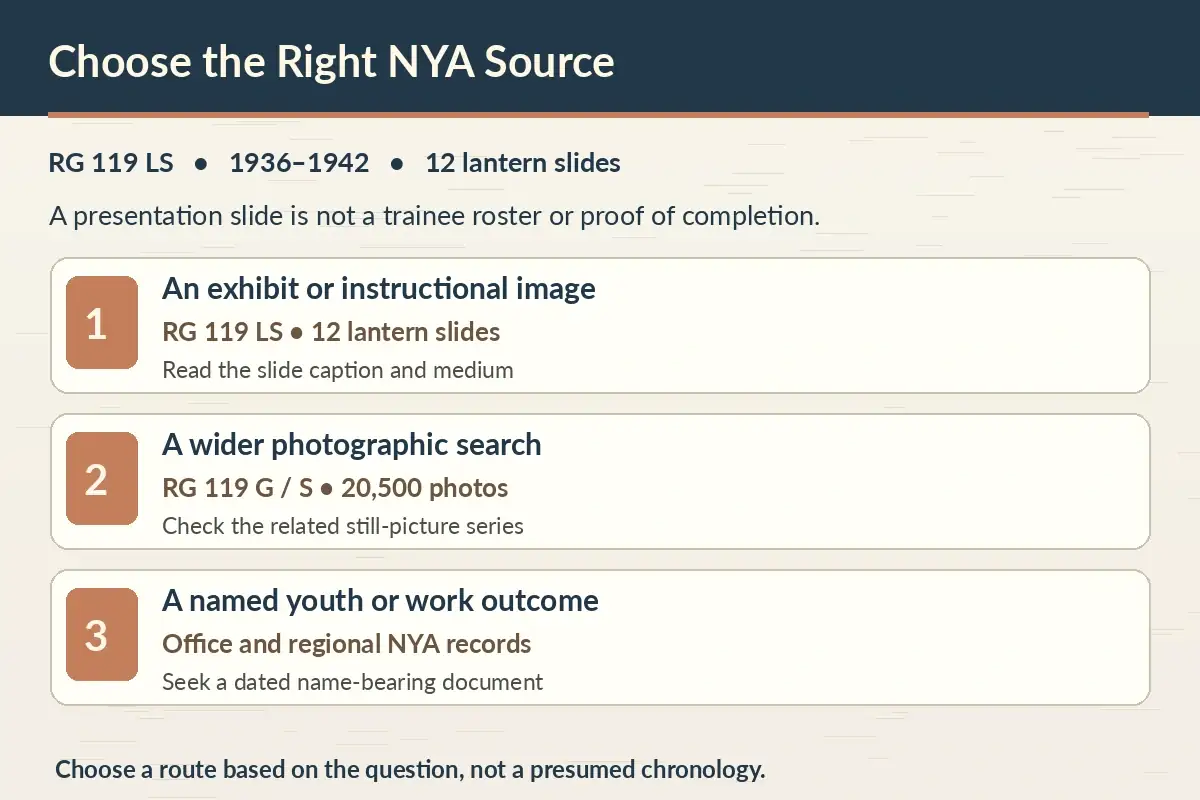
Separate Twelve LS Slides From G and S Photographs
The official NARA guide explicitly distinguishes the LS set from the much larger G and S photograph collections. Record the series every time you save an item. If a webpage uses a broad caption such as ‘NYA youth workers,’ that wording alone will not tell you which series supplied the picture. A source reference that says only ‘RG 119’ is insufficient when multiple formats and bodies of records coexist.
Use the LS slides to discover the subjects emphasized in a presentation, then consult G or S when a wider set of photographs is needed. A similar scene in another series should not be assumed to be the same exposure. Compare local identifiers and physical details before linking two images as duplicates. Differences in crop and caption may reveal how agency publicity developed a message from a documentary image.
Map a Project to the Correct NYA Office
The NYA administered programs through a network of national, regional, state, and area offices. A local training facility did not necessarily report directly to the same office as a school work project in another state. Before seeking correspondence, write down the location, approximate date, type of training, and any institution name visible in the item. These details help route an inquiry to a plausible office series without assuming that every project file survived.
NARA’s regional records descriptions include correspondence about facilities, supplies, health, vocational training, and project work. Such administrative records may corroborate that a program operated in a particular area. They do not automatically put a named individual in a photograph. A purchase order for tools is evidence of administration, not direct evidence that a young person used those tools on a certain date.

Date Training Without Equating All Activities
The 1936–1942 range applies to the twelve-slide series as described by NARA; it is not an exact date for every scene. A caption mentioning a year can be a lead, but a slide duplicated later may carry presentation dates as well as exposure dates. Distinguish the date a workshop existed, the date an image was taken, the date a slide was prepared, and the date an office assembled a program exhibit.
Changes in NYA administration also matter. The agency moved between federal administrative structures over its life, and a record’s custodian can differ from the office shown. Do not infer from agency reorganization alone that an earlier local workshop ceased that year. Use dated regional correspondence or contemporary local reports when reconstructing a specific facility’s timeline.
Treat Work and Training Outcomes as Separate Claims
A visual demonstration of a trade skill documents a presentation of an activity, not necessarily that trainees completed a course or secured employment. A photo showing a finished bench or aircraft component may reflect a teaching project rather than a contract fulfilled. To make a stronger outcome claim, find a contemporaneous project report, assessment, placement summary, or named record. Keep targets, activities, and results in separate research columns.
A family story may say that a relative learned welding, sewing, clerical work, or another occupation through a youth program. A similar NYA slide makes good context but not proof. Seek a school record, letter, payroll, local report, or person-specific evidence from the appropriate time and place. Avoid assigning a stereotyped role based on a person’s appearance, gender, or the equipment visible in a promotional scene.
Track a Person With More Than a Face
For a person-level claim, construct a timeline from independent records: residence, age, school or work history, local program dates, and any available NYA name-bearing materials. The archive’s general description does not promise a complete roster of every NYA participant. If the person’s name is absent from the slide caption, say that plainly rather than assigning an identity by resemblance or shared clothing.
A strong connection requires a distinctive identifier: a named caption and corroborating location, a documented training assignment tied to the pictured workshop, or a contemporary letter that places the person at an event. Even then, distinguish presence at the site from presence in that particular frame. Unnamed faces should remain unnamed unless the evidence can be reproduced by another researcher.

Request the Image and Preserve Its Original Function
Ask for the RG 119 LS local identifier, accompanying caption, and any associated presentation list. NARA’s still-picture reproduction guidance tells you which parts of the reference to record. You should not assume that every slide is scanned because the series is small, nor that all copies retain the original borders and captions. A cropped derivative might conceal exactly the label that distinguishes an LS presentation from a G or S photo.
When publishing, explain both the original scene and the later communicative use of the slide. A cautious caption could say that an NYA presentation illustrated a type of vocational project, without claiming the people are named trainees. The distinction may seem small, but it makes the resulting family history accurate about what the image supports and leaves a practical path toward stronger evidence.
More Records and Archives Guides
How We Research This Historical Evidence
This guide uses the specific official record-group description, a second relevant archival or institutional source, and NARA’s still-picture citation instructions, checked November 16, 2026. We compared the series label, item count, and date statement with their custodians. A series-level guide cannot guarantee that a particular image is digitized, fully captioned, or capable of naming a person; item-level confirmation remains necessary. There are no affiliate offers or paid product recommendations in this guide; see the affiliate disclosure. The editorial illustrations and explanatory charts in this article are not archival reproductions.
NARA describes 12 LS slides covering personnel, facilities, exhibits, programs, and projects during 1936–1942.
No. NARA lists G and S as a much larger photographic collection of 20,500 images.
Not without a named, independently verified connection to that person.
No. Seek a training or project outcome document rather than treating a presentation image as proof.
Check NARA descriptions for regional and state offices and use relevant place, date, and project details.