
Historic aviation images are tempting evidence in a family story: a biplane at an airfield, an expedition party, or a famous pilot standing beside an aircraft seems specific enough to attach a name. The National Archives groups 2,138 photographs of historical flights, aircraft, air races, expeditions, aviators and government figures in RG 80 HAN, HAP, HAS and HAT, covering 1896–1940. The photographs belong to the General Records of the Department of the Navy, but that custody alone does not mean every aircraft was naval, every person served in the Navy, or every pictured airplane completed a particular flight.
The useful method is to identify the picture and its series code before pursuing a pilot. Compare visual markings with dated flight or event records; then seek independent name-bearing service or licensing evidence. An air race and a fleet assignment are different questions. This guide distinguishes the four codes from the far broader RG 80 G and photographic publicity series and shows a reproducible way to avoid assigning a famous or family name to an unidentified cockpit. Cover artwork is an interpretive historical scene, not a genuine NARA image.
Use HAN, HAP, HAS and HAT as Search Keys, Not Biographies
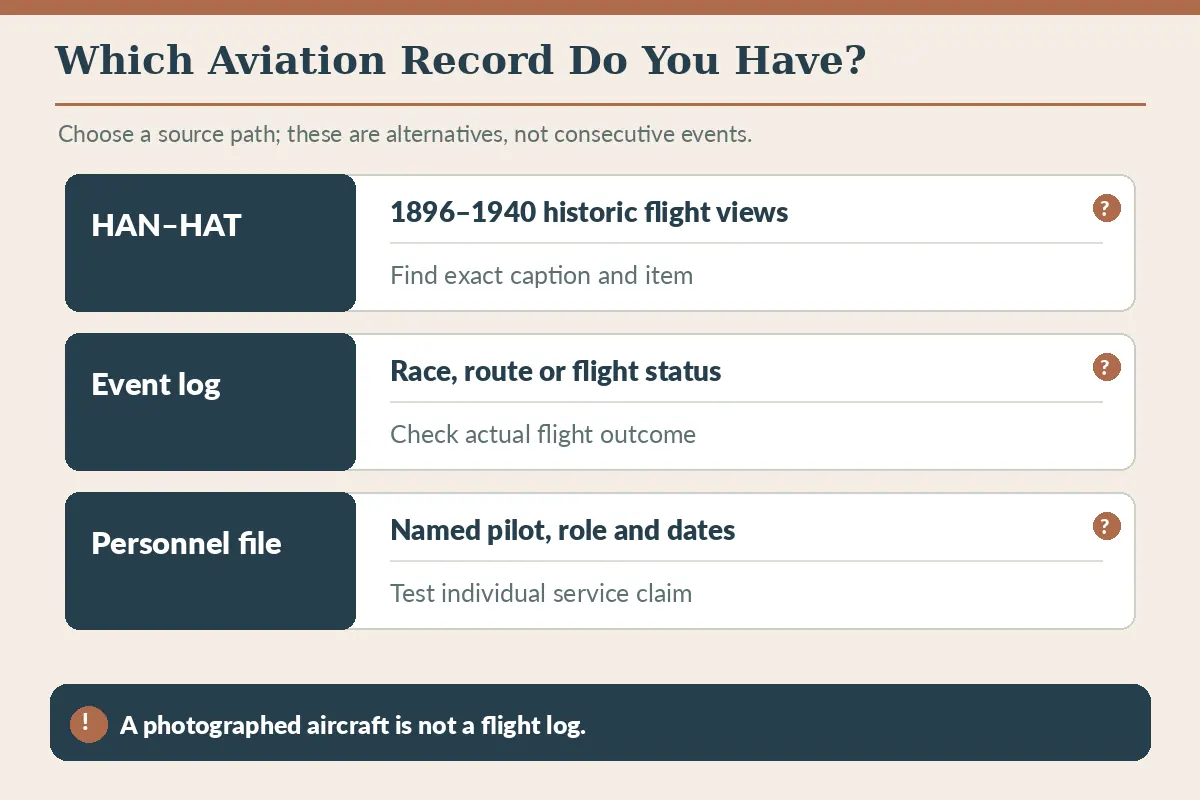
Section 80.11 of NARA’s RG 80 guide groups HAN, HAP, HAS and HAT together under historical flights and related aviation subjects for 1896–1940. The guide does not assign each named subseries a discrete date range or a fixed subject exclusivity. Do not manufacture an acronym expansion or assume every HAP photograph contains a pilot portrait. Search each code, full item titles, aircraft designations, air race names, expedition terms, and alternate historical spellings.
Once a candidate appears, capture the precise local identifier and the unaltered original caption. Note whether the catalog distinguishes a photographer’s date, event date, and later accession or reproduction. A montage assembled for a history exhibit may use older images. A copy labeled for a press release can be dated years after the actual flight. Record the format, condition notes and source of the caption; avoid silently replacing a period aircraft name with a modern museum label.
The department’s much larger RG 80 G/GK/CF photographs span ships, personnel, tests, and naval operations. RG 80 PA/PB personnel images and RG 80 PC publicity materials are different source streams. Their existence is useful for follow-up, but they are not mandatory sequential steps from HAN to HAT. A named pilot found elsewhere in the record group does not automatically appear in an early-flight print. Keep collection structure separate from the historical event narrative.
Identify the Aircraft and Event Before the Pilot

Aircraft can be identified through a registration, military serial, unit markings, unique structural details, or a contemporaneous caption. These cues have different strengths. A number seen on a wing can refer to an air-race entry, rather than a permanent military serial; a museum restoration may use later markings. Cross-check the image against an event program, flight log, contemporary newspaper report, squadron chronology, or manufacturer ledger with a clear date and aircraft match.
For a photograph labeled “historic flight,” ask what event is meant: preparation, departure, arrival, exhibition, record attempt, air race, or expedition press occasion. An aircraft photographed at the field is not evidence that it took off or completed the route. An image of an aviator in formal clothing is not necessarily a photograph of that person at the controls. When the caption names a famous pilot, verify whether the same image has been reused in later histories with different labels.
Maintain a flight ledger with columns for series and item ID, visible airframe and setting, catalog’s dated claim, independent event documentation, and remaining uncertainty. If the aircraft may have been rebuilt, compare photographs of that exact model and period; minor visible features are clues, not proof of a serial number without documentary linkage. If aircraft identity remains uncertain, keep the caption geographically and temporally limited.
Connect a Person Through Service and Event Evidence

Family researchers often begin with an oral account that a relative “flew for the Navy.” Treat that as a hypothesis requiring a full name, approximate dates, rank or civilian capacity, and documentary service context. Official Navy personnel files, aviation duty orders, muster information, flight logs, and unit records may have different survival and access limitations. A photograph cannot replace the service file simply because it comes from the Navy Department.
A named pilot could be a civilian racer, a naval officer, an Army pilot, a foreign guest, or a passenger. Compare event rosters with original personnel documents before deciding which role applies. A crew photograph might include mechanics, officials, observers and ground handlers; do not label all individuals “pilots.” For women aviators and early civilian flight participants, the absence of a Navy service record can reflect that a military personnel question was incorrectly applied to a civilian career. Seek the archive appropriate to the specific role.
When two aviators share a surname, test age, full name, service number, airfield and date in several independent sources. Do not identify a face by resemblance to a family photograph alone. Even when a caption securely names one person, it does not identify everyone standing in the background. Record confidence separately for aircraft identity, event, and each proposed individual. This separation allows a readable public story without creating a fictitious service history.
Cite the Photo Without Turning an Image Into a Flight Log
For each use, retain “National Archives, RG 80, exact HAN/HAP/HAS/HAT local identifier,” followed by item caption, its stated date, and catalog identifier. State who supplied any additional identification and when. Date a flight independently from a flight log or confirmed event report; cite that second source instead of letting an image stand in for its data.
If nothing is digitized under an expected pilot name, do not presume the photograph was destroyed or that the person never flew. These series are organized as historical pictures, not universal pilot registries. Ask NARA about the item and associated captions using the collection code, and compare separately with reliable personnel repositories. The research endpoint may be an identified aircraft without an identified pilot; that is still a valid and useful result.
More Records and Archives Guides
How We Research These Archival Photographs and Claims
The subject and coverage of the four lettered image series are based on NARA RG 80, section 80.11. We used the Still Picture Branch guide for interpreting archival picture descriptions and NARA’s catalog instructions for item searching. The article does not claim a particular pictured pilot or flight was verified. See our affiliate disclosure.
NARA collectively describes the historical aviation images from 1896 to 1940, not a separate year span for each code.
No. The subjects include historical flights, air races, expeditions and prominent aviators, not exclusively Navy fleet aircraft.
No. Establish what the number signifies and corroborate aircraft, date and the person with independent records.
No. A dated flight or event source is needed for that claim.
Start with the picture’s series and identifier; use names to test an identity once the aircraft and event are correctly placed.