
The United States Strategic Bombing Survey produced extensive records assessing the effects of wartime aerial attacks, but a photograph of its staff or offices is not an evaluation of damage. The National Archives describes 370 RG 243 A photographs showing Survey directors, staff, military officials, and facilities in England, Germany and Japan in 1945–1946. That is a compact, personnel-and-place-oriented photographic series within a much larger record group of European and Pacific survey reports, correspondence and analysis.
Start by separating three questions: whom does the image show, where and when was it made, and what did a distinct report conclude? An office portrait may be useful for organizational history without identifying which analysis the pictured person wrote. A survey image is not necessarily a photo of an air raid’s direct effects. The practical path is from an exact A identifier through the relevant administrative records, then to a specific report if it addresses the claim. Illustrated scenes in this article are interpretive, not archival replicas. Historical suffering and bombing damage should never be inferred from a staff photograph alone.
Start With the A Staff Photographs, Not Damage Images

NARA’s RG 243 general-records description includes 370 images in photographic series A for 1945–1946, showing directors, staff, military officials in Japan and England, and Survey installations in England, Germany and Japan. This is not a generic label for all photographs that document bombing effects. Other RG 243 sections and formats contain technical reports and survey data. To research a particular A photograph, record its exact caption, local identifier, depicted office or person, and the date stated at item level.
Check the historical label on the caption before correcting a place name or a title. Wartime and postwar offices moved, personnel rotated, and some locations had allied or military administration. A photograph of officials at a headquarters is not by itself proof of a particular field inspection. A named person may have been a visitor, military liaison, administrative employee or survey director. Do not apply the same occupational title to everyone in a group photograph.
The Survey also had predecessor organizations and changes in official designation during 1944. NARA describes the initial Combined Bomber Offensive Survey, Strategic Bombing Effects Survey, U.S. Bombing Research Mission, and later USSBS. That institutional sequence matters for dating correspondence and identifying signatures; it does not mean that an image showing a 1945 office was photographed during each previous phase. Use the name appearing in the source and explain the institutional change only when it affects interpretation.
Match a Portrait or Office to Administrative Evidence

Begin with a person named in the image description, then look for a named signature, personnel list, correspondence file or report distribution list. The RG 243 guide mentions general correspondence of the Survey chairman, published reports from the European and Pacific Surveys and other messages during the mid-1940s. These materials can establish a documented role or assignment. A staff member’s proximity to a report title is not proof of authorship; the report itself needs a byline, contribution statement or reliable official attribution.
For office views, compare a contemporaneous headquarters address, military unit designation, posting order or staff directory. A photograph of a building in Germany may show a survey installation, not the target of a raid. A portrait of a military official in Japan might reflect an official meeting rather than participation in a particular Pacific Survey interview. Separate the purpose of the photograph from the topic of the institution that created it. The archivist’s subject line may be broader than the exact event.
Make a ledger with five fields: A image number; caption text; identified person or facility; independent administrative document; claim still unproven. For family history, use a service record or employment document to establish a relative’s involvement before matching a face. If privacy or restricted files limit access, record that limitation rather than building an identity from appearance. The record group is a starting point for identifying context, not a substitute for the person-specific evidence.
Read Survey Findings in the Correct European or Pacific Files
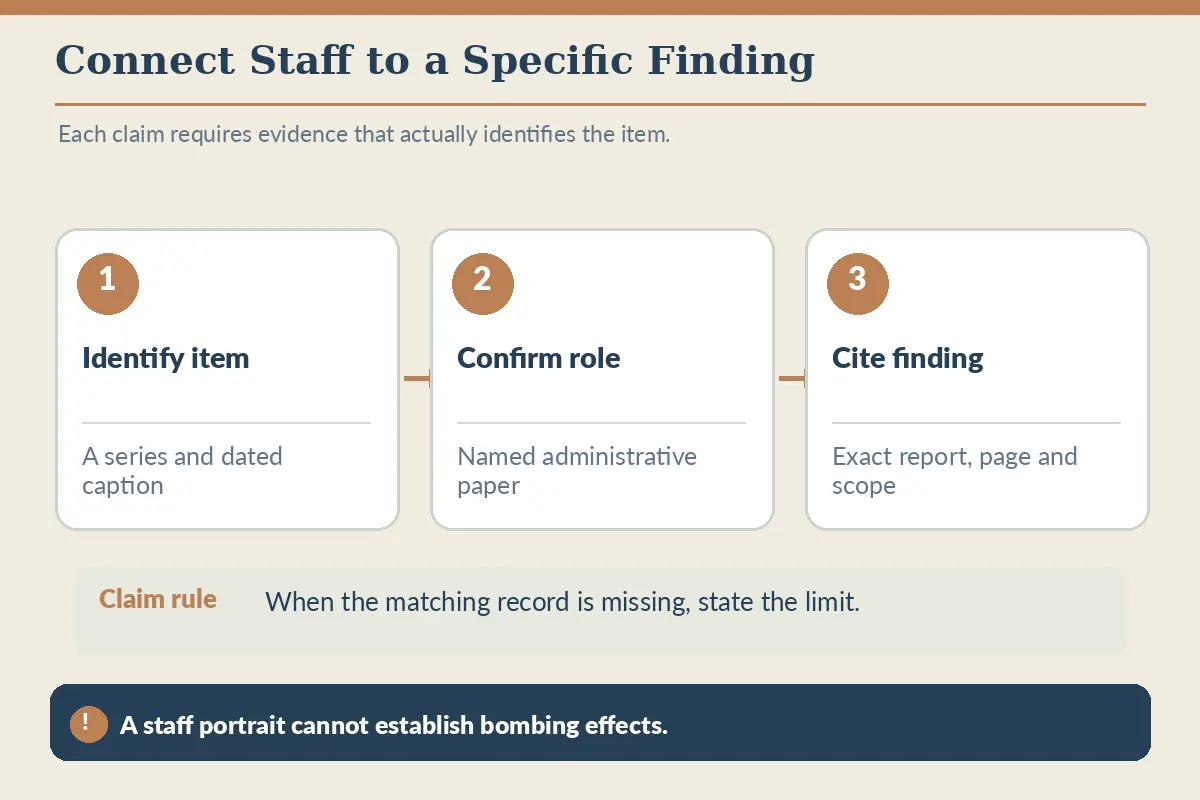
A portrait cannot prove a factory’s destruction, a citywide casualty estimate or an assessment of air power. Such claims must be supported by actual Survey reports or investigative records, read with attention to the branch, date, definitions, and method. RG 243 has separate European Survey and Pacific Survey sections. A finding about German industrial systems should not be sourced to an image of the Pacific Survey staff merely because both sit in one record group. Conversely, a view of an office in Japan cannot establish how its analysts interpreted a bombing’s effects.
Ask whether the cited finding came from an eyewitness interview, a sample, a later compiled report or a statistical reconstruction. Those methods can yield different scope and uncertainty. If a report gives a range, retain the range; if it addresses one district or industry, do not expand it to an entire country. Compare published conclusions with the underlying survey worksheets or correspondence when available. Documentation can be revised after an image was taken. Keep the photo date, investigation date and final report publication date in separate fields.
Respect the human dimensions of the subject. Do not identify a civilian casualty in a general photograph without legitimate reliable evidence, and do not describe a photographed person as a perpetrator or witness based solely on proximity to an office or an event. The most responsible use of RG 243 A may be a clear history of survey organization, with a separately cited analysis of its findings and limitations.
Cite the Staff Photo and Report Independently
A durable photo citation includes National Archives, RG 243 A, item or local identifier, caption, date expression and catalog identifier. A report citation needs its own title, authoring body, report number or series information, date and page. The source chain matters: a staff photograph and a report can complement each other without either proving the facts contained in the other.
If an A item is not searchable online, use NARA’s still-picture contact instructions and the exact identifier or caption wording. Do not treat the 370 images as a complete staff census or a claim that all are digitized. If a person appears in no surviving image, that absence says nothing conclusive about the person’s employment or contribution. Be explicit about what your archival evidence can establish, and your World War II research remains both more rigorous and more respectful.
More Research Method Guides
How We Research These Archival Photographs and Claims
We checked the exact A photographs, subject dates and named locations against NARA’s RG 243 sections 243.2–243.4. The Guide to Federal Records explanation clarifies the role of photographic series letters and survey sections. The still-picture page provides retrieval guidance. The article asserts no unidentified person or bombing outcome. See our affiliate disclosure.
A is the 370-image series of staff, officials and installations associated with the USSBS in 1945–1946.
The specific A description is primarily staff, officials and facilities; consult separate survey records for damage findings.
No. Require a report credit or independent administrative attribution.
Start with the European Survey or Pacific Survey sections respectively and check the precise report scope.
No. The archival count describes photographs, not every person employed or assigned.