
Start With What the 1946 Site Pictures Actually Show
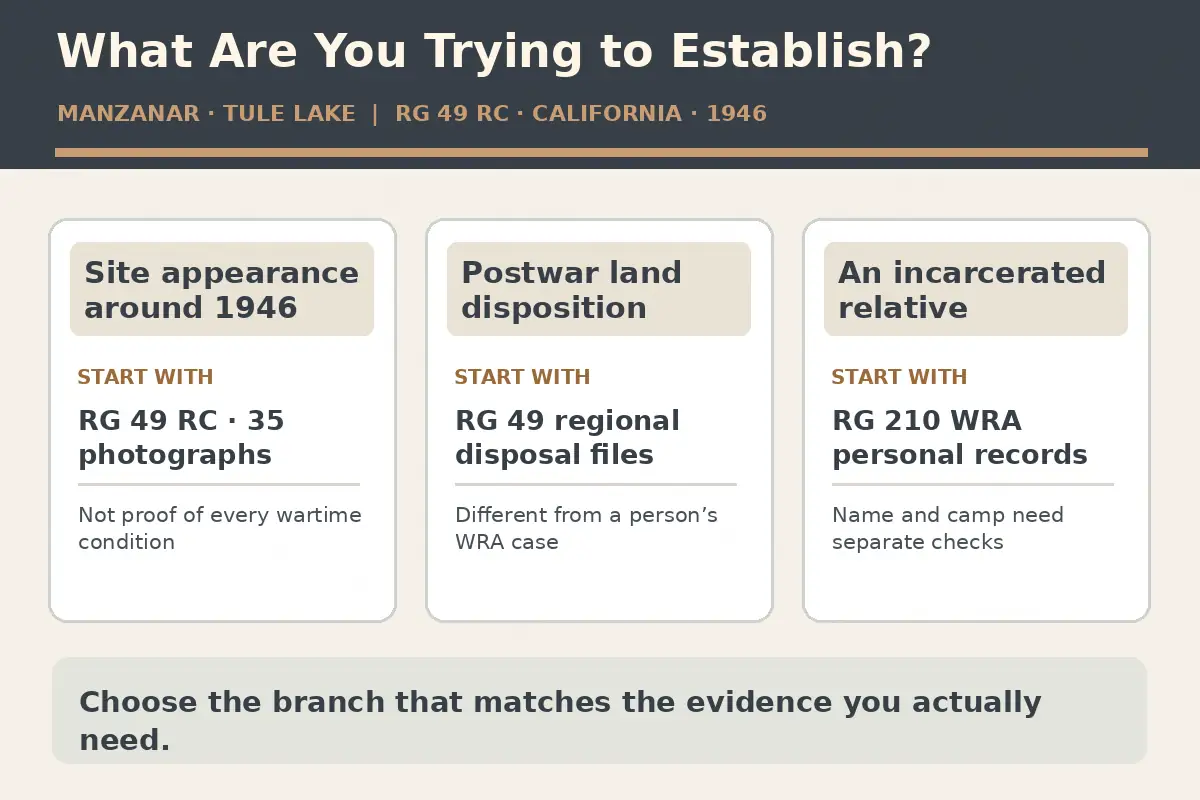
The National Archives lists 35 photographic prints of the Manzanar and Tule Lake sites in California, dated 1946, under Record Group 49, series RC. This is a modest, site-focused photographic group, not a complete visual history of the wartime mass incarceration of Japanese Americans. A picture of a barracks, fence, road or surrounding landscape can show the built environment at the time of the exposure. It does not identify every person confined there in previous years, or necessarily document conditions while a particular family was imprisoned.
The date distinction is critical. These photographs are described as 1946 material, while incarceration and camp operations had begun years earlier. Do not label a 1946 picture “life in the camp in 1942” without item-level evidence proving the earlier scene and date. Buildings could be altered, removed or repurposed. An empty street cannot establish that a site had never been occupied, and a standing building cannot tell which family lived inside it. Record any actual item date and compare it with the series date.
The National Archives preserves the historical term “War Relocation Center” in some record titles. In explaining the history, describe forced removal and incarceration plainly, rather than implying a voluntary move. Manzanar and Tule Lake must also be distinguished as places with different wartime histories, even when the 1946 archival grouping lists them together. Avoid using a single photograph to make a claim about both sites or about the experiences of all imprisoned people.
Follow Site-Disposal Records for Property Questions
The RG 49 guide separately describes regional land-administration records, including Manzanar and Tule Lake disposal files dated 1945–1948. These are a promising route when the question concerns what happened to buildings, equipment, facilities or land after the government’s wartime use. They are not the same thing as the RC still-picture collection. The archive’s record-group association reflects the land-administration provenance, not a transfer of all individual incarceration files into RG 49.
A disposal file could help identify a parcel, government facility, recipient or administrative decision if the specific file says so. But the heading alone does not demonstrate that a pictured barracks was sold, where it was moved, or which private family acquired it. Cross-reference the photo’s location with a dated site plan and an actual disposal document. Keep the original building label, if any, separate from a modern interpretation; inventory and barracks numbers may be difficult to read or reused.
Research into a site’s postwar physical history may involve federal land records, county records, agency correspondence and local preservation work. These sources answer different questions. A land transfer may identify a legal recipient without documenting an incarcerated family’s presence; a survivor recollection may identify a family’s former barracks but not the building’s later legal disposition. When the sources conflict, describe the difference rather than forcing a smooth chronology unsupported by documents.

Use WRA Records for the Family and Individual
For research on an incarcerated person, the National Archives identifies the records of the War Relocation Authority under Record Group 210. NARA’s Japanese American family research guide explains that WRA individual case files can contain identifying details and that individuals and families may appear in multiple agencies’ records. There is no simple assumption that one photograph of a site identifies all its residents. Begin with the person’s name and known variants, family relationships, place of origin and the camp dates from independently sourced records.
NARA’s incarceration records guide identifies WRA case files, summary cards and final accountability rosters among other documentary routes. The entries may be uneven, and some people were moved among sites or otherwise documented by different agencies. A roster or case file can provide a much stronger named link than a site photograph, but you must read the actual entry and understand what its dates and categories represent. A person named in a database is not thereby visible in every image of that center.
Sensitive family information requires care. Avoid displaying private or potentially harmful personal details simply because an archival record exists. Use respectful names and describe the historical reason for the federal record, not just the database fields. Distinguish voluntary recollections, official agency classifications and modern historical terminology. If an original record uses inaccurate or stigmatizing language, label it as an archival quotation rather than adopting it as the article’s own judgment.
If comparing a 1946 site image with a wartime map, annotate changes rather than drawing direct continuity. Barracks, fences, utility structures, roads and public facilities could remain, be altered or disappear as the site was closed and its assets handled by successor agencies. The map’s date, purpose and scale may be as important as the photograph’s. Never draw a specific route taken by an incarcerated person from a site picture alone. A reconstructed movement needs a record of the family, timing, relevant site locations and an explanation of uncertainty about changes in buildings between the mapped and photographed dates.
Caption the Site Without Reconstructing Unseen Lives
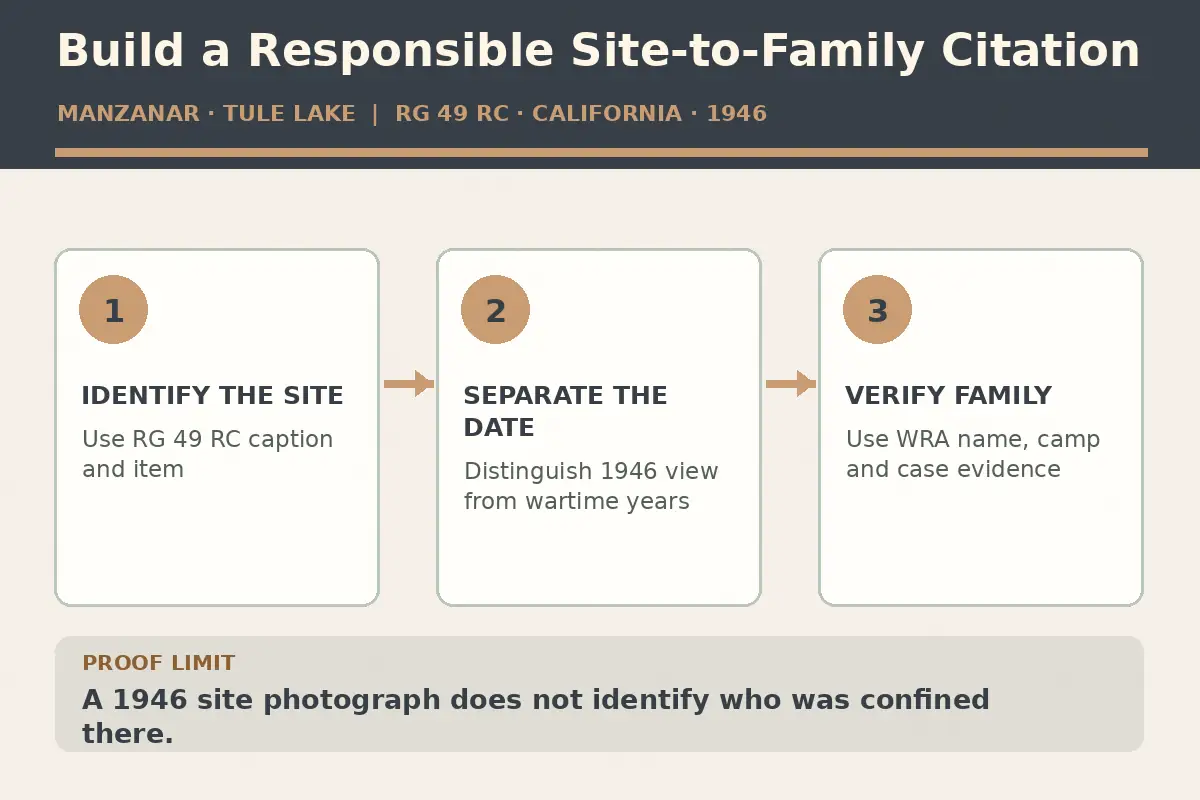
A precise image caption could read: “View of the Manzanar or Tule Lake site, California, National Archives RG 49, series RC, cataloged as 1946; people and former occupants not established by this image.” Use the actual item description to name the correct location, and supply an item number if one is available. Do not use an image of one camp to illustrate a claim about the other simply because both names appear in the series description.
A family history might combine an RG 210 case file verifying an individual’s incarceration with a clearly identified RG 49 RC site photograph. Explain what each contributes: the case file supports the person-level claim; the photo illustrates a site at another documented time. A postwar disposal file may supply a third layer about the site’s later administration. These layers should remain separately cited, with uncertainty noted where an exact barracks or parcel cannot be matched.
Consult the RG 49 description for RC and disposal records, the NARA genealogy guide for individual and family research, and the incarceration records overview for named record types. These authoritative sources distinguish site documentation from the lived experiences that records and family testimony may help reconstruct. Never substitute a general archival collection date for a person’s documented history.
More Research Method Guides
How We Research This Archival Evidence
For this guide we compared the official series-level inventory with independent repository context and checked that the archive descriptions refer to the specific medium, record group and date range cited. Sources consulted on November 15, 2026: National Archives reference 1, National Archives reference 2, National Archives reference 3, National Archives reference 4. The general guide does not substitute for a record-level inspection, so no individual identification or digitization claim is assumed here. We tested the subject and research intent against the supplied WordPress title inventory and the recent article batches, then kept the conclusions narrower than the source evidence. Editorial and commercial relationships: see the affiliate disclosure. This article does not assert any affiliate partnership.
A NARA series of 35 1946 photographic prints of the Manzanar and Tule Lake sites in California.
No. NARA describes RC as 1946 site pictures; wartime conditions require time-specific records.
NARA describes 1945–1948 Manzanar and Tule Lake disposal files among RG 49 regional records.
Search RG 210 War Relocation Authority records, including individual case files, indexes and relevant rosters.
Not on its own. A person- or barracks-specific claim requires a direct named record and careful location matching.