
Read the 47-Print Nashville Set as an Event Record
The National Archives lists 47 photographic prints showing African American youth at the second annual regional 4-H camp in Nashville, Tennessee, in 1949. The designation is Record Group 33, series H, within records of the Extension Service. This is a narrow visual set about a particular event, not a national membership register or a roster of every person who attended. A youth organization’s photographs can be rich family-history clues, but they require careful separation of event identification and personal identification.
Begin with the item-level caption, local number and any dates and place details. The guide establishes Nashville and 1949 for the H group; it does not necessarily label each person or day. A camp group picture could include guests, adult Extension agents, instructors, community leaders and youth attendees. Do not classify every visible person as a registered member, scholarship recipient or prizewinner simply from clothing, position or a banner in the scene.
Keep original historical vocabulary distinct from language used by your article. Federal catalog and correspondence descriptions may use terms that researchers now quote only to document the original filing language. When writing for families, use “African American” or “Black” unless a direct historical quotation warrants otherwise. Acknowledge the historic setting of segregated agricultural education without assuming the photograph alone proves any individual’s opportunities, treatment, or feelings about the event.
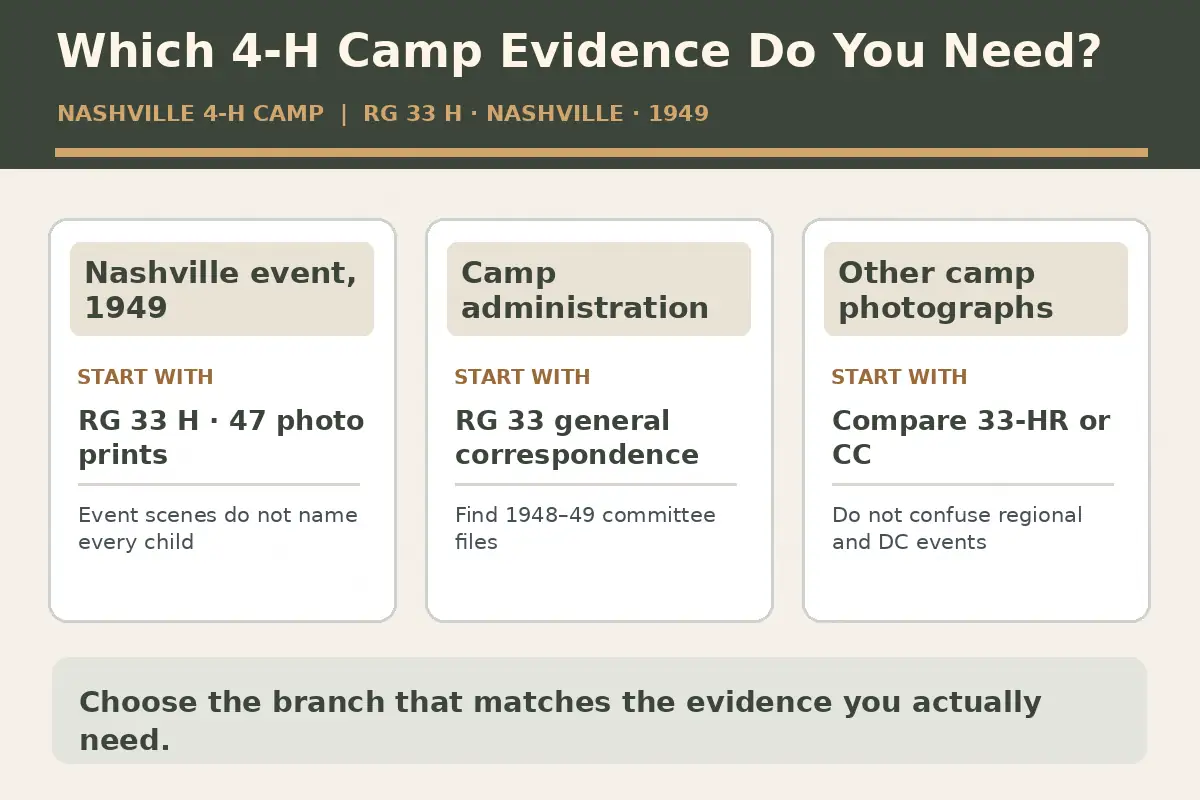
Use Committee Files to Explain the Camp’s Organization
NARA’s Record Group 33 guide to African American history points to general Extension Service correspondence, 1944–1949, including a 1948–1949 file on committees for Black 4-H camps. That filing reference supplies a different kind of evidence from the photo prints: planning, administration and related exchanges rather than an image of a particular camper. It can help researchers investigate why a camp was organized, which offices corresponded and what programs or venues were discussed, if the relevant files survive and actually contain those details.
Do not claim that the committee file includes a complete Nashville attendance roster unless you have inspected it. Its title alone supports an administrative route, not a conclusion about a named student. A letter mentioning an Extension agent may confirm that official’s involvement in planning without proving the agent stood in the photographed group. Build a two-column table: what an administrative document literally states, and which photographs—if any—show an identified related event.
For family research, seek a contemporaneous county Extension report, school newspaper, local newspaper, club scrapbook or program listing a specific participant. Compare names with ages, towns, school affiliations and parents when available. A common surname in the newspaper does not prove an unnamed child in a portrait is that student. The strongest cross-reference identifies the photograph or subject directly and connects that identification to a second independently produced record.

Do Not Substitute Other 4-H Camp Series
NARA separately describes RG 33-HR as photographs documenting African American youth at regional 4-H camps. The broader series description should not be treated as if each image were taken at Nashville in 1949. Another well-known set, RG 33 CC, consists of about 1,000 images from the National 4-H Club Camp in Washington, DC, in 1950. Those descriptions involve different series, places and dates; they cannot be collapsed into one album simply because the words “4-H camp” appear in each.
Make a clear source key for every reference: 33-H for the Nashville 1949 prints, 33-HR for other regional camp photography, and 33-CC for the 1950 Washington camp. If a derivative image is presented online without its original identifier, do not assign it one of these codes by intuition. Request the authentic local ID or compare the copy with the repository record. A banner with the organization’s name is useful for context but cannot place the camera in one particular state.
Use calendar and geography together. A participant documented in a 1950 national event could also have attended a 1949 regional event, but that possibility must not become a statement of fact. Conversely, the absence of a person’s name from a photo caption is not evidence they were not at camp. The 47 images are a small collection selected for preservation, not a complete surveillance record of everyone present throughout the program.
To evaluate a suggested identity, use a transparent confidence ladder. A name printed on an original caption is an attribution requiring source review. A contemporary roster matching a camp date and hometown is stronger evidence of attendance, but still may not identify a face. A named newspaper photo with an overlapping occasion can help connect the two, provided it shows unmistakable and independently documented features. A recollection from a descendant is valuable and should be credited; it should not be silently presented as a federal caption. Preserve a record of who supplied each identification and when, so corrections remain possible.

Write Respectful and Searchable Camp Captions
A cautious caption might read: “African American 4-H youth at the second annual regional 4-H camp, Nashville, Tennessee, 1949; National Archives, RG 33, series H; individual participants not identified in the consulted record.” Where a person is directly named in an authentic caption, preserve that attribution and cite the item number. If the name is supplied by a family member, mark the provenance of the identification and seek confirming documentary evidence before presenting it as certain.
Collect permission and context before publicly naming living people or using family photographs submitted by participants or descendants. The archive may hold a historical image, but identification can still involve privacy and accuracy concerns. A family story about a camp journey should be attributed to its storyteller, with dates and locations cross-checked where possible. An uncertain recollection can be valuable as a research lead while remaining clearly distinct from a federal record.
The NARA RG 33 guide establishes the H and CC descriptions, while its African American Extension Service guide documents the administrative correspondence route. For comparison, see the distinct 33-HR description. These sources allow a precise research plan, not an invented list of names. Preserve that evidentiary limit in every caption.
More Family Story and Preservation Guides
How We Research This Archival Evidence
For this guide we compared the official series-level inventory with independent repository context and checked that the archive descriptions refer to the specific medium, record group and date range cited. Sources consulted on November 15, 2026: National Archives reference 1, National Archives reference 2, National Archives reference 3, National Archives reference 4. The general guide does not substitute for a record-level inspection, so no individual identification or digitization claim is assumed here. We tested the subject and research intent against the supplied WordPress title inventory and the recent article batches, then kept the conclusions narrower than the source evidence. Editorial and commercial relationships: see the affiliate disclosure. This article does not assert any affiliate partnership.
The NARA guide lists 47 photographic prints in RG 33 H for the second annual regional camp.
No. It is a photograph series; individual attendance needs a reliable named source.
No. NARA separately describes 33-HR regional camp photographs; do not assume every image is Nashville 1949.
RG 33 CC concerns the Washington, DC, camp in 1950, not the Nashville 1949 event.
NARA identifies Extension Service 1948–1949 correspondence on committees for Black 4-H camps as a separate research route.