
Answer the Research Question Before Searching Names
A National 4-H Week poster can help date a youth-program message, an agricultural theme, or a period’s graphic style. It cannot, on its own, identify a local club member or establish that a particular child attended an event. The National Archives describes a specific visual and documentary cluster in Record Group 33, Records of the Extension Service: national posters from 1925–1985, accompanying information kits spanning 1925–1991, and correspondence and background papers about poster creation from 1951–1991.
These are three different evidentiary layers. A printed poster presents the message, a kit may explain how the message was meant to circulate, and a design file may document production or revisions. None is automatically a record of who received the poster, put it on a wall, or joined a club. A careful family historian starts by deciding whether the question concerns the national campaign, a locally displayed item, or participation by a named person.
Start With the Physical Poster and Its Date

Examine the actual print or a reliable archive image before trusting a circulating caption. Transcribe all visible text, including any year, sponsoring body, printer line, edition notice or slogan. Note whether the item is a full poster, cropped photograph, postcard adaptation or later digital reproduction. Date the artifact from its own markings and archival description, and keep that separate from a conjectured date when someone displayed it in a school or county office.
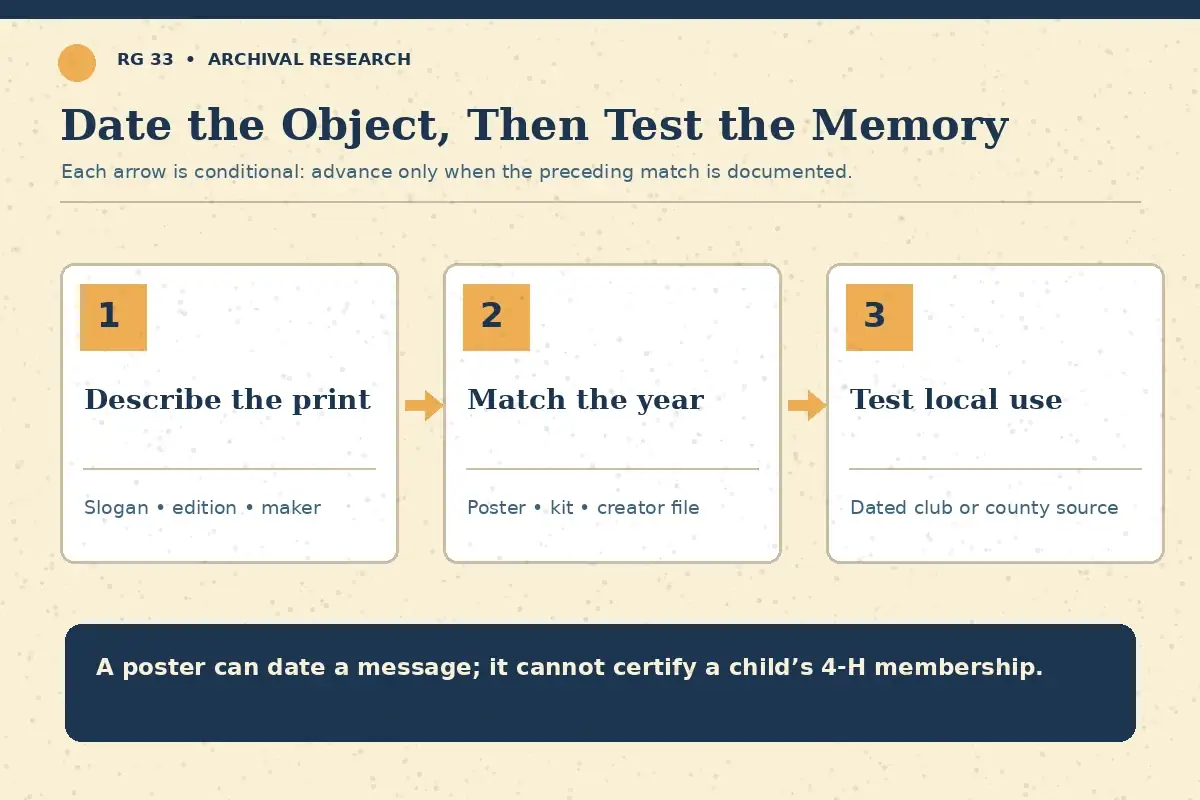
RG 33 section 33.9 lists National 4-H Week posters across 1925–1985. That span describes an archival series, not a promise that one poster survives for every year or location. A style resembling a 1940s design does not establish that it was produced or used in 1940. If a poster is undated, search for a matching design, slogan or text in the archive’s information kits or correspondence before applying a precise date.
Use Information Kits to Reconstruct the Campaign
The NARA guide connects the posters with National 4-H Week information kits dated 1925–1991. A kit may help clarify the intended message or the national communication campaign; verify its actual contents rather than assuming every kit includes the same set of documents. A kit’s issue date can establish a promotional context that a standalone picture misses. It does not show when a particular county used the material or which local youths saw it.
Create a campaign crosswalk with columns for year, poster wording, kit title, archive reference and any documented distribution instructions. If the kit and poster carry different years or revisions, retain both rather than treating them as a single edition. Describe distribution only when the item actually speaks to it. Local newspapers, extension-agent reports, school bulletins or family photographs may provide separate evidence that a campaign reached a specific community.
Follow the Design Paper Trail Only for the Years It Covers

Background correspondence concerning creation of National 4-H Week posters is described by NARA for 1951–1991. This later date window is important: a researcher looking for the story behind a 1930s print cannot assume a matching original design file exists in that series. A later paper might mention an older theme, but it would still be a later source. Search the available creator files with a clear year and design question.
A draft approval, printing instruction or edited slogan can tell you how a national message was shaped. It does not necessarily tell you how a poster was received by a family, what a club taught that year, or whether a student enrolled. Keep separate statements for intended message, documented publication, possible local adoption and proven personal involvement. This prevents a compelling illustration from carrying more genealogical weight than its evidence supports.
Find Local 4-H Participation in Local Records
If the real question is whether an ancestor belonged to a 4-H club, switch repositories. The national poster series is the wrong first stop for personal membership. Look for named county extension files, a dated school or club newsletter, contest results, a fair program, a membership card or a family scrapbook that identifies people. Verify the historical county and local office; the current county government may not hold early extension materials.
A photo showing several children beneath a 4-H Week poster can establish a scene only if the photograph’s origin, date and caption are reliable. Without names, it cannot prove which children are pictured or who was formally enrolled. Transcribe any names as attributed claims and seek a separate contemporaneous source. Respect privacy if the material includes living people; avoid publishing identifying school or youth records without permission.
Preserve the Difference Between Message and Memory
For a family history book, place the poster beside a short archival caption with its exact RG 33 provenance and a statement of what it depicts. If the family remembers hosting a fair or meeting, record the speaker, interview date and wording as testimony. The poster can illustrate the broader national program while the family story remains a separate, attributed source. A later recollection is not proved merely because a suitable poster exists.
Create three evidence labels: “national campaign,” “local use documented,” and “named participation verified.” Move from one label to the next only when another source warrants it. If the year is approximate, state the range and reason rather than inventing a print date. Keep the original file or high-resolution reproduction unaltered; a transcription and an explanatory caption should be stored separately from the archival image.
More Family Story and Preservation Guides
How We Research This Archival Record Group
We reviewed the official National Archives guide to RG 33 for the creating office, identified record categories, date ranges and the limits that make this search different from a broad keyword search. Its descriptions establish that particular materials are held or described, not that a proposed file, named person or unexamined document is already verified. We preserve distinctions between a series, a file unit and an item, and do not invent a catalog identifier where the source gives none.
We also cross-checked NARA guidance on using the Catalog and additional subject context from the sources documented for this page. Availability, digital access and processing arrangements can change; researchers should confirm the current custodian and request instructions. For reproducibility, cite the creator, RG number, series, file identification, exact date and where the original was consulted. If a link offers only an overview, say so instead of claiming to have read a specific manuscript page. See GenHis’s affiliate disclosure; this research route does not require a paid partner.
NARA describes National 4-H Week posters from 1925 to 1985, not a guarantee of an item for every year.
Yes. The guide describes accompanying information kits dated 1925–1991.
Correspondence and background papers on poster creation are described from 1951 to 1991.
No. Local rolls, fair programs, school materials or other named evidence are needed.
Visual style may suggest a range, but a precise date needs an archival match or a contemporary reference.