
The National Archives lists 881 photographs from Robert B. Stanton’s 1889–1890 Colorado River survey within Record Group 57. That is a remarkable historical visual collection, but an image of a boat, camp or surveyor is not proof that a named relative took part. The first task is to identify the photograph, its caption and the place shown; the second is to evaluate whether there is reliable, independent evidence for the people in the frame. Treat those as separate research questions.
The NARA guide to the U.S. Geological Survey, section 57.14, describes the Stanton photographs for 1889–1890 under series identifiers RS, RSA and RSB. These abbreviations are finding handles, not names of river stations or proof of photographer attribution on an individual print. Use the full image reference when requesting an item. The guide also lists other Colorado-related photographs; do not treat every RG 57 landscape as belonging to Stanton’s party.
Find the Stanton Series Before Guessing a Location
Start with the collection name and RS, RSA or RSB identifier, then work toward the unique negative, print or item reference. A search for “Colorado River” alone may retrieve much later photographs, images from another survey, or illustrations of a different stretch of the river. Capture the catalog description verbatim. Where there is a sequence, keep adjacent image identifiers because they may supply contextual clues, but do not assume all consecutive frames were exposed on the same day.

NARA describes 881 Stanton survey photographs. This is a series count reported in its guide, not a promise that every original is online or individually captioned. A web thumbnail may omit margins with handwritten numbers or publication annotations. If the caption refers to a camp, river rapid or geological feature, transcribe the exact wording and note whether it came from an original negative sleeve, a later catalog description or a modern secondary identification.
Check a River Reach Against Dated Maps
The Colorado River changes appearance with viewpoint, flow, weather and later engineering. A rock wall or bend can be distinctive, but a visual match made without a dated map is still provisional. Compare an image’s direction of view, skyline, tributary mouth, channel width and prominent formations to contemporary survey maps where available. Be cautious when matching historical scenery to modern aerial imagery; reservoirs, roads and altered shorelines may have transformed the site.
Make a location note with confidence levels: “caption explicitly names place,” “terrain comparison suggests place,” or “location unknown.” A survey itinerary can help place an image within a general expedition phase, but it is not a GPS track. Do not claim exact coordinates merely because the party passed through a well-known canyon. If a photograph resembles a famous rapid, seek two independent landmarks and consult a river historian or primary survey notes before attaching a geographic label.
Interpret Equipment, Boats, and People Cautiously
A tripod, measuring instrument, riverboat or camp supply may support the interpretation that a scene concerns survey work. These objects do not name their operators. A figure’s clothing, beard or stance is insufficient for identifying an ancestor, especially when the image’s detail is weak. Ask whether an original caption names a person, whether the individual is located consistently in other images, and whether an independently documented expedition roster or diary places that person at the scene.

Photographs can show temporary activities that leave no surviving personnel paperwork in the same series. A family letter claiming service with the Stanton expedition is a lead, not a caption to every unidentified group photo. Keep candidate identities side by side and mark contradictions. If the person’s known residence or age conflicts with the survey dates, do not dismiss the discrepancy without checking the source, but do not silently adjust the story either.
Distinguish Original Frames From Later Reproductions
A printed book illustration, archival copy negative, modern scan and original historical photograph may derive from one exposure. Citation should point to the earliest identifiable object and separately identify the digital representation you consulted. Retouched images or cropped prints can remove location information. When a caption changes between editions, cite both and explain which description is contemporary and which is an interpretation added later.
NARA’s Still Picture reproduction guidance emphasizes series, box and item-level identifiers. Follow that practice when possible. Save the accession or local identifier rather than a filename supplied by a social-media account. If an image is presented as an authenticated Stanton photograph without such provenance, treat the attribution as a research question and look for a match in the institutional collection.
Create a Scene-to-Person Evidence Table
For each photograph, document the archival identifier, caption source, apparent landmarks, visible activity, any named individuals and the certainty of each inference. In another column record the independent source: a diary, field report, correspondence, expedition roster or contemporary publication. This table prevents an easy error in historical writing, where a verified landscape is used to imply an unverified person stood in the pictured party.
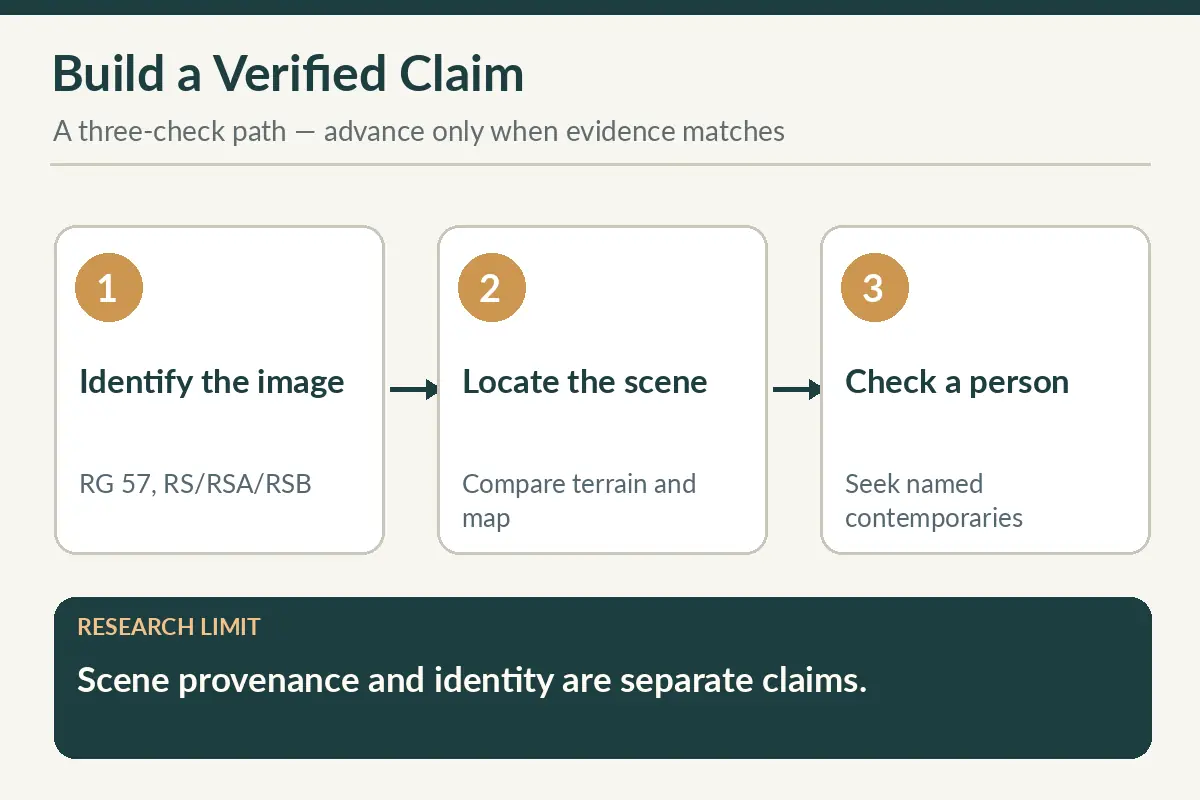
A useful hypothetical finding is a photograph captioned as a river camp near a particular reach, with three unnamed men in front of a boat. The safe conclusion is that the photographed scene represents that camp if the caption is reliable. The unsafe conclusion is that one figure is a specific ancestor because a family story places him near the river in 1889. To name him, obtain a contemporary identification or strong convergent documentary evidence.
How We Research Colorado River Photographs
Our method uses two linked but distinct provenance chains: image-to-location and image-to-person. First, reproduce the item citation and evaluate any original caption against geographical features. Next, examine a named-person hypothesis against dated records unrelated to the photograph. Keep the surveyed period, 1889–1890, visible on the research note, and explain when an image is undated within that interval. The image is a direct witness to a scene, but only a limited witness to names.
Consult the NARA series guide and still-picture staff instructions before requesting a reproduction. Preserve crop boundaries and avoid decorative alterations that could be mistaken for original photographic markings. Include a link to the affiliate disclosure when linking from this research site. A modern illustration accompanying the article is not an archival photograph. For publication, attribute the actual historic item only after confirming its status and citation.
More Research Method Guides
Frequently Asked Questions About the Records
The RG 57 guide lists 881 images for Robert B. Stanton’s 1889–1890 survey.
No. They are series or photographic identifiers, not person-level identifications.
Sometimes tentatively, but a dated map, caption and multiple landmarks improve confidence.
It can suggest a candidate, but corroborating contemporary evidence is needed to identify the figure.
Do not assume so; check item descriptions and reproduction options with NARA.