
The National Archives’ Record Group 18 still-picture listing identifies ten photographs of in-flight refueling operations from 1923, designated HER. The small size of the photographic group makes it a promising research starting point for early aviation historians, but it is not a complete list of 1923 refueling flights. A dramatic aerial photograph cannot by itself provide the aircraft’s full mission record, name everyone aboard, or prove that a test became regular operational practice.
Begin with the RG 18 Army Air Forces guide, which lists the HER material, then use NARA’s Still Picture Branch explanation of record series and content dates. For a family-history claim, distinguish the photographed operation from a named person’s military service and keep the original caption rather than a later online summary as the first source.
Find HER Without Confusing Nearby Aviation Photo Groups
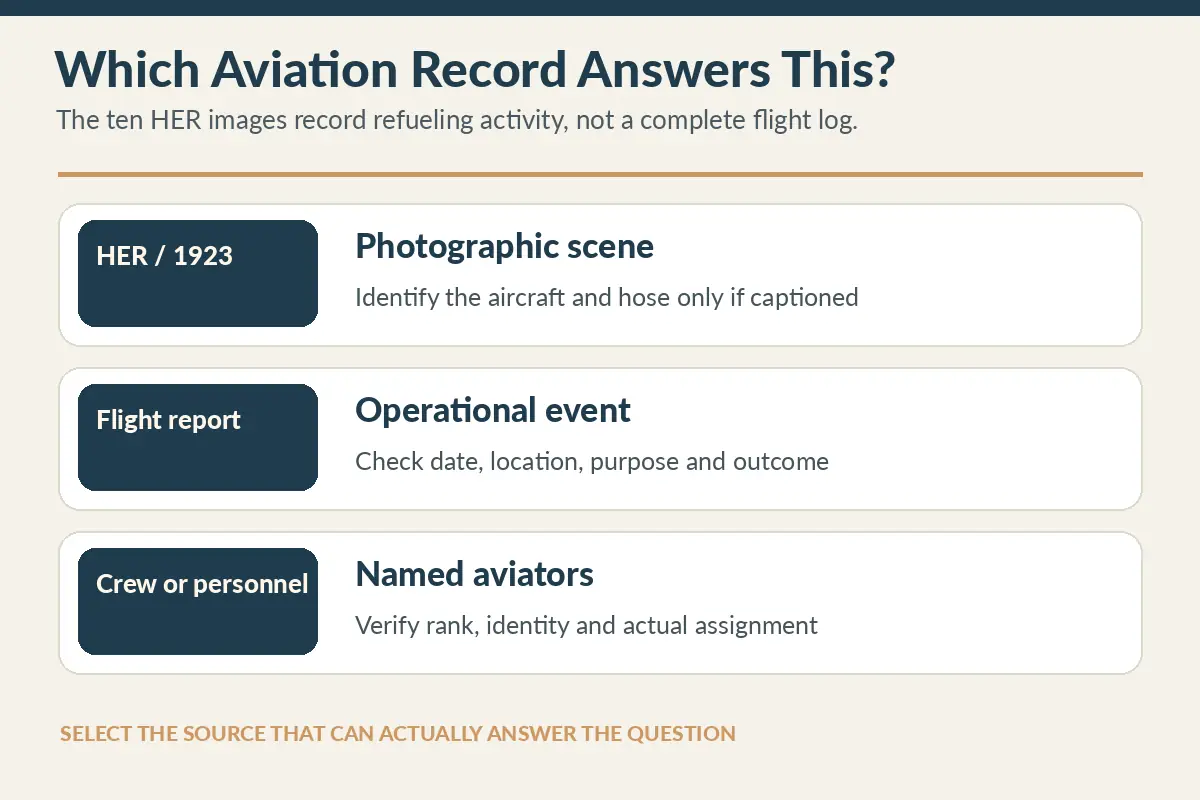
RG 18 includes many photographic designators for different subjects and eras, among them personnel portraits, airfield views and broad aviation activities. HER is a narrow ten-image description for in-flight refueling in 1923. Search by both RG 18 and HER, and retain the full item identifier and caption as shown by the archive. Do not import information from an unrelated aircraft photograph simply because the airplane appears to be of a similar model.
Because an item can have later copies, captions or circulation histories, identify the actual image you are discussing. A subject date of 1923 is not necessarily a precisely dated exposure for every reproduction. If a digital image shows no serial number, pilot name or location, note that limit. Search catalog descriptions and associated finding aids rather than supplying an attractive unsupported detail from aviation folklore.
Identify Aircraft by Evidence, Not by Silhouette Alone
A refueling image may show two aircraft, a fuel line or crew positions, but perspective and image quality can conceal identifying markings. Compare clearly legible numbers, unit insignia, aircraft configurations and camera vantage with independent period records. An airplane type alone does not establish the precise serial number. Repeated tests could involve similar aircraft and photographs from different moments of one operation.
Write the visual observation in neutral language: “two aircraft in apparent refueling formation,” for example, if the connecting equipment cannot be seen clearly. Where NARA labels an image as an in-flight refueling view, attribute that identification to the archival caption while reserving further claims about equipment, safety or success for a report. Avoid drawing an operational procedure from one angle of a historical demonstration.
Date the Photograph and Find the Flight Report

The NARA group-level date is 1923. To attach a specific month, day, location or flight purpose, look for a caption or contemporaneous report recording those particulars. A published retelling may summarize several early aviation demonstrations into a single story; check its cited originals. Multiple photos can document one event, and one archived group may omit other events entirely. Ten images do not imply ten distinct missions.
A flight record, test report, newspaper account or unit document may confirm where the operation took place and what participants intended to demonstrate. Keep the status of every claim clear: the photograph shows an observable scene, the report states the recorded result, and a later historical account offers interpretation. A reported successful demonstration is not evidence of routine service across the whole air arm.
Confirm the Aviator Through Named Service Evidence
Family researchers sometimes encounter a photograph labeled only “1923 refueling” and attach it to an ancestor known to have served as a pilot. Shared aviation service is not sufficient identification. Confirm the person’s name, assignment dates, unit and location through named personnel documentation, orders or reliable contemporary rosters before placing them in the operation. A unit’s presence at an airfield does not automatically prove the presence of every member.
If a caption actually names crew members, treat that as a promising but still examinable identification. Compare full names and service details, and distinguish pilots from photographers, ground personnel and later commentators. When no independent link exists, describe the photograph as early-aviation context and keep the ancestor’s documented service in a separate paragraph. That preserves both the picture and the family story without merging their evidence.
Cite an Aviation Scene Without Inventing Its Outcome

A useful archival caption contains NARA, RG 18, series HER, a specific item identifier, the source’s descriptive title and the applicable 1923 date or narrower verified date. State whether you read the actual digital item or only the NARA group description. Do not refer to an unseen flight log or assume all ten views have been digitized. Availability may differ between the historical guide and current catalog records.
Keep explanatory graphics simple and truthful. A diagram can show the choice between a photograph, flight documentation and personnel records; it should not portray a speculative aircraft model or operational sequence as if sourced from the HER photographs. When uncertainties remain, expose them in the caption. Readers looking for early aviation history benefit more from an accurate limitation than from false precision.
Institutional names are another trap for 1923 researchers. RG 18 is the modern archival record-group classification for records of the Army Air Forces and its predecessors; it does not mean that a 1923 crew served under every later organization named in the group title. Preserve the unit and office names as used by the contemporary report. Likewise, a later museum caption may use a modern aircraft nickname or retrospective label; the original record should control the historical terminology whenever it is legible. This matters when distinguishing a family member’s career from the long institutional history of military aviation.
Worked Example: A Family Photograph Said to Show a Pilot
Suppose a descendant finds a print of two aircraft above a field and hears that a great-grandfather helped with the first refueling experiments. Compare the print with an identified HER item and transcribe differences in crop or caption. Next find the ancestor’s dated service assignment and any documentary mention of an early aviation test. Do not assume that a matching general aircraft type or year proves that the photographed crew includes the relative.
If a contemporary report names the aviator and describes the event, cross-reference its date and location with the photo’s item record. If that link is missing, a defensible family narrative can say the relative served in aviation during the era of the operations illustrated by RG 18 HER, while the identity of those pictured remains unverified.
More Records and Archives Guides
How We Research and Check Archival Evidence
We checked the specific ten-image, 1923 HER statement in the RG 18 inventory and consulted NARA’s pictorial records guidance. We do not claim the photographs identify a particular crew or attest to the success of an entire program without item-level and independent evidence.
For GenHis disclosure of optional affiliate relationships, read the affiliate disclosure; no paid historical source is presumed in this research example.
Ten photographs of 1923 in-flight refueling operations.
No. The series description is not a complete operational flight log.
Only a reliable named caption or independent matching service documentation can support that claim.
No. Broader operational history needs dated technical and unit records.
Quote the archive caption and mark additional aircraft or crew identification as provisional.