
Start with the Land Office Transaction, Not a Modern Address
To trace early Pennsylvania land, find the original transaction in State Archives Record Group 17, then follow the application, warrant, survey and patent as distinct papers. The Pennsylvania State Archives land guide explains that an application requests land, a warrant authorizes survey activity, and a patent is the final conveyance. One piece does not automatically prove all later ownership. Before searching a surname, establish the historical county, rough location and a likely date range.
Pennsylvania’s state land office evidence chiefly documents transfer from the Proprietors or post-Revolution Commonwealth to first purchasers. It is not a substitute for a county recorder’s full deed chain. If the family story concerns a farmhouse occupied decades after an original patent, first establish the later parcel and deed owner; otherwise a same-surname warrant in the county may be irrelevant. Preserve the legal description as it changes over time, and distinguish a person requesting land from the person eventually receiving a patent.
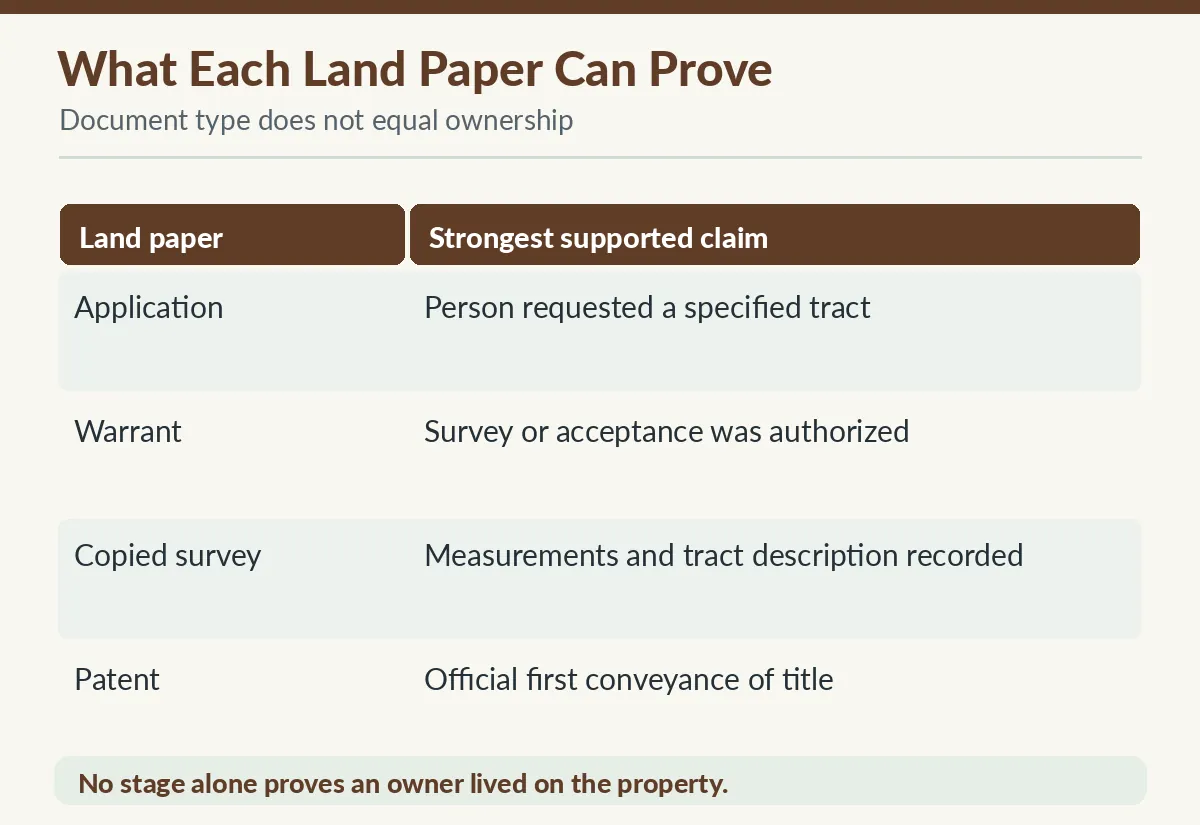
Separate Applications, Warrants, Surveys, and Patents
An application, sometimes called a location, records the request to take up land. The Archives lists Applications for Warrants for 1734–1952, with a chronological arrangement and a special 1762–1776 ordering exception. Warrants are instructions authorizing a survey or acceptance of one; the State Archives specifically notes they do not convey all property rights. A copied survey depicts boundaries, measurements and acreage. A final patent records the government or proprietary conveyance. Record each stage with its own date and series rather than choosing the earliest year as the purchase year.
The same tract may generate names of applicants, warrantees, surveyors, assignees and patentees. These roles need not belong to one individual. Write a four-column transcription listing document title, personal role, tract reference and stated date. When a patent names someone other than the applicant, search for an assignment or other explanation. Treat the discrepancy as evidence to investigate, not as proof that two people with the same surname were relatives.

Use the Proper Index and Access Route
The State Archives provides land indices, applications, original warrants, copied surveys and patent books by multiple digital and archival routes. Availability differs: some images reside on Archives services while others require FamilySearch or viewing at a participating center. Consult the official copies and access guide before promising that an index link opens every original. Save the exact index title, record group and book-page reference and check whether you have an actual image or only a finding aid.
The Archives’ copied survey series includes labeled groups such as A–Z, A-1 to A-89 and C-1 to C-234; its guide notes that certain later D-series original surveys were not copied. Do not convert those filing labels into township or parcel numbers. They locate volumes within the record system. If an index gives a survey reference but no immediate image, move to the appropriate series or request details from the Archives. A successful name hit without a tract-reference chain is a lead, not a completed land history.
Read a Historical Survey Without Moving a Boundary
A survey may give acreage, adjoining tracts, bearings, lines and geographic clues. Sketch the shape as historical evidence, but never drop it onto a current street map and claim inch-perfect precision. Units, monuments, streams and adjoining ownership could have changed; a copied survey may also represent a formal transcription of an earlier measurement. Check the survey’s date and whether it is original, copied, accepted or returned. What matters for identification is a cluster of matching tract descriptions and record references, not one attractive polygon.
Imagine two separate tracts with similar names but different watercourses. A warrantee’s surname and acreage match your target, but the survey’s named adjoining owner does not appear in later county deeds. Keep the match provisional and inspect other warrants in the historical township. Conversely, if a patent references the exact survey book and location, the documents form a much stronger chain. This is an invented example illustrating how to compare descriptions, not an archival transcription.
Turn to County Deeds for Later Transactions
After the initial patent, subsequent sales and inheritances normally require county deed books, probate material, court actions and tax rolls. A tract might be subdivided, merged or renumbered, so follow grantor and grantee, area and boundary descriptions in both directions. A recorded deed supports a conveyance as stated; it does not by itself prove that every named party resided there. Tax and census entries can test occupation, but each has its own temporal and legal limits.
If the search stalls because the patent was issued to an assignee, use the gap as a specific question: who held what interest between the original warrant and the final patent? Do not bridge that interval with a family tree copied from a website. When archives do not provide an online survey or application, submit a focused request using the record identifiers you have already confirmed. Paying for the right record is more efficient than purchasing a vaguely described property-history packet.

More House and Local History Guides
How We Research Pennsylvania First-Purchaser Records
We first consult the Pennsylvania State Archives record definitions and series, then its current access instructions. Our worksheet distinguishes the request, legal survey authority, measured tract and final patent, rather than treating those terms as interchangeable. Every supporting image is cited by the specific book, page or index reference supplied, not by an assumed modern lot number.
Our final comparison shows three columns: directly stated by the item, inferred from multiple items, and unresolved. Family relationships require independent estate, church or civil documentation. We never infer the first purchaser’s occupation or age merely from a patent, because the Archives warns that land-office records often provide little personal biography. See our affiliate disclosure for commercial transparency; archive links here are chosen for evidence, not referral payment.
Not by itself. The State Archives describes the warrant as authority for surveying or accepting a survey; the patent is the final conveyance of title from the Penns or the Commonwealth.
It is the Records of the Commonwealth Land Office held by the Pennsylvania State Archives, containing several record stages and associated indexes.
No. A copied survey reflects an historical tract description. Modern parcel IDs, road names and boundaries may have changed; corroborate with deed chains and later maps.
Possibly, but the Commonwealth land record normally tracks the first purchase. Consult county deeds, taxes and other local material for subsequent owners and occupants.
Verify the historical county and land office used at the record date and trace the associated survey or patent reference before discarding the candidate.