
Search a Claim Dossier, Not a Modern Deed
To trace a colonial-era Florida holding, begin with Florida Memory’s Spanish Land Grants, then open the claim dossier for the named person. These papers were assembled after Florida passed from Spain to the United States in 1821. The federal authorities had to determine whether an asserted Spanish title should be honored. A claim file may combine petitions, testimony, surveys, correspondence, deeds, wills, and translations created at different dates. It is neither a single original deed nor a continuous chain of modern ownership.
Florida’s Second Spanish Period ran from 1783 to 1821; the archive’s confirmed and unconfirmed claims series are described as covering 1763–1821 because some underlying assertions and documents reach earlier years. Distinguish the grant date, the date a settler claimed or cultivated a parcel, the later adjudication, and any modern catalog date. A land grant associated with one surname is evidence for that claimant’s legal process, not a conclusion about all family members who later lived nearby. Write down the name exactly as indexed before testing spelling variations in translated paperwork.
Choose Between State Series S 990 and S 991
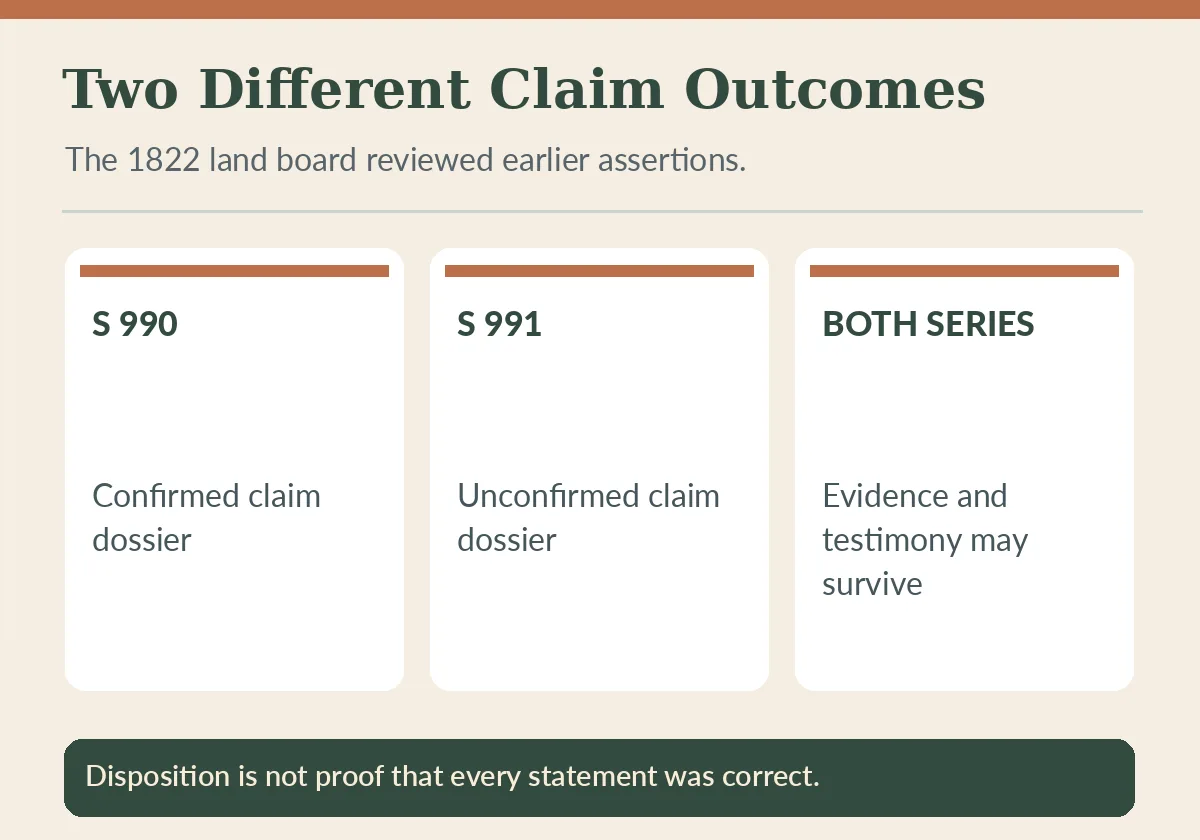
The State Archives’ series descriptions separate confirmed claims, S 990, from unconfirmed claims, S 991. Both have dossiers produced from material submitted to the Board of Land Commissioners established in 1822. The Board’s task was to examine title evidence after territorial transfer. The file jacket may name the applicant, acreage, disposition, and an American State Papers reference. Never describe an unconfirmed S 991 claim as a proven grant, but do not dismiss the papers as worthless: they may be uniquely rich evidence about residence or local transactions.
The disposition describes the particular legal determination, not whether every statement within the supporting dossier is historically true. A valid Spanish grant might be difficult to match to a modern parcel because locations changed and contemporary surveys were imperfect. Likewise an unconfirmed application may be informative about a family’s attempt to occupy, purchase, or exchange land without demonstrating secure title. Keep confirmed status, testimony about use, boundaries on a drawing, and later transfer separately in your notes. Series identifiers belong in citations because the same family name can recur in more than one documentary context.
Read the Plat, Testimony, and Translation Together
A grant package can contain a memorial to a Spanish governor, a royal concession or copy, deeds and bequests, a survey, a sketch plat, and sworn statements intended to prove residence and cultivation. Open every document in its original sequence where possible. Compare the location names and neighboring owners in the plat against textual boundary calls. Do not silently turn a hand-drawn line into a precise modern GPS position. Florida Memory cautions that claims could overlap and surveys might not have been verified on the ground.
Spanish and English forms of names or place descriptions may differ because papers were translated for U.S. officials. Transcribe the language actually visible and note if a page is a copy or translation. Separate a named witness from a landholder, and a requested acreage from the surveyed area. A witness reporting long residence may have firsthand knowledge of a neighbor’s cultivation, yet that observation does not by itself establish a continuous family pedigree. Search probate and parish materials independently when the question concerns heirs instead of boundaries.
Account for West Florida Losses and Other Series
The state explicitly warns that most supporting documents for West Florida claims are missing. This is a regional preservation limit, not a verdict that a settler left no property evidence. The territorial research guide also points to memorials and concessions outside the two main dossier series, including S 992 for East Florida and S 993 for St. Augustine lots. Search those only where the location and claim type actually fit. Do not substitute a city-lot memorial for an agricultural tract.
For an asserted later owner, extend the record chain into U.S. territorial and state-era land systems. The Florida guide distinguishes General Land Office tract books beginning in 1824 from Spanish adjudication documents. A federal tract-book entry and a colonial-era dossier answer different questions; even when names resemble each other, the parcel description and chronology must bridge the records. If a deed is missing, record the gap plainly and compare neighboring parcels, taxes, probate, and later conveyances rather than inventing a transfer.

Document the Exact Claim and Its Conflicts
Keep a six-part extraction for each case: claimant and alternate names, grant or petition date, location wording, acreage, witnesses and asserted occupation, and adjudication result. Add the file-jacket reference, S 990 or S 991, image position, and any cited American State Papers page. If two dossier maps overlap, document both as competing descriptions without making an arbitrary choice. Small-scale historical plats should be treated as contextual evidence until independently reconciled with surveys of known orientation and date.
A useful research conclusion might say that an identified person asserted possession of a named tract and supplied a dated witness statement, while the federal board recorded the claim as unconfirmed. That is a precise historical outcome and more informative than either “owned Florida land” or “had no land.” When a later deed or tract book supports a continuation of that holding, cite the later record separately. An archive website’s free image download is a means of access, not a substitute for describing the precise source from which a claim was drawn.

More House and Local History Guides
How We Research Spanish Land Claims
We compare the Florida Memory collection introduction with the State Archives’ S 990 and S 991 series descriptions before designing the search path. The introductory timeline clarifies why the dossier contains documents predating the 1822 board. We inspect what the repository says about West Florida losses and overlapping surveys rather than accepting a modern family compilation as a complete legal history. We also identify S 992 and S 993 as different documentary classes rather than automatically blending them into a single series.
In a worked claim audit, every observation is labeled as physical document, translation, witness report, or board disposition. Contradictions become research questions; they are not averaged into a fictional property boundary. Readers should recheck the repository’s current navigation and image availability before requesting any copy. The affiliate disclosure describes the site’s policy; archive links in this guide identify custodians and collections, without claiming a commercial partnership.
It is the State Archives of Florida series for Spanish land grant claims confirmed after the United States examined the submitted evidence.
Dossiers of claims not confirmed as valid. The supporting papers can still be useful for studying claimants, witnesses, and historical locations.
Florida Memory states that most West Florida supporting claim records are missing. Search other surviving territorial sources and document the gap.
Not by itself. Some historical surveys were unverified, overlapping, or inaccurate; reconcile with dated and measured later records.
Not automatically. Wills or testimony may name relatives, but identify the informant and corroborate the relationship independently.