
AT 62 contains photographs of properties and interiors around Britain that had been modernized with the help of home improvement grants. The National Archives dates the photographic holdings to 1968–1973. These are useful for building and housing history, but a photographed kitchen or new bathroom does not tell you the name of the person who owned, funded or lived in that property. This guide gives a precise source route, identifies what the archive can and cannot show, and names the independent documents needed before a personal or geographic conclusion becomes defensible.
Begin with the Property, Not an Unverified Household
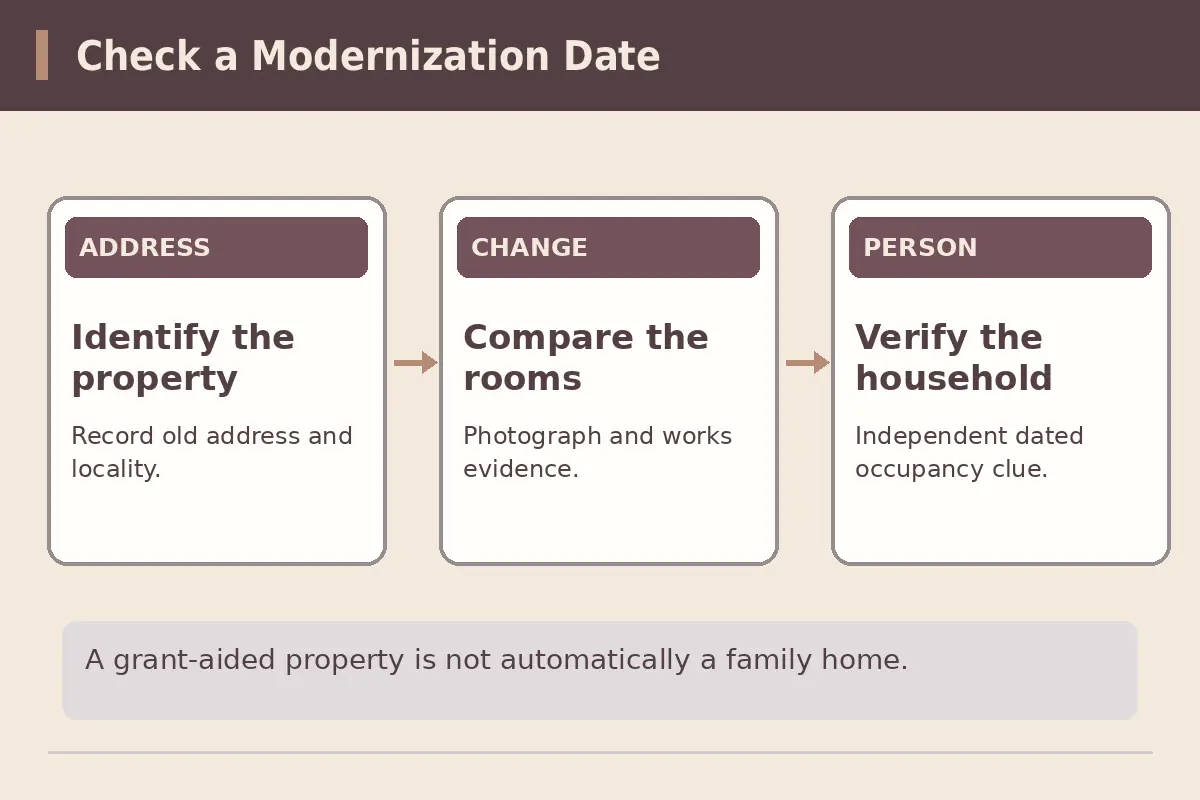
The first question should identify the house: its historic address, village or town, approximate location and the period of the alleged changes. Some streets were renumbered or redeveloped after the late 1960s, so a modern address may not align perfectly with an archival description. Gather an old directory listing, a historical plan or another dated location anchor before matching photographs. Search AT 62 in The National Archives Discovery catalogue for the town, street, administrative district and relevant housing terms. Note whether a result identifies an individual property or a broader group of examples.
The official photographic guide gives 1968–1973 for the collection and says the pictures show grant-aided modernization of properties and interiors around Britain. This does not prove all grants were issued in those exact years or that every photograph carries a street address. A catalogue title may be written at file rather than individual-print level. Copy the full reference and all descriptive wording; if the room cannot be placed at a particular address, do not attach it to a family merely because the photograph resembles the remembered kitchen.

Separate a Photograph from a Grant Decision
A photograph may show a modernized bathroom, new windows or another visible change, but it cannot always say which contractor performed the work, when the grant was approved or what expenses were paid. A photograph taken after changes may still depict earlier fittings and reused materials. Build a three-date timeline: the date of the image, the date of any grant decision and the independently established completion date, if a completion record survives. Do not collapse them into one “renovation year” unless the same reliable documents support doing so.
If the paper file includes a proposal, survey, inspection or financial statement, identify its administrative purpose. A proposed modernization plan is not evidence of a completed renovation. A granted application is not itself proof that every listed alteration was made. Conversely, an interior photograph that shows a new layout may be more direct evidence of physical condition than the application, while offering less information about funding. Label the kind of claim each document supports and preserve any differences.
Hypothetical example: an AT 62 photograph is captioned as a modernized terraced house in a district during 1971, but the street is not specified. A family memoir recalls a similar kitchen. Treat this as a possible contextual comparison only; identify a piece-level address or independent plan before assigning the image to that home. Visual resemblance is not a property identifier.

Read Room Changes and Address Evidence Carefully
Photograph comparison works best when it uses stable architectural features: the position of a stair, chimney breast, doors, window openings or outside wall. Portable furniture, wallpaper and appliances are more easily changed, and several houses of the same type may have near-identical rooms. Before deciding that two images show a before-and-after sequence, check the caption, camera viewpoint and any room numbers. Repeating cupboards or floor tiles may be suggestive but not enough to prove both frames show the same property.
Use a map, planning file or building control record when available to test the street address and physical change. A grant photograph may be an illustrative case chosen to demonstrate a housing policy rather than a systematic record of every home in the district. The lack of a particular house in AT 62 should not be read as evidence it received no improvement grant. Archive selection, incomplete item descriptions and survival must be investigated before a missing result becomes meaningful.
Find Owners and Occupants in Different Records
For genealogical research, establish separately whether a person was a registered owner, landlord, tenant, lodger or other resident. A title deed can demonstrate a legal interest in the property, but it does not automatically prove personal residence. A rate book may identify the person assessed or an occupier under the local rating practice, while an electoral register documents eligible registered voters rather than every family member. Housing grant records could refer to applicants, agents or administrative bodies whose role differs from the actual resident.
Construct a person-and-property matrix with one row for each source. Record the dated address, name, stated role and what that entry cannot show. If two occupants share a surname, resist assuming a parent-child relationship from proximity. If a grant file names an applicant but the interior photograph names no one, the photograph still documents a place or a physical condition, not the applicant’s personal presence in the room. A claim that “Grandmother lived here after the renovation” needs a dated personal source as well.
Preserve the Image Reference and Your Uncertainty
Most images in The National Archives’ photographic collections are not available online. Check the AT 62 reference and the current viewing or copying instructions before promising a download. Once you see a photograph, record any caption, printed marks, sequence and position within the folder. Describe only visible details before adding an interpretation. For example, “newly tiled wall visible” is an observation; “grant money paid for the tiling in 1970” is a different claim that requires other documentation.
When preparing a house history, pair captions with their exact archival references and credit any separate map, rate list or deed used to establish an address. If you create a reconstruction of the room or a color comparison, label the reconstruction clearly; do not present it as an original photograph. State uncertainties where address, date or occupant remains unresolved. The result should help future family members distinguish the house’s physical history from household biography rather than confuse the two timelines.
Even if a house is unambiguously identified, the photograph may be an excellent source for its fittings, lighting or room arrangement without telling you who cooked there, owned the property or funded a job. Place that detail in a building chronology. Use separately cited ownership and occupancy evidence for the people. Retaining this division makes a family history more accurate and more useful.
More House and Local History Guides
How We Research This Archive Series
This guide starts with the documented evidence in an authoritative source, not a claim that we have inspected a particular person’s private file or a specific original piece. The archival statements here concern the series or research method. A hypothetical example is labelled as such; it is not a newly discovered historical event. We use the Discovery search guidance to distinguish keyword matches from archive holdings and document contents, because catalogue descriptions do not transcribe every word of an original.
For every real candidate, record its historical place or person’s name, the creator, document type, date, full AT 62 piece or item reference, access restrictions, and the exact claim being tested. The official citation guide explains how to document those references so another researcher can retrace them. An unread document remains a catalogue lead, never proof of imagined details. If a record is missing, preserve the searched terms and dates and examine survival and alternate custodians before interpreting the gap.
Before sharing a conclusion, audit the difference between original source wording and your interpretation. Require independent evidence for any further claim about an individual, property owner, legal effect, or completed action. Respect archival access limits and living people’s privacy. This website also provides an affiliate disclosure; no paid partnership or commercial access is implied by these archival references.
The National Archives describes photographs of properties and interiors modernized with the help of home improvement grants, dating to 1968–1973.
Do not assume it does. Check the individual file and caption before assigning a photograph to a property.
No. A visible alteration and an administrative grant or payment are different claims that need separate evidence.
Not usually. Consult appropriate dated household, address, tenancy or ownership records.
No. AT 62 is an archival photographic collection, not an exhaustive register of every improvement project.