
AN 28 contains British Railways Eastern Region civil engineer photographs dated across 1949–1971. The National Archives identifies architects photographs from 1953–1956 and a five-volume group of Darlington railway workshop facilities, staff and training scenes dated 1951–1958. These are strong site-history leads, but a photographed workshop cannot establish that a specific relative worked in the room. This guide gives a precise source route, identifies what the archive can and cannot show, and names the independent documents needed before a personal or geographic conclusion becomes defensible.
Choose the Building or Workshop Subseries First
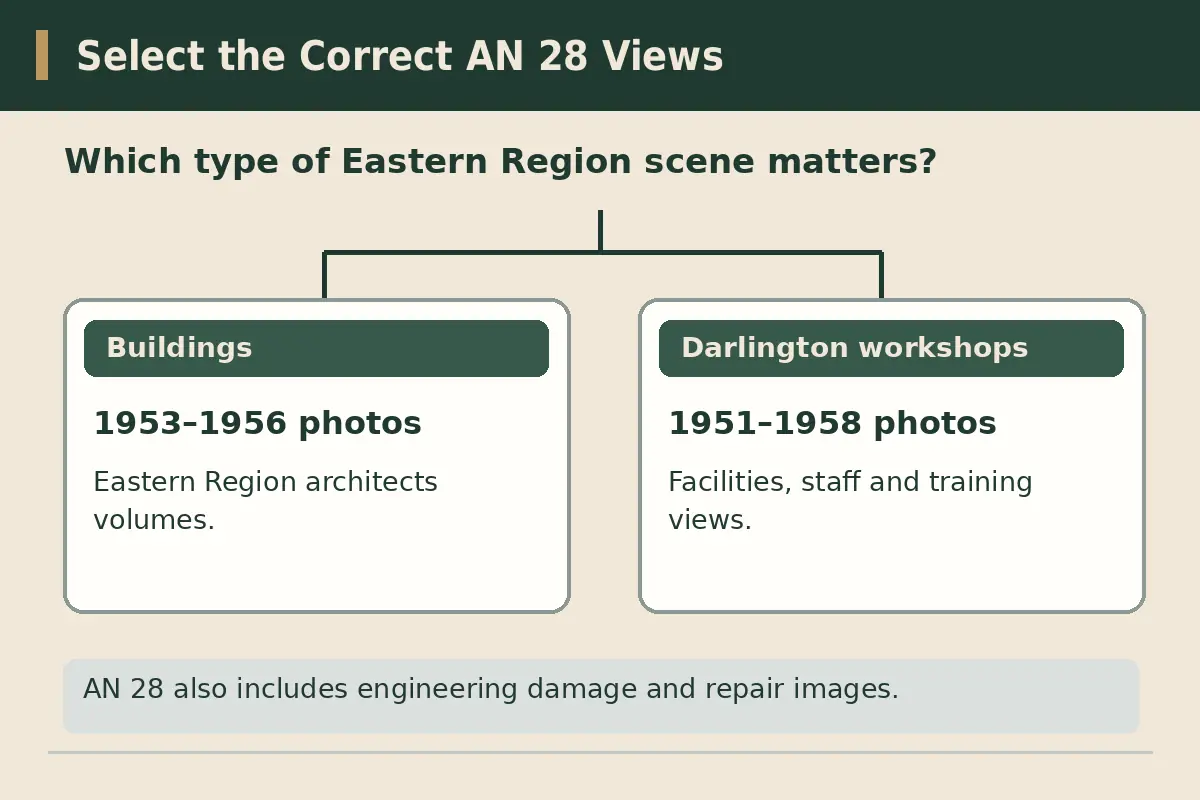
AN 28 is not a single series of photographs taken on a single day. The National Archives places it among British Railways Eastern Region Civil Engineer records, giving 1949–1971 as the broader range. Within it, four architects photograph volumes cover 1953–1956, while five volumes concern Darlington workshop facilities, staff and training procedures in 1951–1958. Those subgroups serve different questions. Start by choosing the establishment, kind of room or engineering problem you want to investigate, then browse or search the series descriptions and the relevant volumes rather than searching only for a railway employee’s surname.
Record the exact catalogue title and its date range for each promising volume. A subject label such as “staff and training” does not imply that every figure in the photographs is named or that the collection constitutes a personnel register. The official guide also mentions views of track or building damage and repairs compiled for training new engineers. Such a photograph may document a technical example without identifying an accident date, a responsible individual or whether the depicted repair was actually carried out at the photograph’s location.
Distinguish the Exposure Date from the Album Range
A file spanning several years tells you when its photographs were created or collected within an archival description; it does not provide an exact exposure date for every image. Transcribe image captions, sequence numbers and any written date separately from the overarching volume dates. Identify visible signs such as roof configuration, machinery, tracks, benches or new walls, but remember that equipment can be moved and old photographs can be copied into later training albums. A dated print and a dated annotated plan are different evidentiary objects and must be recorded in separate columns.
Build a photographic comparison register with reference, physical location, viewpoint, caption wording, apparent alteration and external corroboration. If two views show changed windows in a workshop, that suggests a change between image dates, not a date for the actual remodeling. Likewise a photograph of a damaged bridge can reveal its condition at one moment without proving the precise cause. Use dated work orders, engineers’ correspondence, approved drawings or inspection records to decide whether the image is of work planned, underway or completed.
Hypothetical example: an architect image dated 1955 depicts a brick workshop door, while a later plan proposes replacing it. Without a completion or inspection record, the plan is evidence of a proposal and the photograph is evidence of an earlier visible arrangement. Neither proves when the replacement was installed. Keep proposed work and observed work as separate rows in your chronology.

Read Training Images as Examples, Not Attendance Rolls
The Darlington photographs include facilities, staff and training procedures according to the official description. A training photograph can illustrate a method or workplace arrangement without proving that every employee underwent that lesson. If a person is named in a caption, check whether the name belongs to an instructor, photographer, engineer, visitor or worker, and whether the identification was made at the time or added later. An unnamed face should never be assigned to a family member just because age and occupation appear plausible.
If your question concerns an ancestor’s railway career, begin a separate person-level evidence trail. Use staff records, wage documents, apprenticeship records, retirement information or another named series appropriate to the employer and dates. Confirm middle initials, workplace, position and dates before joining it to an AN 28 image. Even a well-supported staff member at Darlington in 1954 is not proven to appear in an undated photograph of a classroom or engine bay. Presence at the site and presence in one frame are independent claims.
Use Engineering Papers to Verify Building Change
The broader civil engineer context helps interpret railway infrastructure. Architects photographs are particularly useful for seeing existing building fabric, but they do not always reveal whether a later scheme was approved, funded or completed. Compare image details with successive maps, station or workshop plans, asset inventories and engineering minutes where they survive. Write down competing dates as an interval when the evidence cannot narrow the event. A newly visible gantry may indicate a phase of modernization without giving the installation date or the name of its contractor.
When a photograph shows damaged track or repaired masonry, distinguish a condition report from a claim of negligence. The presence of a defect does not identify who caused it, and a teaching collection may use photographs from different locations. Match place signs, structural geometry and the original caption before placing the event on a map. A potentially interesting but unidentified scene belongs in a research log as “location uncertain,” rather than being silently merged with another station whose features look similar.

Obtain the Original Frame and Cite Its Limits
Most photographs held by The National Archives are not available for direct viewing online. The official photographic guide recommends using Discovery and explains that some images require a visit or a copy order. A catalogue description at volume level cannot substitute for reading each caption. Capture the full AN 28 reference, page or print number, date and physical arrangement when you see the record; note whether you consulted an original photograph, reproduction or catalogue summary.
In a family or local history publication, label reconstruction drawings as reconstructions and credit original photographs with a traceable archival reference. Explain any inferred construction interval and cite the independent plans behind it. Where an album does not show a particular building or year, consider the photographer’s selection, missing cataloguing and preservation before claiming the building did not exist. The proper conclusion is often a well-identified photographic phase plus a set of unanswered research questions.
If family tradition says an ancestor trained at Darlington in the 1950s, treat the AN 28 training scenes as context. Obtain separate personnel evidence for the named person’s employment and a dated posting or training record before associating that individual with the program. A captionless group photograph should be described as an unidentified group, even when it is tempting to fill in a familiar surname.
More House and Local History Guides
How We Research This Archive Series
This guide starts with the documented evidence in an authoritative source, not a claim that we have inspected a particular person’s private file or a specific original piece. The archival statements here concern the series or research method. A hypothetical example is labelled as such; it is not a newly discovered historical event. We use the Discovery search guidance to distinguish keyword matches from archive holdings and document contents, because catalogue descriptions do not transcribe every word of an original.
For every real candidate, record its historical place or person’s name, the creator, document type, date, full AN 28 piece or item reference, access restrictions, and the exact claim being tested. The official citation guide explains how to document those references so another researcher can retrace them. An unread document remains a catalogue lead, never proof of imagined details. If a record is missing, preserve the searched terms and dates and examine survival and alternate custodians before interpreting the gap.
Before sharing a conclusion, audit the difference between original source wording and your interpretation. Require independent evidence for any further claim about an individual, property owner, legal effect, or completed action. Respect archival access limits and living people’s privacy. This website also provides an affiliate disclosure; no paid partnership or commercial access is implied by these archival references.
The National Archives describes Eastern Region Civil Engineer records from 1949 to 1971, with several more narrowly dated photographic subseries.
Yes. The official photographic guide identifies five volumes covering facilities, staff and training procedures at Darlington in 1951–1958.
No, not usually by themselves. A named railway employment record must establish the individual’s job and dates.
No. It may capture condition, damage or an intermediate phase. Verify any claimed completion using dated engineering documentation.
Do not assume so. Check Discovery and The National Archives copying or reading-room options for the relevant volume.