
A Deposited Plan Is a Proposal, Not a Journey
RAIL 1071 contains parliamentary deposited plans, principally related to railways but also including some canals and tramways. Such plans are records of schemes presented for legislative consideration, not a complete map of railways that eventually opened. Begin with the company or bill name, route locality and proposed date. The existence of a drawing does not prove that Parliament approved it, that land was purchased, or that tracks were laid.
The National Archives railways guide places RAIL 1071 alongside broader railway map series and company records. Parliamentary documentation must be read at the correct stage: an initial deposited line, a revised alignment and an as-built route can disagree without anyone making an error. Each represents a different historical act.
For family or property research, the valuable question is often whether a proposed scheme crossed an identifiable estate, farm, garden or street. Record the plan’s stated scale, orientation, sheets, chainage or plot references if present. Do not interpret every drawn parcel as proof that a named owner resided there or received compensation.
Trace the Bill, Session and Version of the Route
The National Archives guide to maps and plans explains that thousands of plans accompanied private bills, including railway and tramroad schemes from 1802. Some related bills were not introduced or never passed; others have committee annotations recording proposed changes. That makes the exact bill and session as important as the geographic place.
A useful first-stage worksheet contains BILL OR COMPANY, SESSION OR DATE, RAIL 1071 ITEM, PLAN SHEET, AFFECTED AREA and DOCUMENT STATE. If the title contains “deposited,” “proposed,” “amended” or similar language, preserve it as written. Do not silently upgrade those terms to “authorized” or “constructed.”
If a plan refers to an accompanying reference book or schedule of lands, look for that specific document rather than guessing owners from the map alone. Reference books may name property interests, but the roles of owner, lessee and occupier require direct reading. An owner’s name on a schedule is not proof of a residence at the site.

Read a Plan Without Inventing Compensation
Follow the scale, north point, boundary symbols and any legend printed on the particular plan. Identify the centerline of the proposed railway and the limits of land affected, rather than marking every adjacent property as part of the railway. A plotted route may be imprecise when transferred to a modern map; preserve the scale uncertainty and do not invent latitude and longitude for an unsurveyed feature.
If a property appears in a plan, three separate questions follow: did the bill advance, was the plotted alignment approved, and was the relevant parcel actually taken? The answer to one does not imply the others. Parliamentary plans may be amended and a project can fail entirely; compensation or conveyance usually needs land agreements, conveyances, company files or related legal evidence.
Create an evidence grid with SOURCE, DOCUMENTED FACT and UNPROVEN CLAIM. For RAIL 1071, the documented fact is often a proposed alignment at a named date. For a parliamentary bill, it may be a procedural stage. For a later survey, it may be the physical presence of a line. Do not draw a causal arrow from proposal straight to construction without the connecting record.

Test Whether a Line Was Actually Constructed
Compare the proposed route with appropriately dated later maps, construction accounts, a company minute book, a contemporary timetable or an opening announcement when available. This is a corroboration task; one source may show track infrastructure while another establishes the date passenger or freight service began. A railway can be built but never open for the expected traffic, or its operating name can change.
The National Archives holds railway company material and several distinct RAIL map collections. RAIL 1030, for example, covers plans of proposed as well as constructed railways. Treat this as a parallel research route, not a mandatory sequential series for every RAIL 1071 plan. Check the creator and piece description to avoid conflating two different schemes in the same county.
When comparing two alignments, record the date and scale of each. If the later line lies one field away from the deposited plan, that discrepancy matters to property history. But a mismatch does not independently establish that an owner resisted the project; that would require correspondence, petitions or parliamentary evidence about the reason for a revision.
A parliamentary plan can also show relationships between infrastructure and established routes, but these depend on the document’s legend. Note the difference between a boundary line, a parcel number, a cutting, an embankment and a proposed centerline when those symbols actually appear. Transcribing the accompanying schedule is more reliable than interpreting colored washes by guesswork. If a later version adds a deviation, compare the altered section instead of pretending that every sheet belongs to one final approved layout.
More House and Local History Guides
How We Research Railway Plans and Land Claims
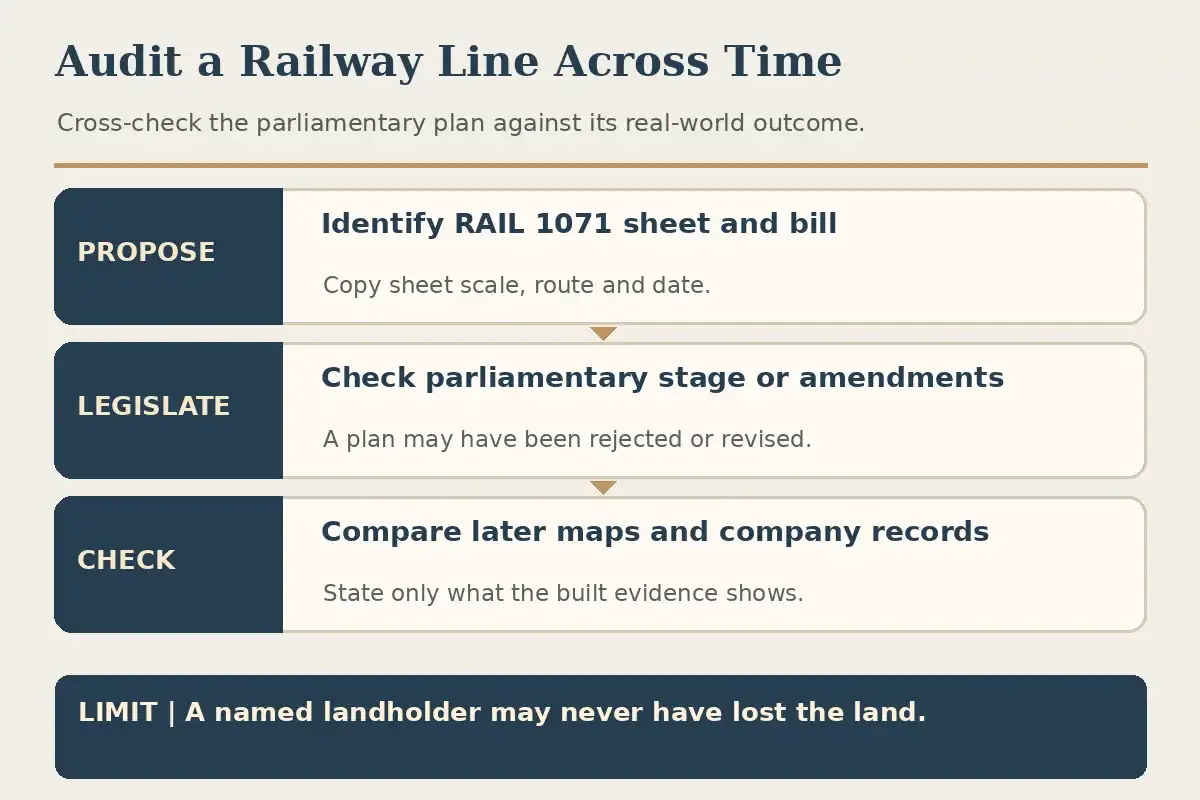
We record the deposited plan’s item reference, proposed scheme and document state, then search separately for the bill outcome and route as built. The accompanying diagrams illustrate alternative evidence paths and do not pretend to be a georeferenced survey of any real line. This prevents an attractive map from becoming a fictional account of a family’s displacement.
For a property claim, keep a timeline of PROPOSAL, BILL STAGE, LAND INTEREST and CONSTRUCTION PROOF. Leave a cell blank when the record is not found. Historical field names, company names and county jurisdictions should be transcribed from dated sources rather than modernized without explanation. Check whether the archive you consult holds the document or simply describes another repository’s holdings.
Many maps are not freely downloadable, as The National Archives explains; copies or a reading-room visit may be necessary. Verify the current access route and cite the document you actually saw. The affiliate disclosure applies to any later commercial recommendations, but no paid service can replace the bill-versus-built distinction.
No. RAIL 1071 includes deposited parliamentary proposals, some of which were never constructed.
Sometimes an accompanying reference book or schedule can identify interests; the plan alone does not establish ownership or residence.
Search the bill and session; The National Archives also points to House of Lords and Commons deposited private-bill plan series.
Compare the proposal with later contemporary maps and independent company, construction or operating records.
Call it a proposed or deposited alignment at the document date, not an operational railway.