
Find the Certificates in Their Charles I Context
The National Archives’ reference key for State Papers Domestic explicitly maps “Trinity House Certificates” to SP 16/16–17, within the Charles I record series. These are ordnance certificates associated with a maritime institution, not a complete seamen’s register or a modern merchant shipping database. Start from a defined historical claim: which certificate, which date, which person or vessel if actually named, and what was certified? Read the surviving item before proposing more.
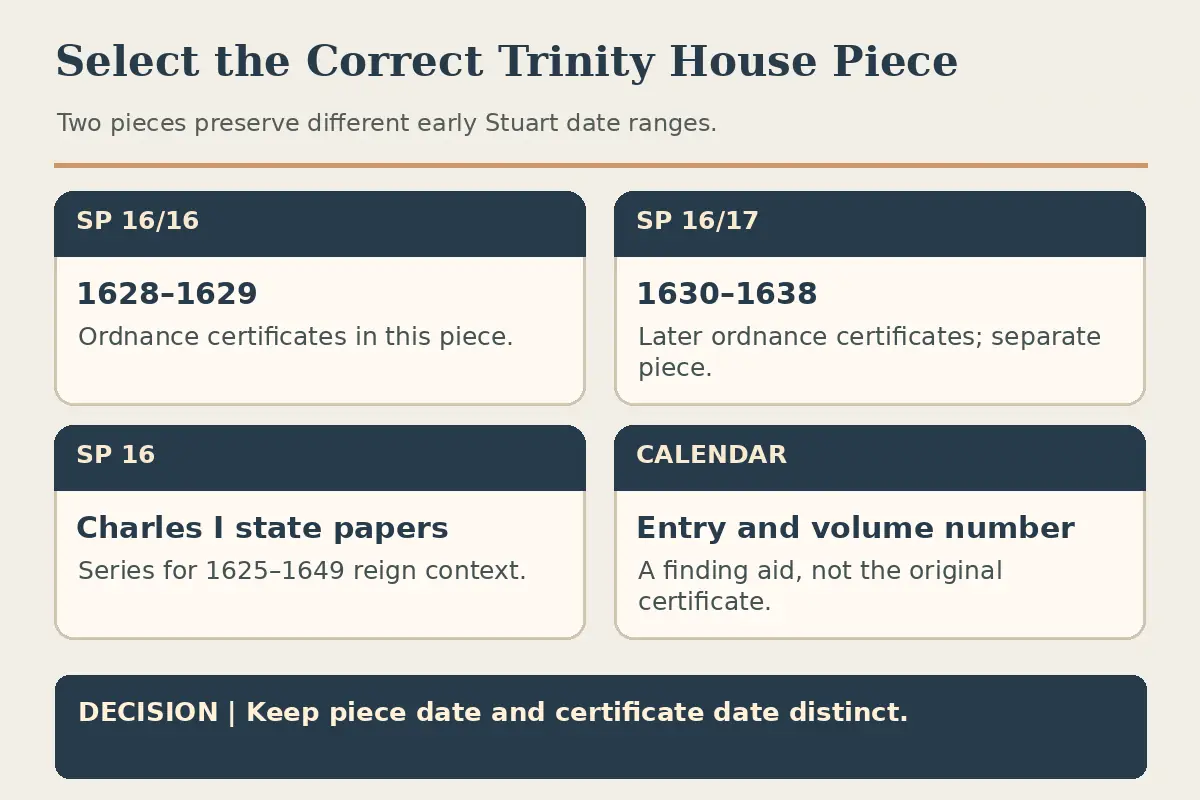
The relevant State Papers Domestic series covers Charles I, 1625–1649, but a reference to SP 16/16–17 is not authority to assume every piece spans the whole reign. An archival reel listing labels SP 16/16 as 1625–1629 and SP 16/17 as 1630–1638; a naval records guide summarizes their ordnance-certificate coverage as 1628–1638. These are descriptions at different levels: inspect the manuscript date for the actual certificate. Handwritten dates can be incomplete or later assigned by clerks. A date stated in a calendar title is not a proven issue date for every enclosed page.
The National Archives guide to Tudor and Stuart State Papers places Charles I domestic papers in SP 16 and SP 17 and provides the exact Trinity House certificate reference in its key to older calendar designations. It also warns about varied handwriting, missing dates and private custody. These limitations make a precise piece-and-item citation essential.
Convert a Printed Calendar to SP 16 Correctly
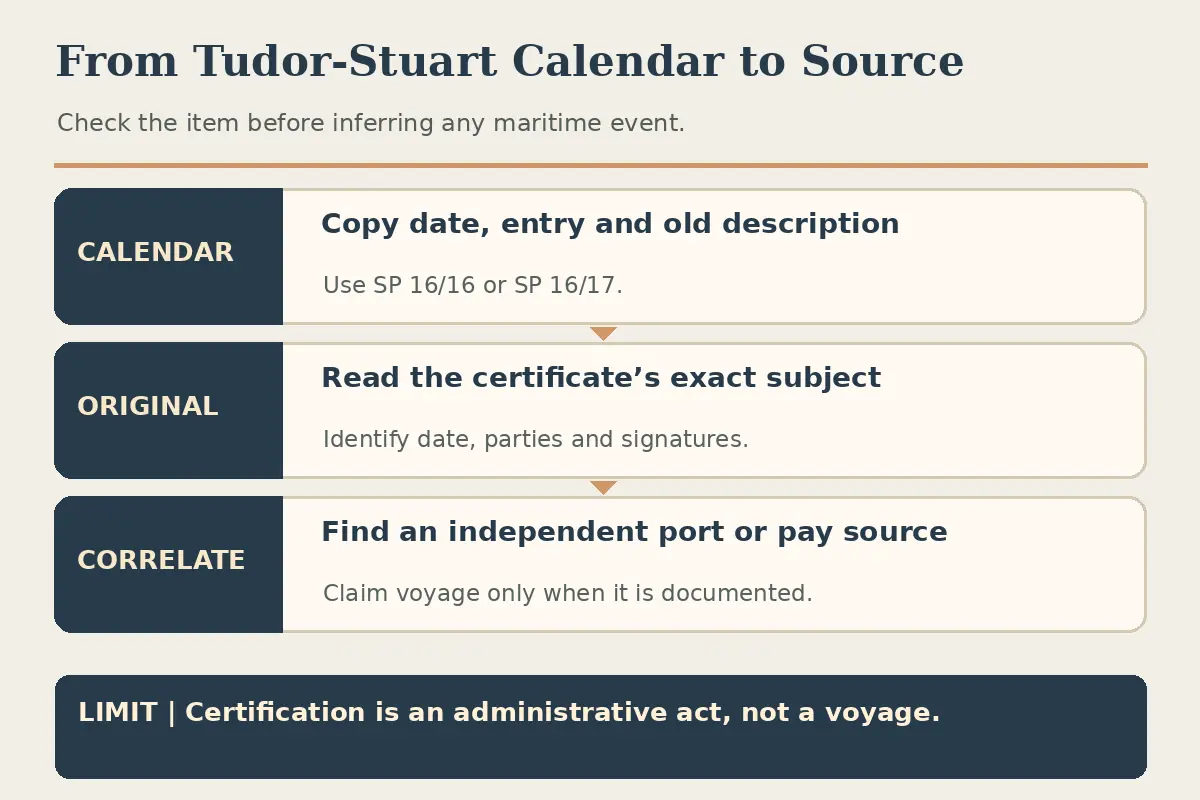
For Charles I, the National Archives recommends the 23-volume Calendar of State Papers, Domestic Series, edited by Bruce, Hamilton and Lomas. The standard conversion method uses the Roman numeral printed as a calendar volume heading as the SP 16 piece number and the numbered calendar entry to help locate the manuscript item. Do not confuse the calendar’s volume number with a document’s folio, membrane or certificate number.
Some entries use an older named source designation rather than a standard item number; the archive’s key specifically supplies SP 16/16–17 for Trinity House Certificates. Copy the original calendar phrase, date, page and entry number, if present, alongside the target SP 16 reference. Inspect the actual certificate, marginal endorsements and any attached items before treating the calendar summary as a word-for-word transcription.
State Papers Online may provide digital access under subscription or at The National Archives in Kew, as described in the official guide. Digital availability and personal-name indexing are separate things. If a name search fails, browse the relevant piece and calendar entry. If an original is not available for inspection, explicitly state that the conclusion comes from the calendar rather than from a manuscript reading.
Read Certification as an Administrative Act
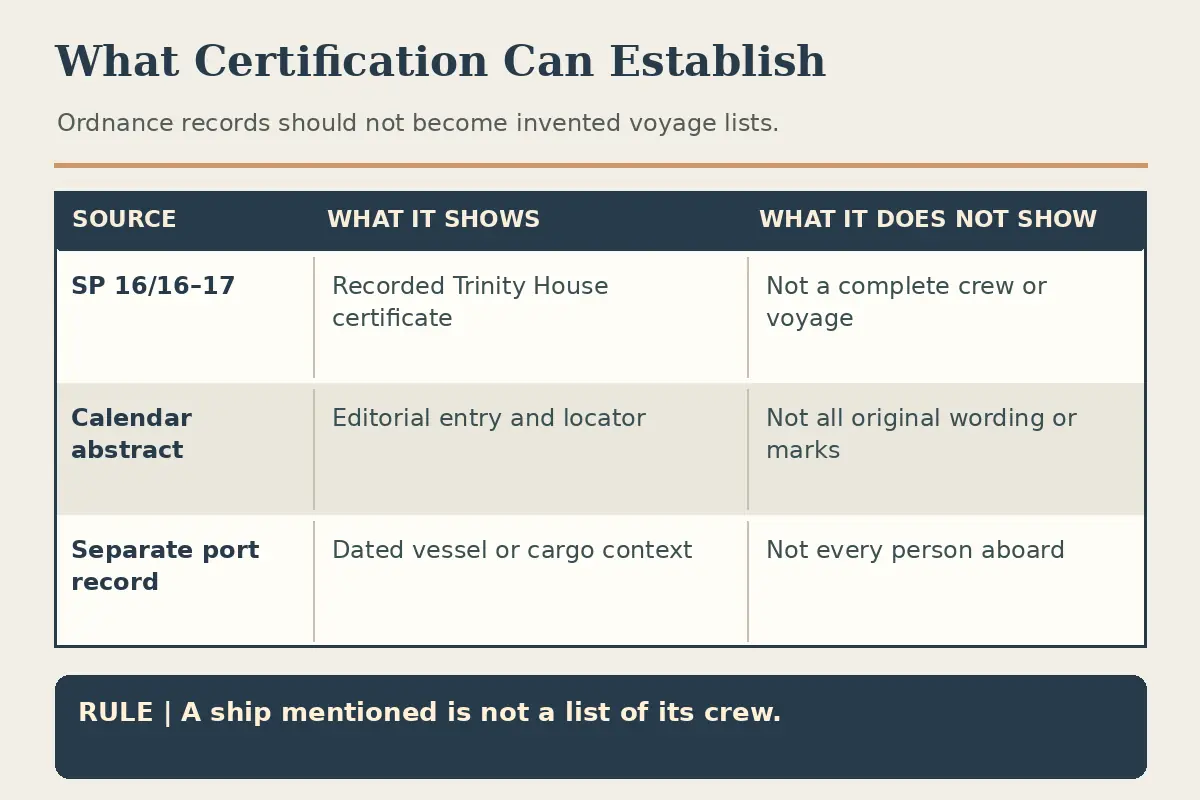
An ordnance certificate can establish that a recorded authority attested to the specific ordnance-related matter actually described on that document. Even the term “ordnance certificate” cannot establish what was certified in a particular instance without the page. Do not assume it is a license for a voyage, confirmation of sea service, a crew list or proof of a vessel’s arrival. Build an evidence table with REFERENCE, DOCUMENT DATE, NAMED ROLE, CERTIFIED SUBJECT, ISSUING AUTHORITY and LIMIT OF THE STATEMENT.
A person mentioned in correspondence might be a petitioner, shipmaster, officer, witness, clerk or named recipient. The correct role comes from the text, not from how a later researcher wishes to tell the story. A statement by an office is an official record of an assertion, which may need corroboration. It is not proof that every event it concerns actually occurred, and a ship name does not identify everyone aboard.
The diagram compares a certificate, another State Paper letter and a separate dated crew, port or customs document where one survives. These do not form an automatic mandatory sequence. A later sailor who shares a family name in nineteenth-century registers should never be joined to an early Stuart mariner without a chain of person-level evidence spanning the gap.
Test a Maritime Event With Its Own Record
If a certificate appears to relate to a proposed journey or maritime employment, identify an independent account of departure, port call, wages, customs or naval administration appropriate to the exact year. Such material may survive in different archive departments and is not guaranteed. A government note that a ship was expected at a port is not the same thing as a dated sighting there.
The National Archives cautions that Charles I’s later state papers were disrupted by the Civil Wars and that some royalist papers remain in other libraries. The 1642–1660 State Papers guide concerns a different overlap and administrative context. Do not assume a complete sequential State Paper archive or derive the absence of a maritime event from a missing manuscript. Search coverage must be stated with its actual chronological limits.
A ship’s name can be reused and early modern surname spellings vary. Match evidence by historical date, office, vessel details and the exact role recorded. When a certificate provides only a broad subject, document that limitation. Do not supply imaginary cargo, destination or sailors in a teaching illustration or table merely to make a maritime story appear complete.
More Records and Archives Guides
How We Research Trinity House References
Our route starts with a historical name or subject in the Charles I calendar, uses the official conversion to SP 16/16–17, checks the certificate’s literal language, and only then compares a separate voyage or personnel record if one exists. The three graphics explain calendar conversion, source roles and conditional verification. Their illustrated documents are modern teaching art, not claims to be authentic Trinity House scans.
A complete citation states SP 16 piece and internal locator, certificate or letter date, calendar reference if used, and whether the original or an editorial abstract was consulted. Maintain separate labels for a calendar’s standardized date and an uncertain manuscript reading. Be cautious with an unidentified signature, a clerk’s reverse-side filing note and any terminology added by a modern index.
Our affiliate disclosure explains commercial transparency. A historically responsible conclusion says what the certificate actually supports and what would require a crew, wage or port source. That distinction is the difference between useful evidence and an invented maritime biography.
The National Archives maps the old calendar designation to SP 16/16–17.
Charles I, whose reign began in 1625 and ended in 1649.
No. Read its exact contents rather than inferring an entire ship’s crew.
No. Use its volume and item information to identify and inspect the manuscript where possible.
Look for a separate dated port, pay, crew or voyage source linked to the correct person or vessel.