
HO 334 certificates and HO 409 indexes trace some changes in British nationality. Date and legal category determine the right evidence. Begin with the official archive guidance, distinguish a catalogue entry from an original image, and review our affiliate disclosure before choosing paid collections.
Begin With the Legal Event, Not Just a Nationality Label
A person described as British in a census did not necessarily become British through the same legal process as another person with a similar history. The National Archives separates naturalisation of foreign nationals from registration of nationality, a particularly important distinction for people connected with British colonies and Commonwealth countries after 1949. A document in HO 334 may be a duplicate certificate or declaration. Start by writing the question precisely: what was the person’s nationality status on a particular date, and what legal action, if any, changed it?
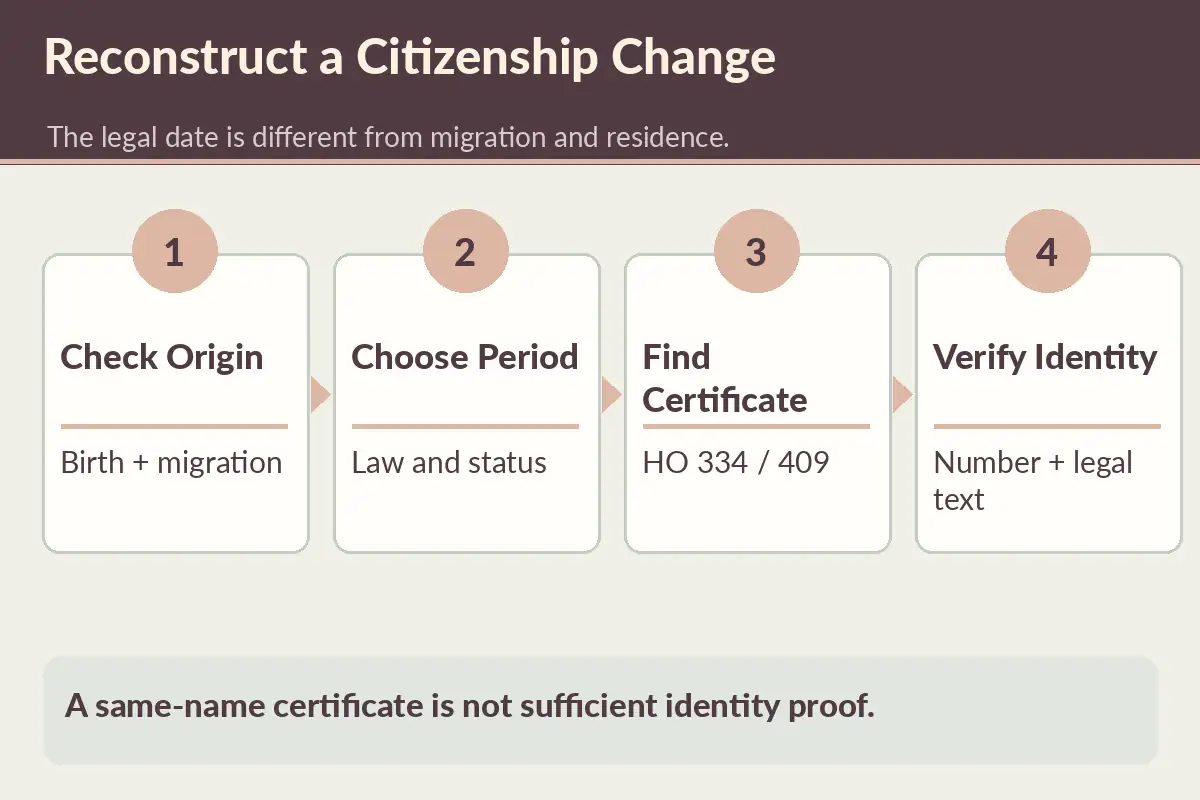
Collect the person’s name as used at the time, approximate date of the claimed change, birthplace, residence and any certificate number in family papers. Retain earlier and later name forms without forcing them into one spelling. A ship arrival date is not a naturalisation date, and a passport’s later description of nationality does not automatically identify the legal instrument that created it. The official guide directs searches according to statutory periods and type of application. That framing is more reliable than searching the word ‘naturalization’ and accepting the first same-name hit.
Use HO 334 Together With the HO 409 Index
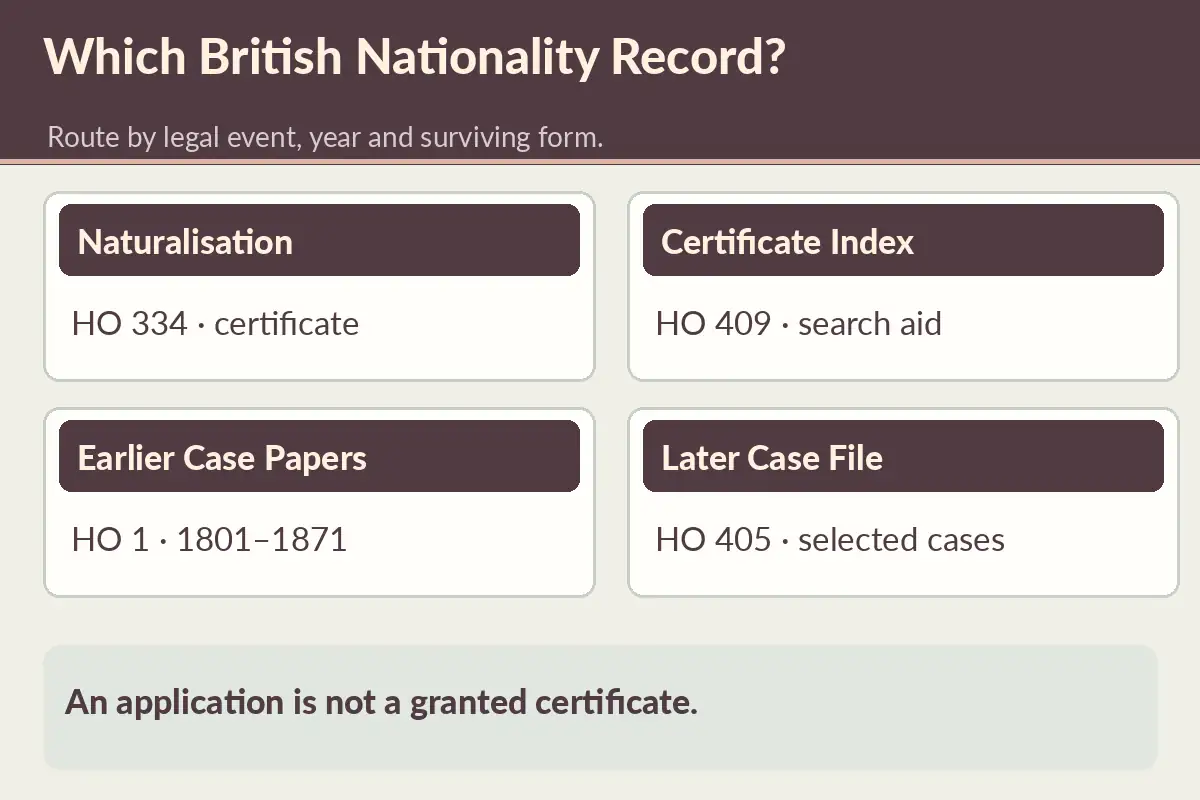
The Archives identifies HO 334 as a series containing naturalisation certificates and related nationality documents, with HO 409 acting as an index for parts of the collection. For many searches, use the surname followed by nat* or a known certificate number. Read the precise certificate description, date and legal form before ordering a copy. Index descriptions are not necessarily the document, and two records returned for the same name may refer to an index and its certificate rather than two separate status changes.
The guide explains that certificates from 1870–1916 have a different online access path from later periods, and that certified copies may need to come from The National Archives itself. Record whether the image is a partner site’s reproduction, a Discovery catalogue listing or an official certified copy. Do not claim legal status on an uncertain date from a search-result snippet. Check initials, name changes and certificate numbers against household, travel and employment records when available. A document’s registration date may have a different meaning from the date on which the person first arrived in Britain.
Respect the June 1969 Duplicate-Certificate Break
An essential survival boundary appears in the Archives’ guide for the 1949–1981 period: from June 1969 the Home Office stopped keeping duplicate certificates for foreign nationals who naturalised in the United Kingdom. The index may therefore be the only retained detail in that route. An unsuccessful search for a duplicate image after that point does not mean naturalisation never happened. Different record types, especially registration as a citizen of the United Kingdom and Colonies, may follow other arrangements; distinguish these before applying the June 1969 rule.
The Archive’s published image of a 1969 registration document illustrates why a researcher must read the actual form rather than infer the category from a generic title about citizenship. Preserve the statute or section cited on the form and the administrative action described. Some certificate records are subject to access restrictions, especially where the person may be living. Use the custodian’s established copy and access processes. Never try to expose private personal identifiers by substituting guesses for a missing index entry or by describing inaccessible papers as if they had been read.
Do Not Confuse HO 1 Papers With the Final Certificate
Previous British naturalisation research may have begun with HO 1 case papers for 1801–1871. Those papers are an application or administrative case route, not a substitute for every later certificate series. The National Archives explains that before the modern Home Office system, private Acts of Parliament and other proceedings were also used. If a family claims an 1840s naturalisation, it requires a different record path than a 1920s certificate. A successful case application and the legally operative instrument are separate events and sometimes separate custodians.
For later periods the guide names HO 405 for some files concerning foreign nationals arriving in 1934–1948, while also cautioning that only part of that series survives and that closures apply. Such a file may discuss the circumstances of an application but should not be assumed to include every document issued afterward. Make a two-column proof ledger: ‘application or enquiry evidence’ and ‘certificate or registration evidence.’ Record exact dates, legal terminology and the person’s confirmed identity. Avoid treating a petition, eligibility statement or completed form as an unconditional grant of citizenship.

Search Overseas Certificates Without Assuming Residence
The Archives describes overseas naturalisation certificates within HO 334 for particular years. Certificates bearing the letter O can denote overseas grants under the 1914 legal arrangement before 1949; the official guide explains that the meaning of Certificate O changed for 1949–1980. The correct interpretation therefore depends on date and statute, not merely on the letter. A certificate issued or applied for overseas is not proof that the person lived permanently in the United Kingdom during the same period. Verify geographic context from the document and independent residence evidence.
Make a dated nationality timeline with reported birthplace, residence, citizenship application, legal certificate and later travel or voting records. Use source-specific labels instead of simplifying every entry to ‘became British.’ A spouse or minor child in a related household did not necessarily undergo an identical legal change automatically. Such cases require the legal regime applicable to them and their own supporting evidence. The goal is to establish the narrow status action that actually occurred, not to infer the nationality of an entire family from one ancestor’s certificate.
Prepare a Credible Certificate Citation and Research Outcome
A useful citation identifies the correct archive, HO 334 or HO 409 reference, named person, certificate or index entry number and date, as well as whether the researcher inspected a full original image. Keep any certified copy request separate from a discovery note. Transcribe the full legal title and status granted where the document does so, leaving unfamiliar historic categories in their proper language. Use the Archive’s current guide to check availability because image access and administrative responsibility differ between periods.
In the written family account say whether you verified a naturalisation, another form of registration, an application, or only an index reference. Preserve unresolved same-name cases and dates. An index showing that a certificate existed may support a useful lead, but it does not automatically prove every associated family story, subsequent residence or uninterrupted nationality throughout life. If the relevant records are closed, or the person is living, avoid speculation and respect present access rules. A careful status-specific result is worth more than an impressive but legally inaccurate claim.
How We Research This Specific Archival Claim
Our review first distinguishes the office that created the records from the later catalogue, digital provider and modern interpretation. We check the repository’s period, surviving extent, original arrangement, access rules and description of each series. Every source is read for exactly what it reports: an original statement may be accurate about one event yet inadequate for a family relationship, legal outcome or residence claim. We test competing namesakes with independent dates, places and record identifiers, keep conflicting claims in separate rows and document precisely which portions of a collection were searched. A negative online search is not a negative archival finding without a documented coverage assessment.
More Records and Archives Guides
Archive Sources and Their Evidentiary Limits
The primary archival guide explains Identifies HO 334 certificates and HO 409 indexes, certificate numbers, naturalisation versus registration, and the June 1969 duplicate-certificate change.. An additional official research source confirms Shows an original HO 334 registration example and illustrates why legal form and registration type should be read rather than assumed from surname.. These institutional descriptions establish the existence and general scope of records; only the original document can establish what it says about a particular person. Date your retrieval, cite the full piece and page, and keep unresolved namesakes open rather than borrowing unverified details from a published tree.
No. The archive separates processes and historical nationality categories.
It provides index entries that can help locate certificates or document the event when a duplicate is absent.
The Home Office stopped retaining those duplicates for UK naturalisations of foreign nationals from that date.
No. An application and the operative legal certificate or Act must be distinguished.
Not automatically. Their legal status requires its own date- and statute-specific test.