
Search The National Archives’ HO 1 for early British naturalisation petitions, denization letters and selected related papers dated 1801–1871, but do not treat the request as proof that nationality was granted. The archive describes all applications to the Secretary of State from 1844–1871, some applications by private Act in 1801–1868 and some denization correspondence from 1801–1840. Begin in the official HO 1 guide. A full citizenship conclusion needs the corresponding grant, enrollment, or legally relevant evidence rather than a petition alone. Our affiliate disclosure explains site policy.
Decide Whether the File Is a Petition or a Grant
Write the research question in two parts: what did the applicant report about origin and family, and what legal result followed? HO 1 can be valuable even if the application was not completed. The papers may identify a profession, nationality, family details, birthplace, birth date, arrival year, address or character references. These are reported assertions within an administrative process, not all independently verified facts. When a certificate or enrolled copy is located, it can answer a different question about legal status. A family tree that collapses both stages into a single ‘naturalized’ event loses this distinction.
Use the historical date to determine the search. Before 1844, naturalisation could be unusually expensive and often required more exceptional procedures. Within HO 1 the archive distinguishes denization requests, parliamentary processes and later Home Office applications. Denization conferred some rights but not all rights of a British subject; it should not be translated into full citizenship. The 1844–1871 application span is different from the 1801–1868 private-Act span. A record from 1805 cannot be understood using exactly the same procedure as an application in 1855, so first identify the instrument and its date.
Choose the Correct Home Office Period
Search the name in Discovery using both given-name and surname variants and, where practical, a country or state of origin. The official guide allows name or origin searching. Copy the full HO 1 reference and read the file title carefully: it may name an application rather than a successful grant. Names can be anglicized and places can be stated according to nineteenth-century political geography, not modern national borders. Narrow an identity by occupation and residence if the papers give them. The earliest matching result should never be selected merely because a modern family-history index prints a familiar name.

Extract Origins and References From HO 1
Read the declaration as a source with a purpose. An arrival year supplied by the applicant could have been approximate, and a character reference reports what a referee said, not what an official proved. A document mentioning a wife and children may clarify the applicant’s contemporary household, but relationships should be transcribed in the words used. A witness who wrote a recommendation is not necessarily a relative. Keep a column for the writer or informant, another for the claim, and a third for the independent record that could test it. This avoids treating office correspondence as a verified birth or marriage record.
To verify the final act, follow the archive’s instruction to look for C 54 enrollment of naturalisations in 1844–1873, consulting its chronological C 275 index first, and for applicable private Acts in parliamentary material. The existence of a copy or legal instrument should be recorded with its own date and reference. Do not confuse the application date, decision date and date of a certificate copy. If the file is incomplete, say exactly which stage is documented. A subsequent census describing someone as a British subject may be useful context, but it is not a substitute for the legal instrument itself.
Confirm an Award Beyond the Application
The endpoint matters for records after 1871. TNA directs researchers to HO 45, HO 144, HO 382 and HO 405 for various later case papers; it also documents HO 334 certificates for later periods. Do not assume that one HO 1 search covers all British nationality applications. A later-naturalized family member might require a different series and access procedure, especially where personal privacy restrictions remain. The separate nationality research guide is the correct gateway for legal and chronological distinctions outside HO 1.
A no-result search has several interpretations. The person may never have applied; the spelling, title or origin description may differ; the documents may be elsewhere; or the request may have been handled under a distinct legal process. Repeat a Discovery search with less restrictive terms, then test the relevant year and custody before claiming absence. Keep a record of every search phrase and full archival series searched. If nationality is central to a family-history question, corroborate the candidate with independent residence, marriage, employment and migration sources rather than arguing from an empty catalogue result.
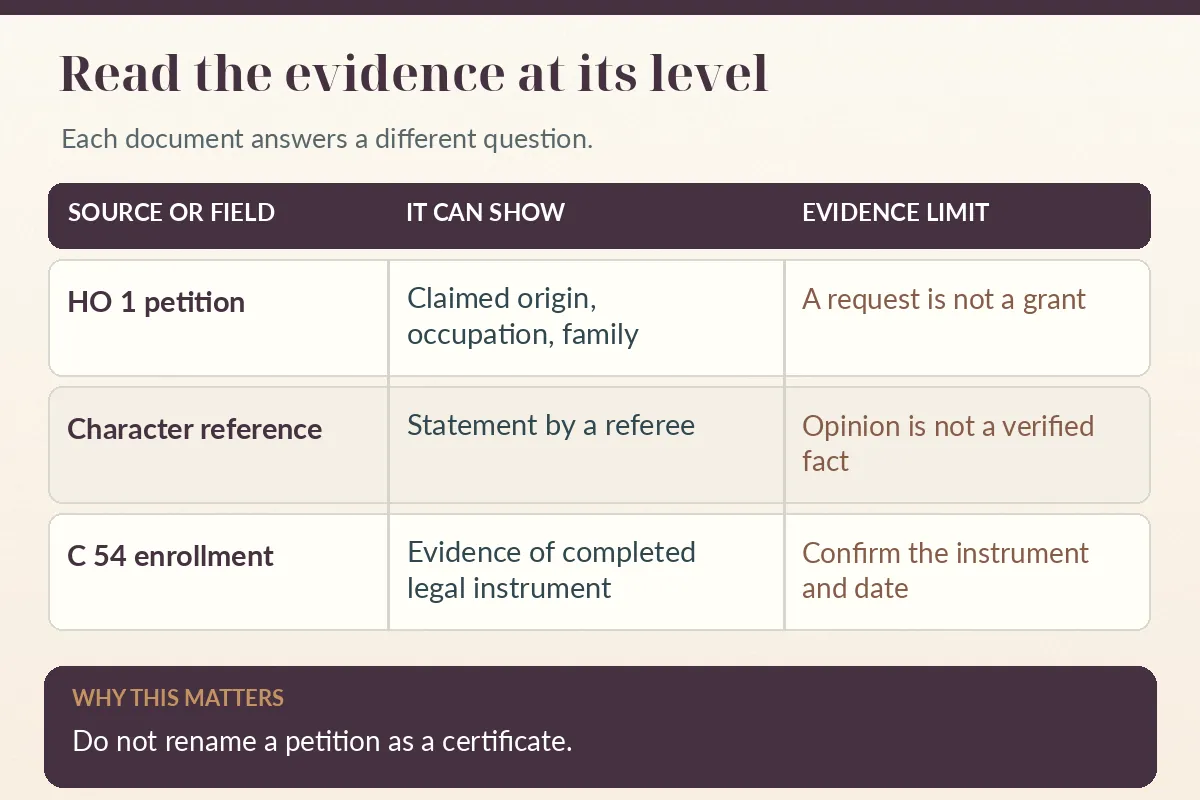
| RECORD / FIELD | CAN SHOW | DOES NOT PROVE |
|---|---|---|
| HO 1 petition | Claimed origin, occupation, family | Request is not legal grant |
| Character reference | Statement by a referee | Witness statement may be biased |
| C 54 enrollment | Evidence of completed legal instrument | Legal instrument needs date check |
Search Alternate Routes When No File Appears
Identity matching should be tighter than a surname. For immigrants with common names, the papers’ profession, location and associated people can separate candidates. Note when an address may be a working office instead of a home. A person reporting a country of origin in 1840 may use a political term no longer on modern maps; retain it verbatim. If an applicant claimed a birth date that differs from baptismal evidence, enter both dates and assess which informant was closer to the original event. A difference is a question to research, not a reason to erase the less convenient record.
Suppose a fictional German-born bookseller, Johann Weber, appears in an 1851 HO 1 description. The file names a London address and a referee; a later directory lists John Weber at a similar address. This suggests a candidate identity, not yet a proven one. Read the application for age, birthplace, family and chronology, compare the business address with the directory’s edition date, and search for a corresponding legal grant. If the only original document remains an application, describe him as an applicant even if later family stories say he was naturalized.

Reconstruct One Hypothetical Naturalisation Claim
A claim ledger can use five columns: HO 1 file and page, exact wording, document author, conclusion the wording supports, and missing independent proof. Store image copies with precise citations and distinguish contemporary administrative notes from later annotations. Dates may refer to receipt or follow-up correspondence years after the original request. Where a document was created for an application, note its legal purpose. A reader should be able to reconstruct both the person’s life clues and the citizenship-status evidence without relying on unsupported assumptions embedded in an online tree.
More Records and Archives Guides
How We Research British Citizenship Case Papers
We start with TNA’s HO 1 coverage statement, then date-route each application, denization request or private-Act paper to the proper evidentiary question. We verify that the original file and legal outcome are different objects, seek C 54 or relevant parliamentary evidence where appropriate, and compare names, origin and occupation against independent records. Our conclusion uses calibrated language: applied, requested denization, received a certificate, or outcome unproven. A plausible immigration biography is not evidence of the legal result unless the record actually says so.
No. It may document only an application, denization request or supporting correspondence.
The archive describes early naturalisation and related case papers from 1801 to 1871, with subtypes covering different date spans.
The National Archives directs researchers to C 54 for enrolled certificate copies in this era.
No. Denization conferred certain rights, but not the full rights described for a British subject.
Use later Home Office record-series guidance instead of assuming HO 1 covers it.