
For a Quaker birth, marriage, or burial in England or Wales, search The National Archives’ RG 6 collection by historical place, date, and meeting, then inspect the original record. RG 6 holds Society of Friends registers, notes, and certificates, with material dating roughly 1578–1841. It is distinct from the wider nonconformist series RG 4, RG 5, and RG 8. Start with TNA’s collection guide; record the repository reference and document type before treating a name hit as an identified relative. See our affiliate disclosure.
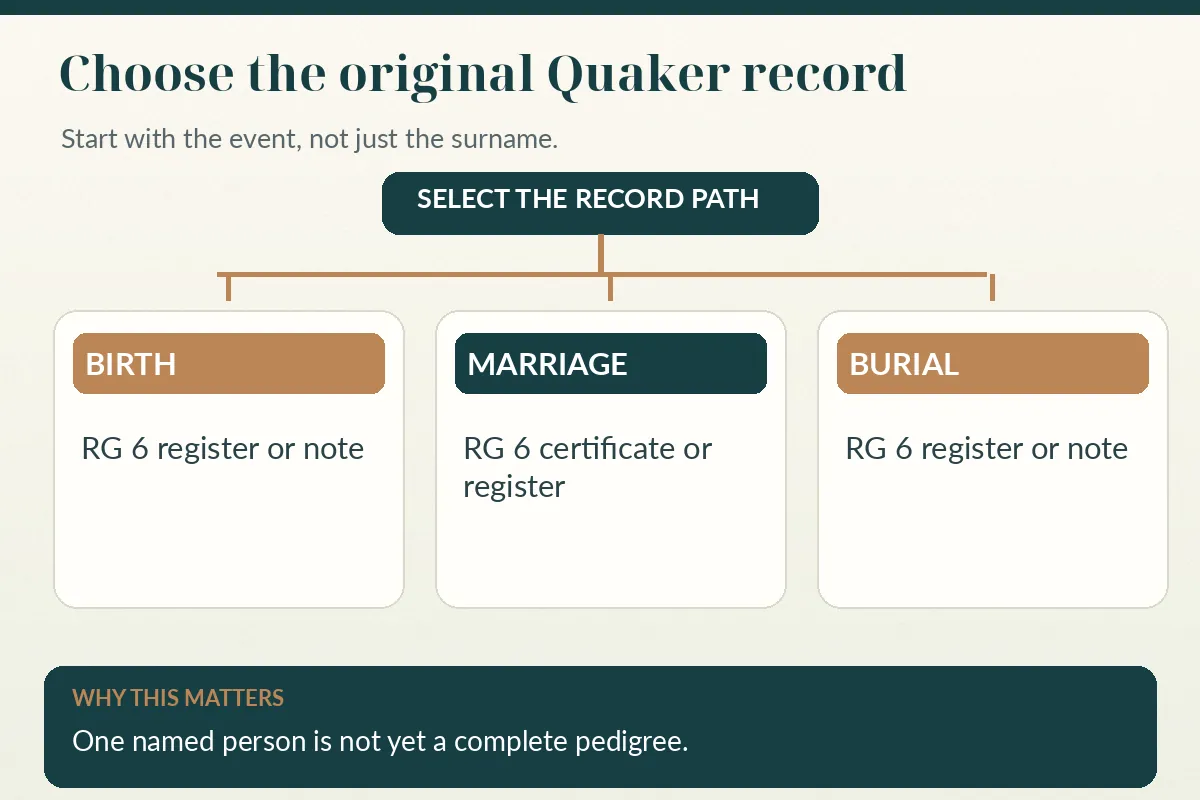
Choose an Event Type Before Searching RG 6
A reported Quaker event can appear as a birth entry, marriage certificate or note of burial rather than a standard Anglican baptism or marriage register. First write down which event the family is actually trying to establish. If the question is the date of a child’s birth, a baptism search may be beside the point; if it is whether two adults married, the precise certificate wording matters more than a similar pair of surnames in an index. Make separate columns for event date, date of recording and whether the record is a contemporary entry or a later copy.
The record-class distinction is essential. The TNA guide identifies Society of Friends’ registers, notes and certificates in RG 6 and gives 1578–1841 as the digitized collection’s broad Quaker span. RG 4 includes registers of various other denominations; RG 5 consists of certain nonconformist birth certificates; RG 7 includes irregular marriages. An unexplained RG number is not merely a storage label: it indicates a different type of source and often a different context. Capture the full piece or volume reference rather than only a database collection name, because one piece may have a restricted local scope.
Locate the Correct Meeting and Historical Place
Quaker organization did not always align neatly with an Anglican parish. Search the settlement where the household lived and its nearby meeting, but also account for historic county boundaries and variant spellings. In TNA Discovery a place and date search within RG 6 can locate relevant catalogue units; the nonconformists research guide describes place-based searching. Commercial transcript indexes can help find an image but should not substitute for checking the volume heading, chronological sequence and the names written on adjacent entries. Document a meeting name as such, not automatically as a parish of residence.
Read a Marriage Certificate Differently From a Birth Note
A Quaker marriage record may be unusually rich in witnesses and names. Transcribe the marrying parties, stated places, event date, meeting or location, and witness roles exactly as written. A witness signature can support presence or association at that ceremony; it is not in itself proof of parentage. If a printed transcription expands an abbreviated name, note the expansion as editorial rather than original handwriting. A handwritten certificate might report that a marriage occurred, but verify where it was registered or copied and how the date is expressed before tying it to a later civil index entry.
Birth notes can supply parents’ names, a place and an event date, yet the form and completeness vary. A birth entry is not automatically a certificate issued at birth, and its informant may not be named. For burial material, distinguish the death event from a burial recorded days later and from a memorial inscription made much later. Exact documentary language deserves attention: a reported age or relationship may be copied from a prior source. If an entry is hard to read, retain a literal transcription plus a separate interpretation rather than silently correcting the record.
Test Coverage When No Quaker Entry Appears
RG 6 is not a universal list of all Quakers. The surviving material represents surrendered and selected historical records, with local and temporal gaps. TNA also describes nonconformist collections extending well beyond the Quaker dates, but those broad collection limits do not extend every RG 6 register to the same years. Check whether the particular meeting’s volume survives for the target decade before drawing conclusions from no hit. A family might also appear in secular civil registration from 1837, Anglican records at a later life stage or other local community material, depending on the event and personal circumstances.
An efficient negative-search log lists the queried place, meeting, years, name variants, and whether a transcript or original page was inspected. Widen geography only after checking the surviving meeting boundaries; do not assume the first modern postcode is the right historical place. If parents moved between birth events, consecutive children may appear in separate meeting records. Evidence of movement should come from dated addresses or other original records, not an invented migration based on a single absence. Record what would make an apparent namesake unlikely, such as incompatible parents or clearly conflicting dates.
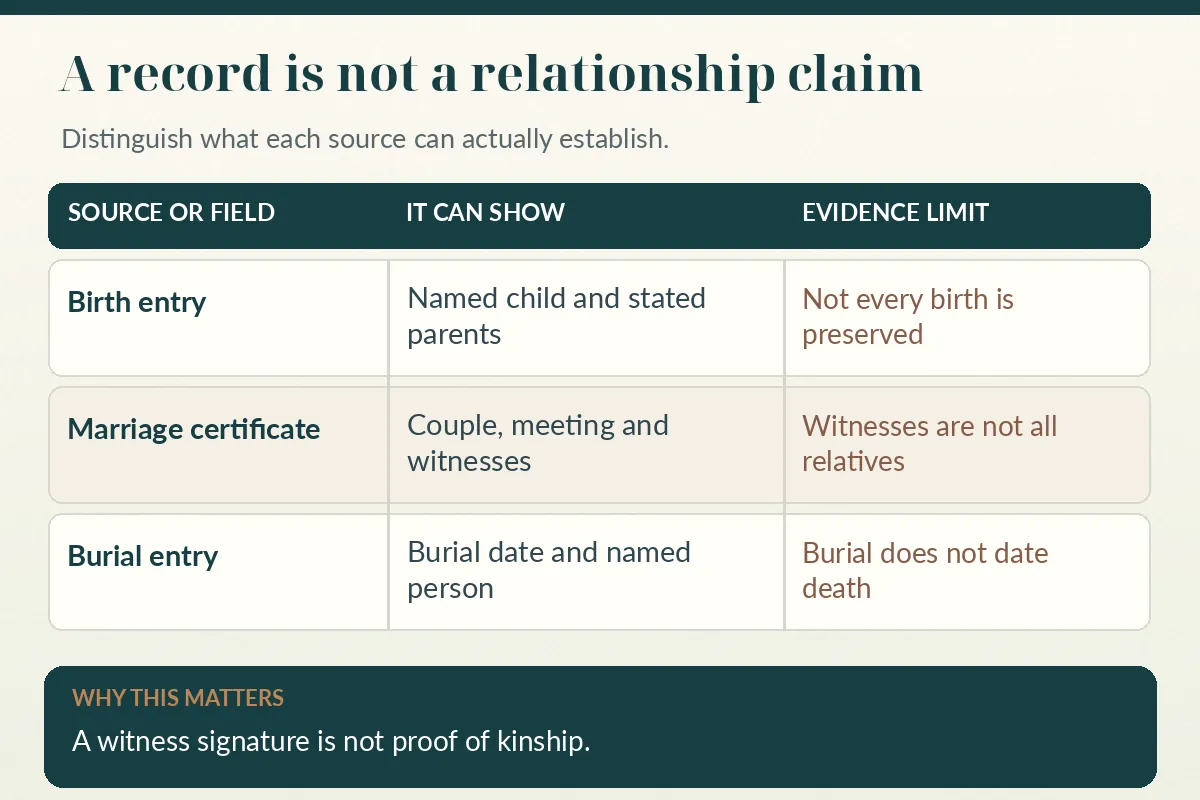
| RECORD / FIELD | CAN SHOW | DOES NOT PROVE |
|---|---|---|
| Birth entry | Named child and stated parents | Coverage may be incomplete |
| Marriage certificate | Couple, meeting and witnesses | Witness signature is not kinship proof |
| Burial entry | Burial date and named person | Burial date is not necessarily death date |
Compare Multiple People Without Assuming Kinship
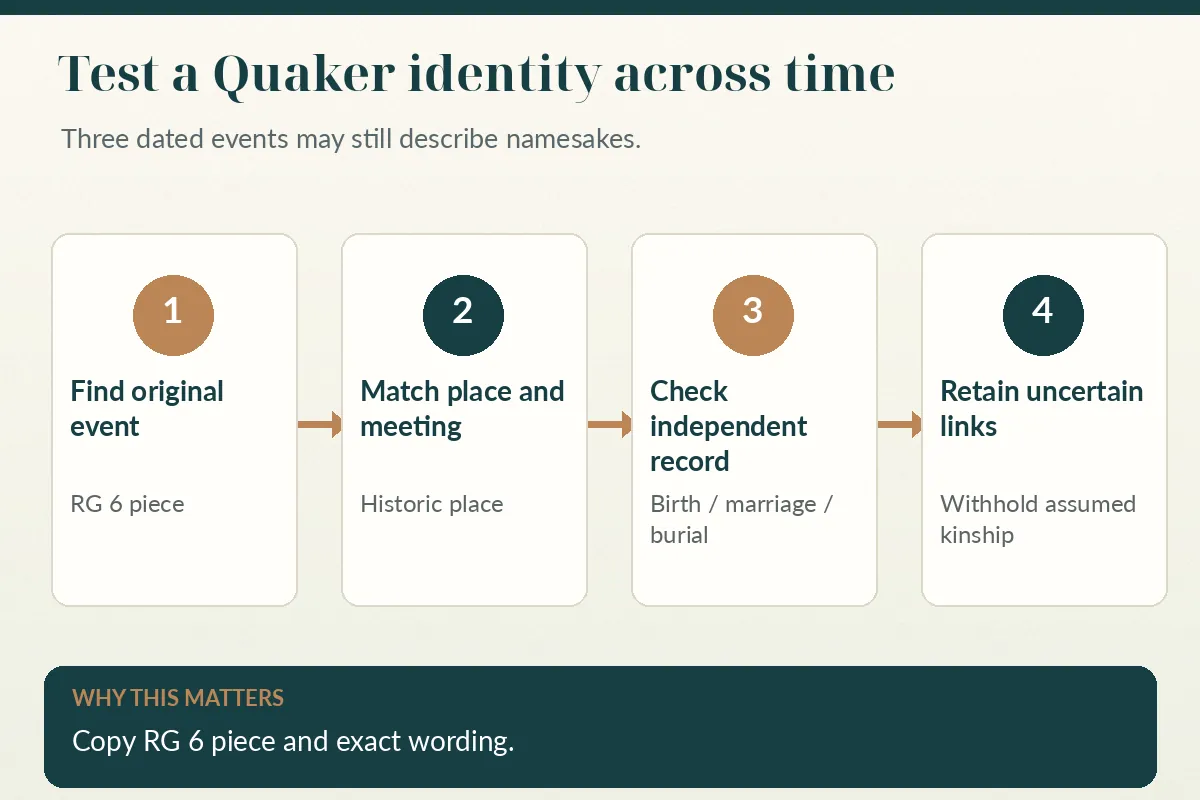
Compare one family line event by event. A birth record naming two parents, a marriage certificate naming a person of similar age, and a later burial notice may concern one individual, but connecting them requires more than the repeated surname. Look for household addresses, close dates, plausible age and meeting continuity. Where several families used the same given names, distinguish them in a candidate table. A date within a broad expected range only increases plausibility; it does not settle identity. Never turn a series of entries from one meeting into a proven pedigree without explicit relationship evidence.
For example, imagine a fictional Hannah Ellis born around 1801 whose later marriage is said to have occurred in a nearby market town. An index displays an RG 6 birth to Thomas and Mary Ellis; a different RG 6 certificate names Hannah Ellis at marriage. Before connecting them, copy both images, capture their meeting and place headings, compare the dates and record each relationship actually stated. A witness named Ellis might be family or simply another attendee. Search independent residence and death evidence; leave the link provisional if another Hannah Ellis fits equally well.
Work Through a Hypothetical Meeting Record
A reliable citation identifies The National Archives as repository, RG 6 piece or item, the named meeting or register, the event, folio or page if given, and the image provider or access date. Write down whether the image is original, a register copy, or a certificate so the citation does not overclaim first-hand knowledge. Keep an event ledger with fields for text as written, transcription uncertainty, possible individual matches and what independent document would test each claim. The ledger should make it easy for another researcher to repeat a search rather than merely accept a family-tree entry.
More Records and Archives Guides
How We Research Quaker Registers and Certificates
We compare the archive’s description of RG 6 with the actual format of each record, not with assumptions about all Quaker practices. We route births, marriages and burials separately, audit place and date coverage, preserve the original series reference and look for independent evidence when merging entries into a person. A source that records a ceremony is evidence for that ceremony; an incidental witness is not a documented parent. Where sources disagree, the conflict remains visible until records explain it. Our method treats the original entry, its transcription and the researcher’s inference as distinct layers.
No. It contains surviving Society of Friends registers and documents, with individual meeting and date limits.
It may include many signatures; a signature alone does not establish a family relationship.
Start with a historical place, nearby meetings and a date range, then inspect catalogue coverage.
No. Look for the recorded event and its original wording, not a substitute sacrament.
Cite and transcribe the image, preserve the conflict and seek an independent contemporary source.