
RG 7 is a route to records of irregular marriages associated with London and its outskirts, notably the Liberty of the Fleet. A ceremony could be performed by an ordained clergyman without ordinary banns or licence, and its irregularity does not alone make the marriage fictitious. But the surviving entry is not a modern civil marriage certificate, and The National Archives warns that some Fleet material contains duplicated or forged entries. The best question is whether two named people participated in a particular ceremony, not whether a surname alone proves a marriage.
What an Irregular Fleet Entry Can Establish
The label Fleet marriage can conceal multiple venues. The National Archives identifies material connected with Fleet Prison, King’s Bench Prison, the Mint and May Fair Chapel, not merely weddings physically inside Fleet Prison. Record the precise venue written in the source, the date as presented and all name spellings. The principal historical research window is 1667–1754, though some related records extend later. Do not mechanically apply the 1754 change to every non-Anglican marriage practice.
Search RG 7 by Both Names and Place
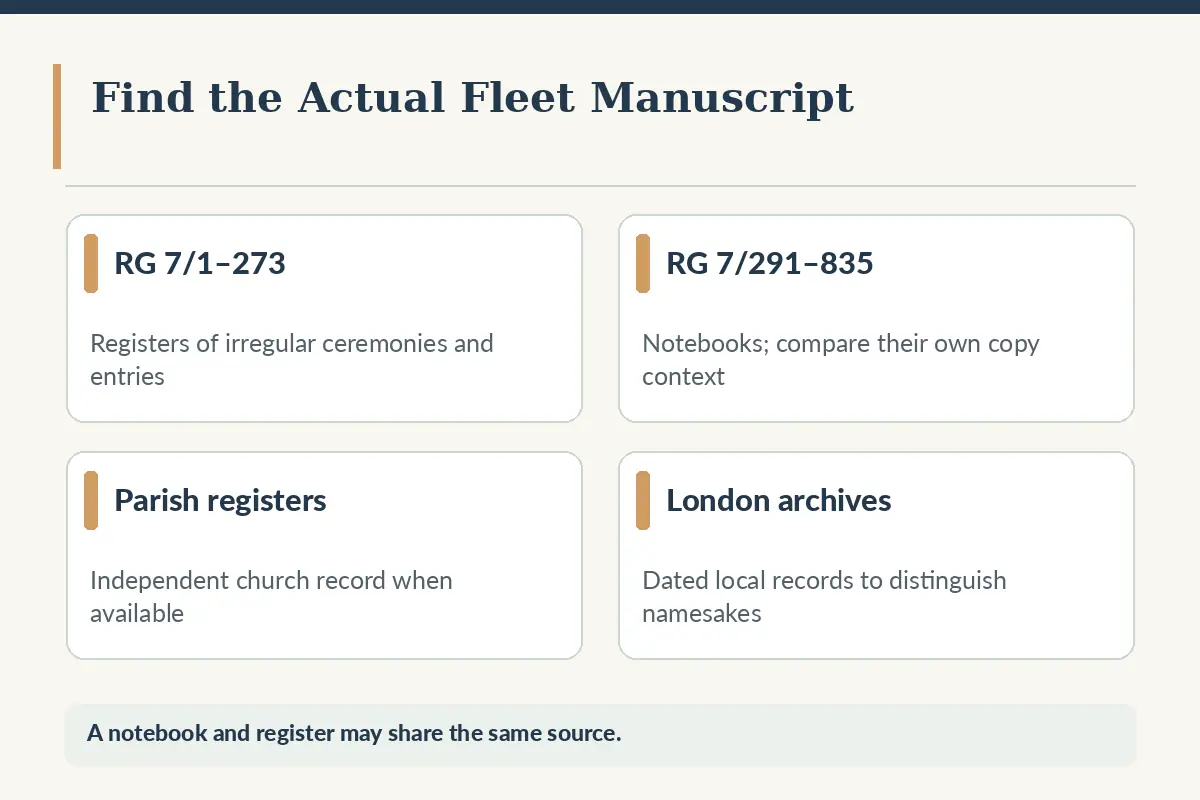
Start with the National Archives nonconformist guide and its specific Fleet Registers section. RG 7/1–273 contain registers, while RG 7/291–835 contain notebooks. Identify whether your online result refers to a register, notebook or index transcription. A surname-only search may retrieve one of many namesakes in an era when ages and residences are often under-specified. Use known occupations, neighbourhoods and a plausible wedding interval to reduce false candidates.
Browse the original page when possible, including entries immediately above and below the marriage. A duplicate description may represent another copy of the same transaction rather than a second ceremony. The Genealogist and other licensed collections provide differing access to digitized material; access conditions can change. Preserve the RG 7 piece number, image or page reference, both names and the exact place from the original; a search-result URL is not a durable substitute for a source citation.
Separate a Register From a Notebook Copy
Build two rows for the couple: one for any register entry and another for a notebook. Enter day, month, year, officiant if named, bride and groom name forms, residence claims, marital status and any witnesses actually recorded. Do not supply missing fields from an online tree. A notebook and register made by closely connected record keepers may repeat the same information; matching wording is not automatically independent corroboration. A discrepancy over a name, date or venue is a real research question, not a formatting detail.
The archives explicitly identify uncertainty about reliability. Record a possible false entry as such and look for independent confirmation: a later baptism naming the same parents, a deed using a married surname, an associated settlement record or a parish document. None of these alone proves the exact ceremony, but together they can test the identity. Avoid treating a listed witness as a relative without a separate statement of relationship, and avoid assuming that a residence written in a notebook was the permanent home.
Test the Couple Against Their Later Life
Construct a timeline before and after the proposed wedding. Check whether both people were alive and unmarried at the date, whether the bride used the reported surname subsequently, and whether later records place them in a plausible locality. If the same common names recur, distinguish the candidates by occupation, street, witnesses and consistent children’s baptisms. A child born after an indexed Fleet ceremony is evidence to investigate, not proof that the parents are the couple shown in RG 7.
Look separately for a parish marriage, licence allegation or banns record covering a similar date. A second wedding-looking record might reflect a formal ceremony following an irregular union, a duplicate transcript, or entirely different namesakes. Treat these as hypotheses until the underlying pages can be aligned. The official BMD research guide routes pre-1837 church registers to local archives, not routinely to the national repository.

Handle Dates, Legality, and Known Gaps
Marriage legislation changed in 1754, and the archives distinguish irregular marriages from the usual parish and licence pathways. Do not turn that historical transition into a universal statement about every marriage celebrated in Britain: religious exemptions and local jurisdiction matter. More important for a family-history claim, a document may accurately report that a ceremony was written down without proving every biographical detail asserted by the parties. A forged entry cannot be authenticated merely because it is held in a government archive.
If a name search is empty, try maiden-name possibilities, phonetic spellings and an earlier or later date. Search a wider London district instead of treating the Fleet as a single address. Older abstracts and collections may index names differently, and a surviving notebook may not have a matching register. Record the exact search terms and digital collections used. A genuine negative conclusion requires evidence of coverage, not only a failed query on one commercial platform.
Treat the expression “Fleet marriage” as a clue to a group of surviving collections, not as a street address. In an index result, prioritize the manuscript heading over a modern database category. If the same date and couple appear in multiple notebook images, log that relationship as a possible copying chain. A true second ceremony would require a different event supported by its own context.
Citation and Evidence Ledger for a Fleet Marriage
Cite the National Archives series RG 7, the piece and folio or page when present, the entry date, parties’ names and the provider or repository used for the image. For every claim keep a column for what the document literally says and another for the inference you propose. A marriage date in a clerk’s handwriting is a recorded assertion; an independently verified wedding is a stronger conclusion. Cite secondary indexes separately rather than dressing them as inspected manuscript pages.
When sharing an ancestral story, retain uncertainty visibly: “A Fleet notebook records a marriage of two people with these names” may be accurate even when “these are the parents of our ancestor” is unproven. Record the contradictory evidence and the next source most likely to change that conclusion. The process protects families from repeating attractive but unverified stories and preserves an audit trail for the next researcher.

More Records and Archives Guides
How We Research Fleet Register Claims
We first define the couple, date window and possible London venues, then search both register and notebook subdivisions of RG 7. We inspect source images and transcribe ambiguous writing before comparing dates, occupations and alternative identities. A separate independent record is required before connecting the entry to a later family. We do not treat repeated transcriptions as multiple witnesses, and we mark any entry that appears to be a forgery or copy without silently rejecting it.
For a transparent citation we capture series, piece, original entry, access provider, image date and the exact extent of the search. Any commercial access is disclosed separately from the research conclusion; see our affiliate disclosure. This method is intended to support a limited historical claim, not to grant a blanket certificate of legality or identity.
Not automatically. Some irregular ceremonies were recognized in their historical setting, but authenticity, jurisdiction and identity require examination.
Not necessarily. The same information may have been copied between books, so exact agreement may reflect a shared source.
The principal RG 7 marriage period is 1667–1754, with some later related material; consult the specific piece description.
No. A witness role proves only what the original entry records, not a biological or marital relationship.
Duplicates, alternate manuscripts, name collisions or separate ceremonies are all possible; compare full images and dates.