
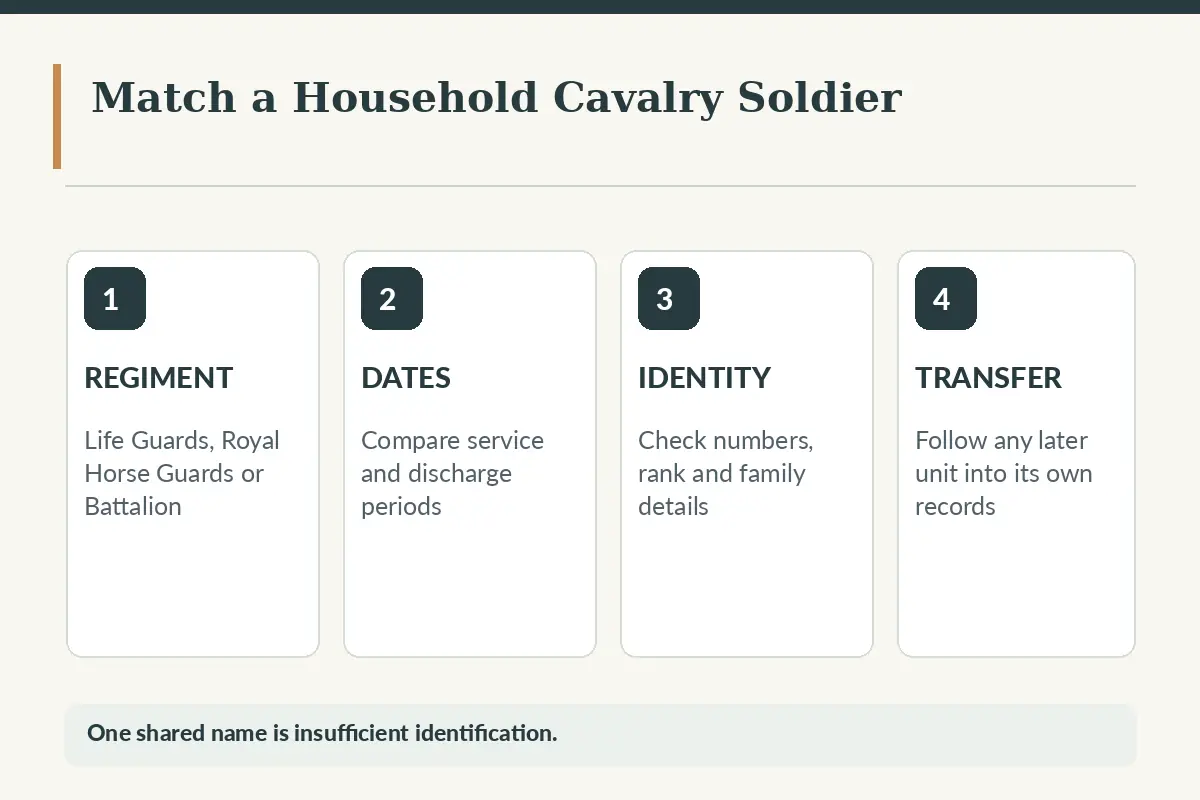
WO 400 contains surviving service records for noncommissioned officers and other ranks who were discharged from the Household Cavalry in the period 1799–1920. The National Archives identifies the Life Guards, Royal Horse Guards and Household Battalion. This is not a master roll of every British cavalry soldier, not a complete series for commissioned officers, and not proof that each soldier who served left a surviving file. Start with the regiment and discharge context rather than entering a common surname into every military collection.
Who Is and Is Not Covered by WO 400
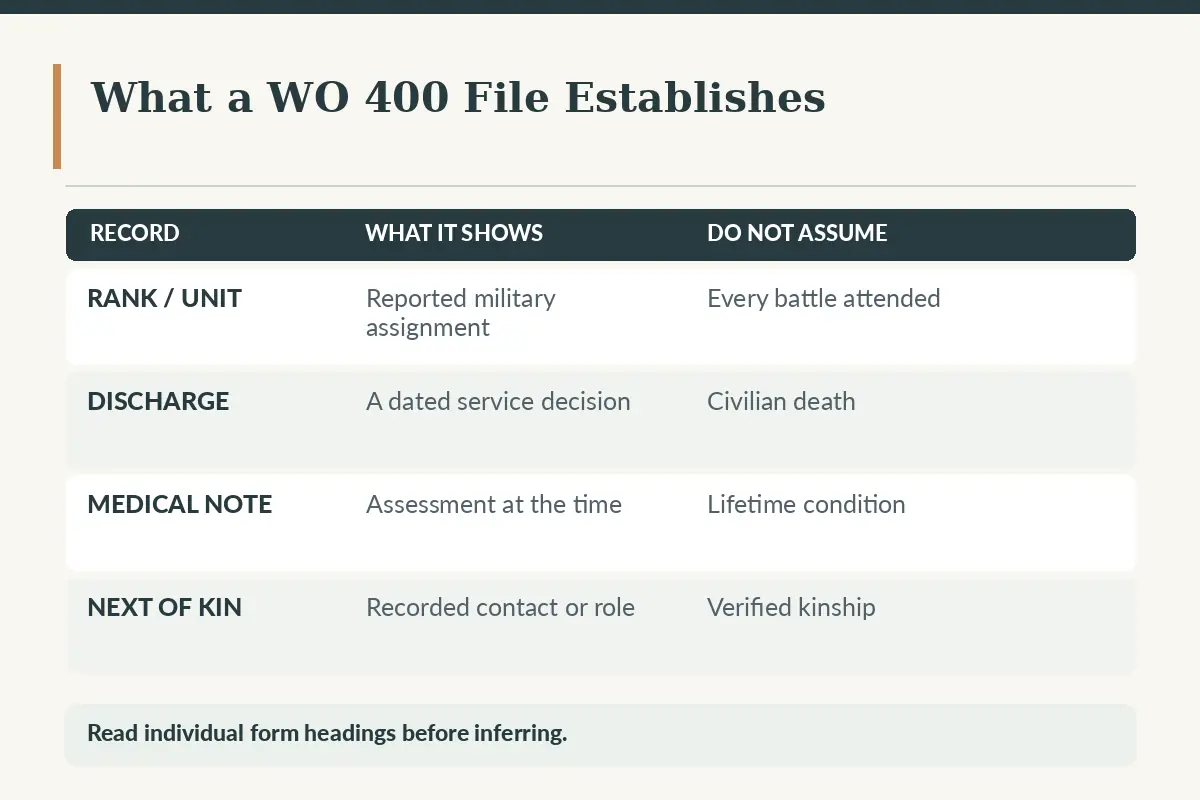
The collection contains more than 11,500 records, according to the official series guide. A file may show regimental and rank details, next of kin, medical information or pension context, but surviving information varies. An absent next-of-kin field does not mean the soldier had no family, and a recorded relative’s name does not by itself prove every stated relationship. Establish what document is being described and its date before incorporating it into a family tree.
Use Regiment and Discharge Date to Find a File
Search the official WO 400 guide and Discovery with name variants, an approximate date and any known rank or regiment. Check a candidate’s unit rather than assuming that all Life Guards or mounted soldiers are represented in the same catalogued material. An index can yield a plausible match, but the underlying image may contain identifying details that separate the target from a same-name comrade.
Prefer a specific timeline: enlistment or attestation when shown, changes of rank, an apparent transfer, medical examination and final discharge. These are distinct administrative events; an enlistment date is not a first battle date, and a discharge date does not always describe the end of every military connection. Record the entire reference and the file’s internal chronology. Do not invent missing service periods between two entries.

Decode Medical, Family, and Pension Clues
In a surviving WO 400 file, isolate statements about rank, wounds, illnesses, conduct, next of kin and pension awards, only when those statements actually appear. Medical remarks can explain a discharge but are not automatically proof of a lasting disability or its later consequences. A pension reference may point to another record of administration; a recorded pension recommendation is different from a later verified payment.
Keep stated ages as reported values. A soldier may give a rounded age on enlistment, and later forms may repeat it mechanically. Compare with civil birth or baptism records and census enumerations when possible. A next-of-kin entry may list a contact, parent, spouse or another person depending on the form; copy the exact field label and wording. An address provides a possible place to look for that contact, not title to the property.
Distinguish Transfers to Other Army Units
A negative WO 400 search can be explained by transfer to another regiment. The official guide explicitly redirects some soldiers who subsequently served elsewhere toward First World War service collections, and to the appropriate Guards headquarters when a transfer involved a Guards regiment. The custody route depends on the soldier’s actual administrative history; do not relabel a later Guards posting as Household Cavalry service merely because it followed a mounted-unit enlistment.
Check medal rolls, published Army Lists for officers, local newspapers and service documents from the receiving unit where relevant. The First World War soldiers guide discusses WO 363 and WO 364 survival and scope. These may be useful for a transferred man but are not a substitute for reading the WO 400 original. Keep separate citations for each custody and each claim.
Resolve Two Soldiers With Similar Names
Create a side-by-side identification sheet for every plausible candidate: full name, service or regimental number if available, regiment, rank, family contact, approximate age, discharge location and dates. No single common name should be treated as sufficient. An occupation mentioned in a census may strengthen a match only if the dates and geography are compatible. Equally, different ages may be recording errors or evidence of two distinct soldiers; neither should be silently corrected.
Where documents disagree, rank original dated forms by the question they were created to answer. A medical board knew the recorded physical assessment better than a decades-later obituary, but that does not make its next-of-kin claim infallible. Preserve the exact discrepancies, propose alternatives and identify a practical next record. One missing record is not evidence of desertion, death, a rejected pension or lack of service.
The Household Cavalry should also be kept distinct from the broader Household Division. A researcher may find a soldier described in family papers as “in the Guards” without knowing his particular regiment. That description opens several archival routes rather than deciding one. Use contemporaneous pay, discharge or regiment evidence to make the routing decision, and keep the uncertainty visible if the only source is a late family memory.
Build a Citable Discharge Timeline
Begin the timeline with each original date and its administrative meaning. Separate a date written on a later discharge certificate from an event said to have occurred years earlier. If a file contains medical pages, preserve page sequence and headings: detached pages can lose important context. Attach the archival piece or document reference and the date it was inspected. Photographs of later mounted soldiers should not be used to identify an ancestor without independent provenance.
Then connect military evidence to parish and civil records only through explicitly supported identity facts. A uniform, family tradition or shared regimental nickname is useful context but cannot alone link a name to a specific WO 400 file. Mark conclusions as confirmed, plausible or unresolved. The method is designed to build a reliable service chronology rather than a decorative list of regiments.
More Records and Archives Guides
How We Research a Household Cavalry Soldier
We start with the person’s civilian name variants, regiment, service period and plausible discharge range. We search WO 400 and inspect original forms, then compare all viable candidates by dated identifiers. We follow apparent transfers into the relevant War Office or regimental custodian without presuming that every record is centralized. Each record is scored separately for what it actually states about service, family or pension status.
Our working log includes negative searches with name spellings, year limits and catalogue series. We independently verify reported kin with civil or church records and distinguish a medical assessment from a later outcome. For information about links or funding, see our affiliate disclosure. No commercial search result is treated as a substitute for a cited primary source.
No. It specifically concerns the surviving Household Cavalry service papers for the regiments identified by The National Archives.
The published collection focuses on noncommissioned officers and other ranks; officer research requires a different route.
Some include next-of-kin statements, but coverage varies and each relationship should be checked independently.
Follow the receiving unit into its own records; WO 400 alone may no longer be the correct custody route.
No. It reflects the condition and decision as recorded then; later disability or outcomes need separate evidence.