
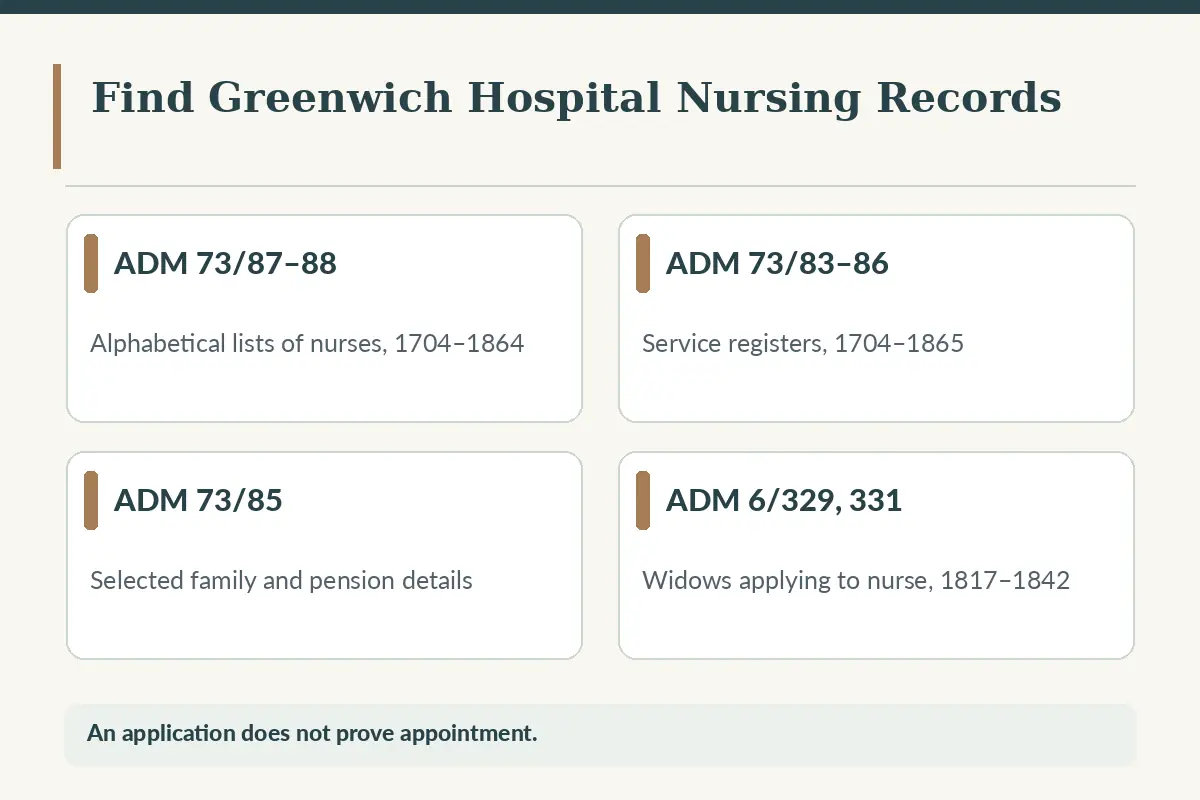
Greenwich Hospital cared for naval pensioners, but the women who worked as nurses can be traced separately from the sailors or officers they served. The National Archives identifies ADM 73/83–86 as nursing service registers from 1704–1865 and ADM 73/87–88 as alphabetical nurse lists from 1704–1864. That combination supports an institution-first search for named women rather than assuming that any mention of a widow in naval pension papers identifies a hospital nurse.
Whose Service Appears in ADM 73
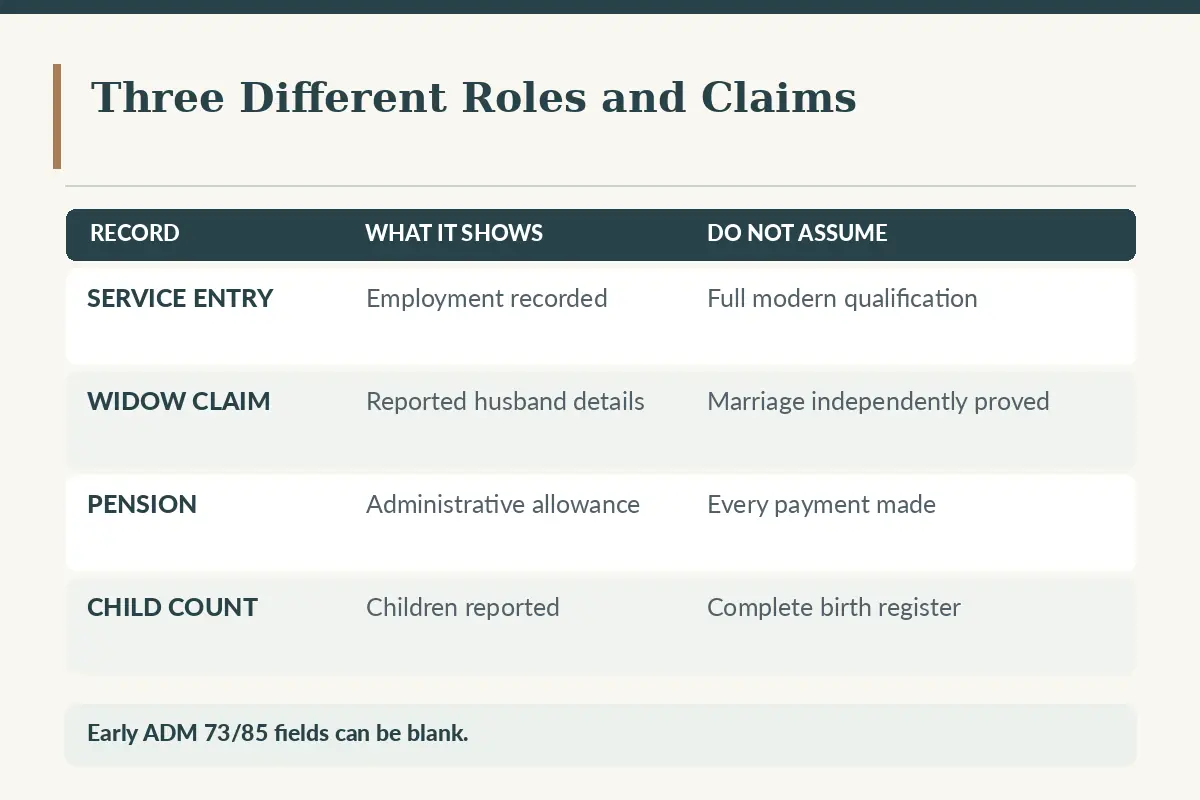
A service-register entry can record a name, admission or employment date and when and why the woman left. It does not automatically describe formal nursing qualifications by modern standards or prove the duration of daily duties. Separate the date entered on a later compiled list from the date the original event is said to have occurred. The record-keeping purpose here is hospital employment, not a complete account of a woman’s life.
Follow the Alphabetical List to the Service Register
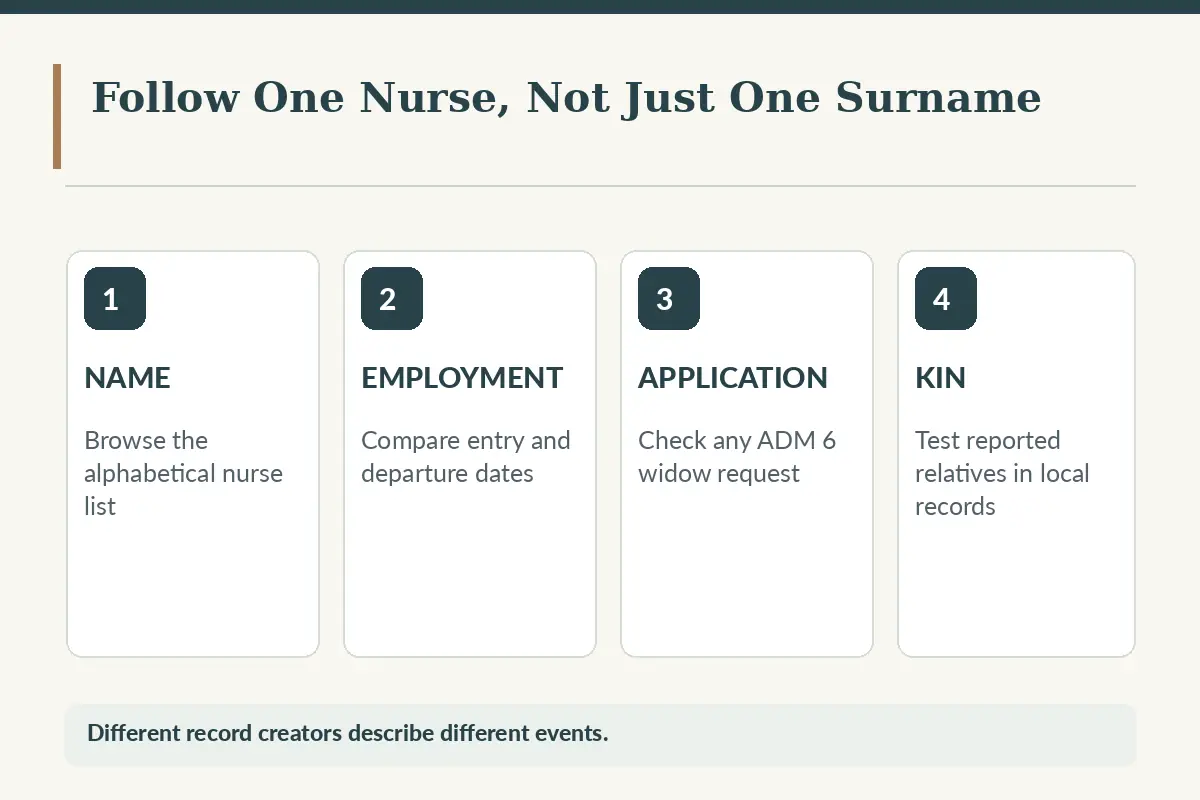
Start with the Royal Navy nurses guide, which gives exact piece ranges. Search the alphabetical lists ADM 73/87–88 for surname variants and transcribe the original name form. Then locate any corresponding service details in ADM 73/83–86. These registers are not all freely viewable online: the official guide directs researchers to visit Kew or obtain a copy after locating the correct document reference.
If the list gives two women with the same name, do not choose the first. Compare the beginning and ending of employment, stated birthplace or age when recorded, household ties and any previous married surname. A blank field is not evidence of an absent marriage or child. If the list and service record disagree, preserve both readings, note whether one is an index copied later, and check adjacent entries before writing a conclusion.
Read ADM 73/85 as a Special Family Source
ADM 73/85 has particularly useful columns for some women who entered during 1783–1863. The official archival guidance describes fields that can include age, birthplace, husband’s first name, husband’s death date, his service, pension amount, children and their ages. Crucially, not all these fields are completed in the earlier records. Make a field-by-field transcription and indicate blanks rather than filling them with estimates from other sources.
A husband’s name written in a register is evidence of what hospital administrators recorded; it is not automatically proof of the exact marriage or the complete naval career. Likewise, a child count is a contemporary report, not a complete birth register. Use it to locate independent baptism and civil sources if the dates permit. Do not merge two nurses because they share a husband’s first name or came from the same naval town.
Distinguish Widow Applications From Employment
The National Archives identifies ADM 6/329 and ADM 6/331 as registers of ratings’ widows applying to enter Greenwich Hospital as nurses, covering 1817–1842. An application is an intention or administrative request: it is not, without subsequent evidence, proof of being hired or paid. Use the widow’s name, possible husband and application date to locate a relevant ADM 73 service entry; record nonmatches explicitly instead of assuming every candidate worked there.
Naval pension paperwork can further test the reported husband’s status, but the application’s wording determines what was claimed, not what later happened. Compare any death date or service statement with independent naval or parish records. If no corresponding pension or service record survives, state that limitation. The distinction between an applicant, an admitted nurse and a beneficiary is central to preventing a fabricated career.
Build a Woman-Centered Employment Timeline
Create a dated line for each documented event: widowhood if recorded, application to join, employment entry, departure, reported pension change and later residence. Some steps may be absent or appear out of sequence because different books were maintained for different administrative purposes. Avoid converting gaps into a continuous term of service. The first surviving register entry may postdate the actual start of work, and the last entry may concern an administrative update rather than a final shift.
Place hospital work in the correct historical and institutional setting. The Greenwich Hospital records are not the same thing as the later Queen Alexandra’s Royal Naval Nursing Service, and a title such as “nurse” may describe a different occupational role across eras. Follow original vocabulary and dates. This also matters for identifying a woman in census returns, directories and church registers, where her job or marital status may have been described differently.
A woman named in a hospital nursing register is part of the institution’s workforce, not merely a dependent attached to a sailor. That distinction changes the questions asked of the record: entry and exit dates, duties and employment setting matter in their own right. Place the woman’s identity at the center of the inquiry, and treat a possible husband’s naval history as a separate, corroborating line of research.
Handle Gaps and Multiple Possible Identities
An unsuccessful online keyword search is especially weak evidence for ADM 73 because relevant manuscripts are often accessed by piece rather than indexed person. Expand the search to variants, marriage and maiden names, then browse the appropriate date range at the repository. Check that a proposed nurse really appears in the nursing subset ADM 73/83–88 rather than an unrelated pensioners’ book also filed under ADM 73.
Preserve the source title and creator for every result. A widow application and a later list may have copied the same personal information, so agreement does not make the marriage independently proven. Compare a local burial or marriage register, navy service details for the husband and an age-appropriate census where available. For women with common surnames, state the unresolved alternatives plainly rather than hiding them behind an unqualified identity assertion.
More Records and Archives Guides
How We Research Greenwich Hospital Nurses
We first identify the nursing register’s exact ADM 73 subseries and the documented employment interval, then browse alphabetical and chronological records independently. We use ADM 73/85 for reported family details only when relevant fields are actually completed. Widows’ applications in ADM 6/329 and 331 are compared as separate administrative acts; they are never treated as proof of appointment without a further record.
Our research log records name forms, register number, page, original date, copied field wording and whether a proposed family link was externally verified. We protect uncertainty about both employment and kinship and do not reconstruct missing columns. See our affiliate disclosure for information about links. This is a targeted record-reading method, not a roster of all historic nurses.
No. ADM 73 also contains pensions and other Greenwich Hospital records; use the specific pieces ADM 73/83–88.
Alphabetical lists are in ADM 73/87–88, and service-register details are in ADM 73/83–86.
No. ADM 6 applications should be checked against subsequent service or appointment evidence.
Some entries contain those details, but many early fields are blank and statements need independent checking.
No. Some require catalogue browsing and consultation at Kew or a requested copy.