
Historical Victorian hospital records are usually located by the institution and the time of treatment, not by a convenient name search. Public Record Office Victoria (PROV) explains that it arranges patient material under the hospital, type of document and date span; many patient files remain closed under privacy provisions. A family researcher can still make a disciplined search by verifying the hospital name, locating the surviving admission or patient series, checking the access status, and recording what the file can actually show. This guide does not offer medical interpretation and does not encourage access to restricted personal information.
Identify the correct hospital before entering a name
Start with a dated family letter, occupation record, death registration, newspaper notice or address that names the institution. Hospitals changed names and functions, and some moved premises. Note the historical name used in the relevant decade instead of searching only a modern health service label. If the family account says “Melbourne hospital” without specificity, keep several institutions as candidates until you can test them against place and period evidence.
Search PROV by institution, document type and year
PROV warns that its hospital patient records are not generally catalogued under each patient’s name. Search an institution title together with terms such as admission book, case file, patient clinical notes, theatre register or post-mortem book. Examine catalogue descriptions for the start and end dates of each series before choosing a volume. A record may exist but need to be ordered and paged through; no surname result in a catalogue is not a valid negative result. Our guide “Adelaide Hospital Admission Registers” covers a related question.
Decide whether an admission book answers the question
An admission register may list a date of admission or discharge, patient name and selected identifying facts; exact columns vary by period and hospital. It can support the claim that a person was recorded as entering that hospital. It does not by itself establish the ultimate cause of death, the success of treatment, or every stay across multiple wards. Transcribe the heading, including abbreviations, so that dates are not shifted between admission and discharge columns.

Distinguish case notes from administrative registers
PROV lists patient clinical notes and case files alongside simpler lists, post-mortem books and theatre registers. Medical notes may contain detailed treatment information, while administrative volumes may record only a transfer, name or date. A clinical term written a century ago may not map safely to a present-day diagnosis. If the question is about a family timeline, prioritize dated administrative events instead of making unsupported medical claims from old terminology.
Check whether the hospital was public or private
PROV states that it holds records from many public hospitals but not the records of privately operated institutions. Some hospitals that still operate retain their own patient records, while closed public institutions may have transferred series to PROV. Before pursuing a false missing-file problem, establish which organization created the record and which repository or successor now has custody. A building history in the catalogue is not evidence that patient records were transferred with it.
Choose among Victorian hospital patient record types
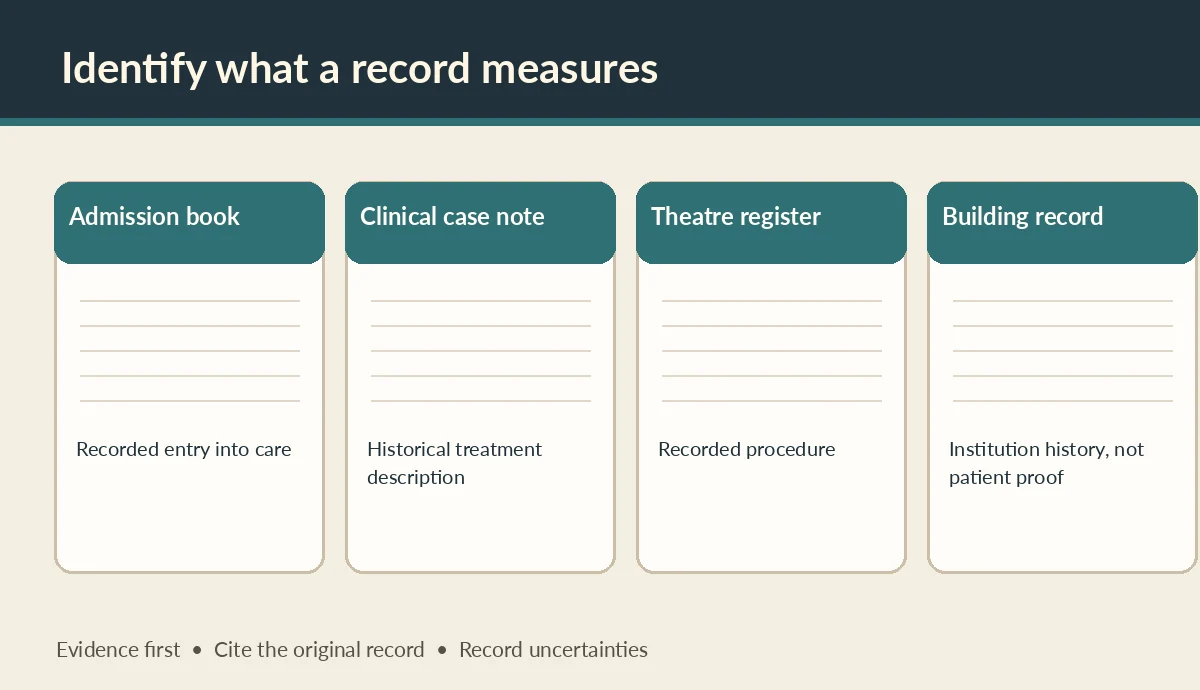
| Record type | Question it may answer | What it cannot prove |
|---|---|---|
| Admission book | Was someone recorded as admitted? | A complete medical history |
| Clinical notes | What treatment was recorded? | A modern clinical diagnosis |
| Theatre register | Was an operation recorded? | Long-term outcome |
| Building contract | Did the hospital build or alter rooms? | That a particular patient attended |
Read access restrictions before requesting records
Many patient records are restricted for privacy under section 9 of Victoria’s Public Records Act, according to PROV. Read the series and item access status; do not infer that a very old building or an online finding aid means the patient information is openly available. If a record is closed, follow the lawful archive request procedure where applicable, or use openly available civil registrations, directories and historical newspapers for the narrower family-history question.
Build a two-date admission-and-discharge worksheet
Make columns for the reported treatment date, hospital name, register date as transcribed, register type, item reference and an independent corroborating source. Keep discharge distinct from death: a blank discharge field could reflect a missing entry, transfer or lost page, not proof of fatality. Where two records disagree about age or residence, cite each explicitly. Hospital admissions can anchor a timeline without proving every biographical detail written by a clerk.
Apply a fictional patient-match test carefully
Imagine that a fictional Ellen Morris was reported ill in 1907. A hospital register contains an Ellen Morris aged about forty, while a city directory places the researched woman in a different suburb. Keep the register match provisional until admission date, locality and other independent identifiers align. A shared name and plausible age are not enough. Avoid disclosing diagnoses, identifying details of living people, or sensational descriptions in a published family narrative.

Document an inaccessible or absent file accurately
A search may end because an institution’s material never survived, belongs to another custodian, is arranged by dates only, or is closed. Record each cause separately in the research log. If the catalogue contains only drawings or building contracts, PROV warns that this can indicate it does not hold the relevant patient-care records. That is a custody finding, not proof that the person was never treated at the hospital.
Create citations that respect family privacy
A reproducible reference identifies the institution, creating agency, series, unit, volume, entry and access date if available. For a confidential document, keep your private citation without reproducing personal health information in a public tree. In the public account, state only claims that an authorized source and appropriate consent support. Separate a documented admission from unverified later family interpretation.
How We Research Victoria Hospital Patient Records
Our method begins with the named archive’s descriptions of the collection, series and access conditions. We distinguish official finding aids from original entries and from our own inferences. We check known date boundaries and catalogue warnings before proposing a search path, and use fictional examples solely to illustrate how researchers can test ambiguous identities. Also, We do not claim to have inspected a particular ancestor’s file or to know which family stories are true. Recheck archival availability and restrictions at the time you search.
More Records and Archives Guides
Primary archival guides for victoria hospital patient records
PROV patient-record guide: hospital/date searching, record varieties and privacy closure (prov.vic.gov.au).
PROV overview of public hospitals and health-and-welfare records, including private-hospital exceptions (prov.vic.gov.au).
Editorial and affiliate disclosure: GenHis is an independent educational family-history publication. No archive listed here is claimed as a sponsor or affiliate partner. Official access rules, privacy restrictions and fees may change. Use archival records thoughtfully and do not identify living people from sensitive files. Read the affiliate disclosure for our general approach to commercial links elsewhere on the website.
Usually not directly. PROV says to begin with institution, record type and date.
No. Many remain restricted for privacy, even when their catalogue descriptions are public.
PROV says it does not hold records of privately operated institutions.
Search by its historical name and check successor institutions and PROV custody notes.
An entry may contain clues, but corroborate the legal death record and do not substitute present-day medical conclusions.