
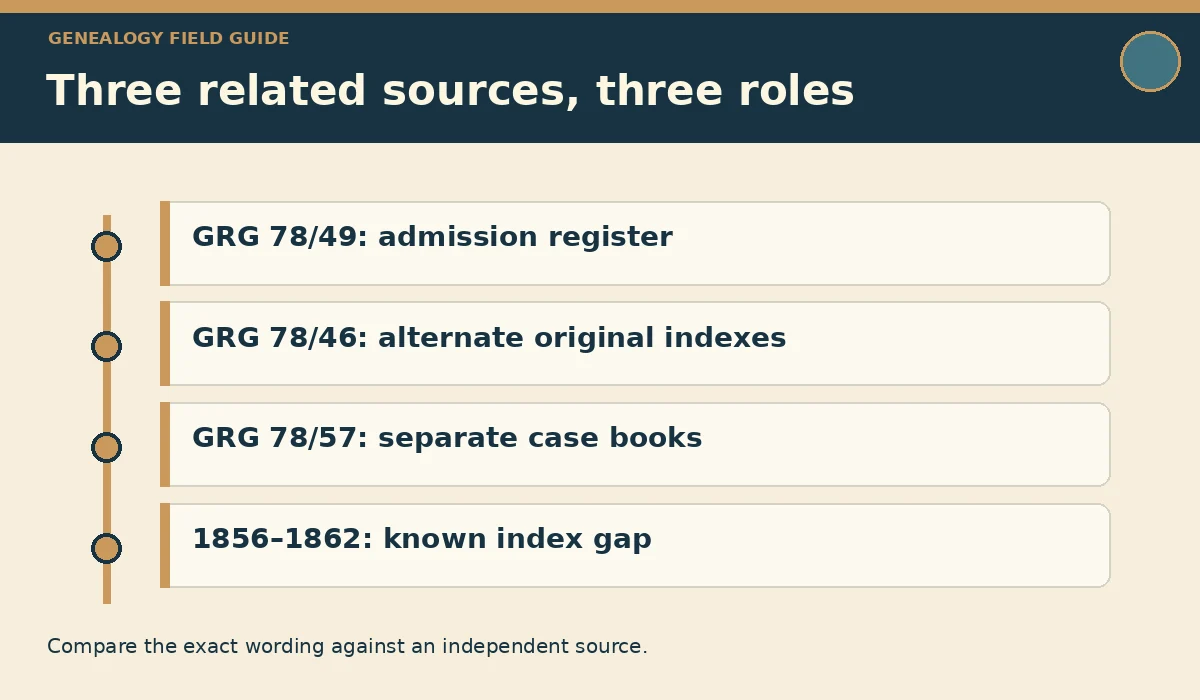
The key source for historical Adelaide Hospital patients is GRG 78/49, the admission-register series described by State Records of South Australia. The archive describes volumes spanning roughly 1840–1961, with separate online index sets focused on historical periods through 1924. A patient’s name alone is not a reliable record locator: you need an approximate admission year, matching identity clues and the register’s volume and admission number. Adelaide Hospital grew from the Colonial Infirmary and later became Royal Adelaide Hospital in 1939. Search both historical and later institution names when using the state catalogue, but do not assume every local hospital admission is in this series. The archive also holds registers from other public hospitals, while records from private hospitals are generally outside its holdings.
Locate the correct index band before browsing images
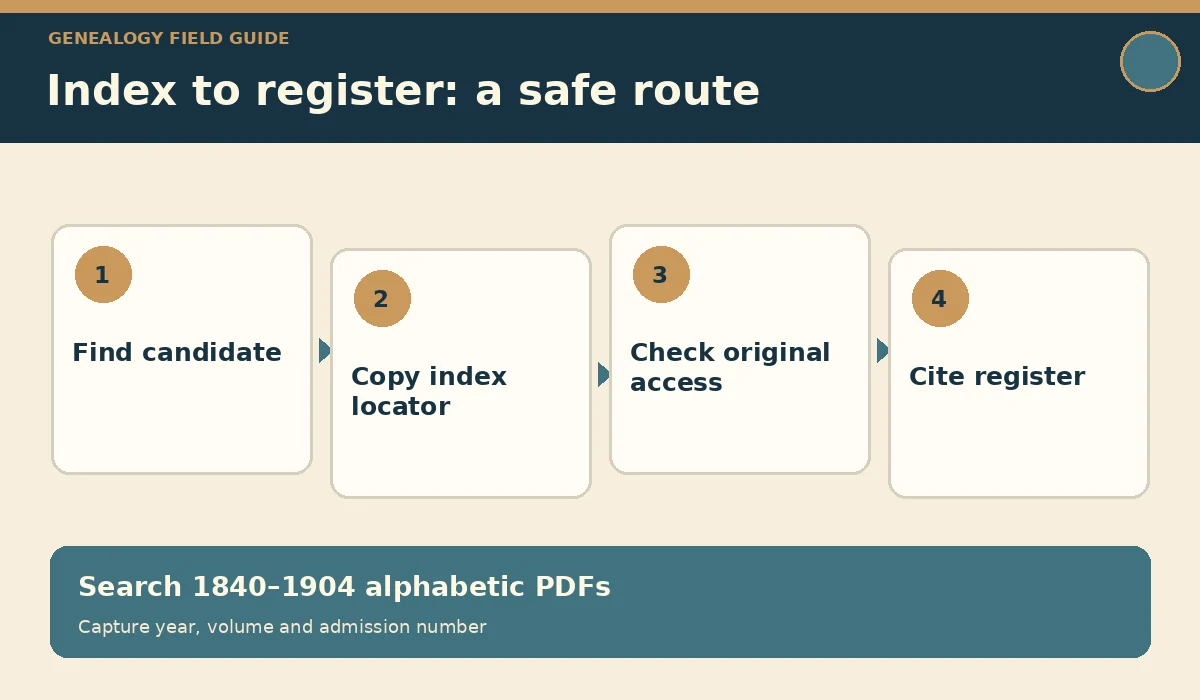
State Records publishes alphabetically arranged index PDFs for 1840–1904 and separate chronological index files for 1905–1924. Start with the person’s likely admission period and surname, then note every candidate with the same or similar name. Copy the admission date, volume and number if present. This combination connects an index line to an original chronological register much more reliably than surname alone.
Do not treat the index as the original medical entry. The archive says index listings omit the ailment and medical officer notes even when present in the register. Some transcriptions have errors or uncertain spellings. A meaningful research conclusion should be based on the original page where lawful access is available, with the index cited separately as the finding aid.
Understand the documented 1856–1862 index gap
The State Records hospital guidance explicitly warns of known gaps in an index list for 1856–1862 and says it is being reviewed. A missing indexed admission in those years does not establish that a person was never treated. Try another published index, the FamilySearch route specified by the archive, or hard-copy original indexes in GRG 78/46 at the Research Centre.
Your search log should state which index files were checked and whether original register pages have been viewed. An online system may lack some temporarily missing digital volumes. In that situation, ask the repository about viewing or ordering the source rather than making a negative claim from an unavailable image. Distinguishing absence of access from absence of evidence is essential for this collection.
Read GRG 78/49 as an administrative encounter
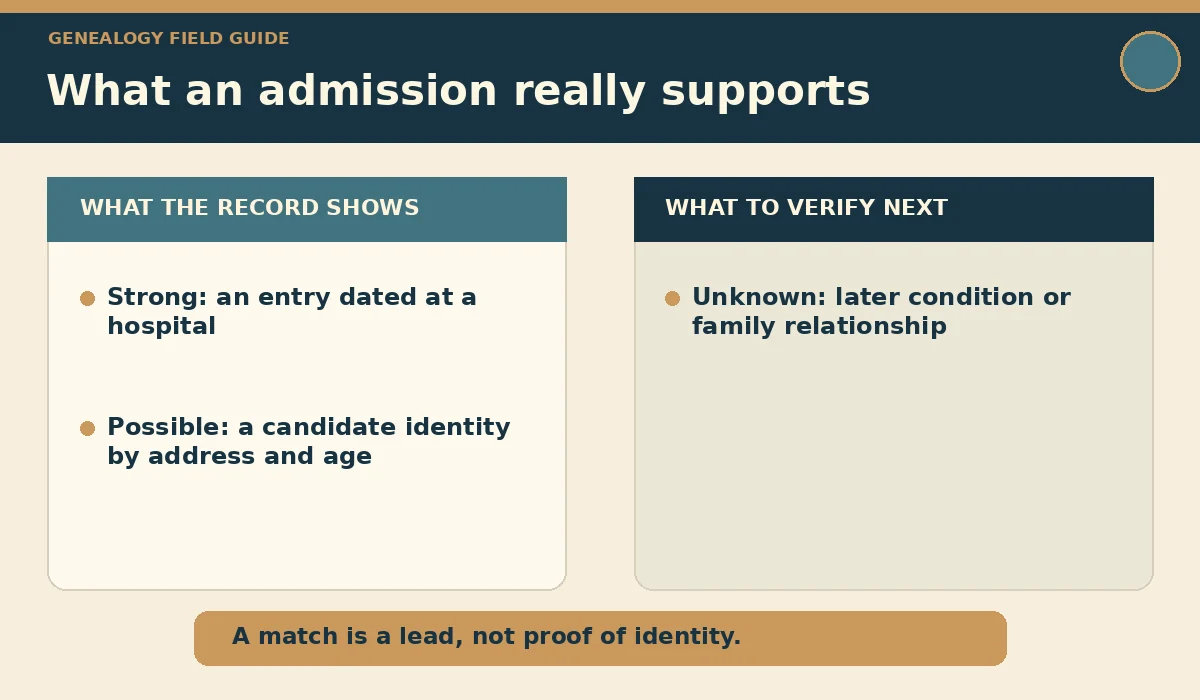
The original register may contain admission and discharge dates, age, residence, occupation, marital status, place of origin and a recorded ailment, depending on the page and period. A single hospital admission supports a dated encounter with that institution. It does not by itself establish a lifelong diagnosis, the identity of a spouse or a complete residential history.
Capture each field literally and remember that information may have come from an informant. A recorded place of origin and ship might provide promising migration clues but should be checked against actual passenger lists. Likewise, a reported age should be compared with a baptism or civil birth entry rather than converted to a precise unverified date.
Keep case books distinct from admission registers
State Records identifies GRG 78/57 as Adelaide Hospital case books, with entries organized by medical officer and admission order. If a register includes a doctor’s name, it may help route a lawful request toward the right case book. This is a different series, not automatically a second page attached to every GRG 78/49 admission.
Preservation, privacy and completeness may prevent access to individual case files. The archive says detailed medical records are rarely held across its hospital collection. Do not promise that every patient has an extended clinical narrative. Research the finding aid and the custodian first, then make a carefully scoped request specifying the series, date, volume and admission number.
| Research checkpoint | What to record | What it cannot establish |
|---|---|---|
| Search 1840–1904 alphabetic PDFs | Exact source date and identifier | A surname hit alone is identity proof |
| Or search 1905–1924 year index | Original wording and relevant jurisdiction | An administrative step is a final event |
| Independent corroboration | Person, place and dated comparison | Shared names automatically mean kinship |
| Access or coverage gap | Series/item and precise search attempt | No hit proves absence |
Protect medical privacy while reconstructing family history
South Australian hospital records may be restricted for periods ranging from 60 to 100 years according to their creation and content, with administrative records subject to other rules. A century-old page is not automatically usable for unrestricted republication. Check the current item-level access determination and ask the hospital or archive about lawful permission for restricted material.
Do not attempt to bypass restrictions, identify living patients or turn historic diagnostic words into modern medical judgments. A relative’s old case file is sensitive evidence, not public entertainment. Historical wording should be quoted in context when necessary and minimized in public family histories unless the reader has an appropriate reason and authority to share it.
A fictional admission number illustrates source matching
Imagine a fictional 1908 index hit for Mary Collins, age 34, with an admission number and a district residence. Another Mary Collins appears in an electoral roll in a different town. Save the index volume, admission date and number, then inspect the corresponding GRG 78/49 page if permitted. Compare occupation, birthplace and residence before deciding whether the hospital patient matches the family member. Our guide “Victoria Hospital Patient Records” covers a related question.
An admission number is useful because it connects finding aid to register, not because it identifies a person across all institutions. If the patient later appears in an obituary, use its date and stated relatives as an independent check. A recorded discharge does not tell the entire medical outcome; a blank discharge field is not proof of death.
Finish with a traceable reference and a narrow finding
Cite State Records of South Australia, the creating hospital, GRG 78/49, volume or indexed year, admission number, date, page or image, and the repository’s access route. Where you used GRG 78/46 indexes or GRG 78/57 case books, cite those series individually rather than combining them into one undifferentiated reference. Our guide “South Australia Destitute Asylum Registers, 1870–1924” shows how to find families.
End with a summary that separates a documented admission from your identity inference, and states what cannot be concluded about health or kinship. If the original is restricted, a cautious statement may rely on a legally available index without guessing its unseen fields. The next step should be an independently dated address, employment or family record—not a speculative diagnosis.
How We Research Adelaide Hospital Records
We reviewed the repository descriptions and historical finding aids cited below on October 22, 2026, and compared the intended question with prior GenHis article topics. The example names and situations in this guide are fictional and do not reproduce original named people’s private records. Administrative sources can be incomplete or affected by access restrictions; we describe each reported field and date as applicable to its specific series, not as a universal guarantee. Check the current item-level catalogue, rights, fees and restrictions before requesting or publishing information.
More Records and Archives Guides
Original catalogues and archive guides for Adelaide Hospital Records
State Records SA: GRG 78/49 patient registers, index gaps, original access and separate GRG 78/57 case books (www.archives.sa.gov.au).
State Records SA: online links to historical admissions images and indexes (www.archives.sa.gov.au).
Also, state Records SA: general conditions applying to historically sensitive health records (www.archives.sa.gov.au).
Editorial and affiliate disclosure: This independent educational article is not sponsored by the repositories listed here, and it includes no paid partner links. Verify original documents and respect any restrictions affecting living individuals, historical allegations or medical information. Read the GenHis affiliate disclosure for the site-wide commercial-link policy.
It is the South Australian archive series of Adelaide Hospital, later Royal Adelaide Hospital, admission registers.
Use a historical index to capture the volume, admission date and admission number, then consult the corresponding original register when permitted.
State Records reports gaps in an index list around 1856–1862 and warns that some digitised volumes may be unavailable.
No. GRG 78/57 contains distinct medical case books organized by doctor and admission order.
Check access determinations, privacy restrictions and consent or other applicable authority before sharing sensitive information.